New York Orchard and Cidery Car Trip

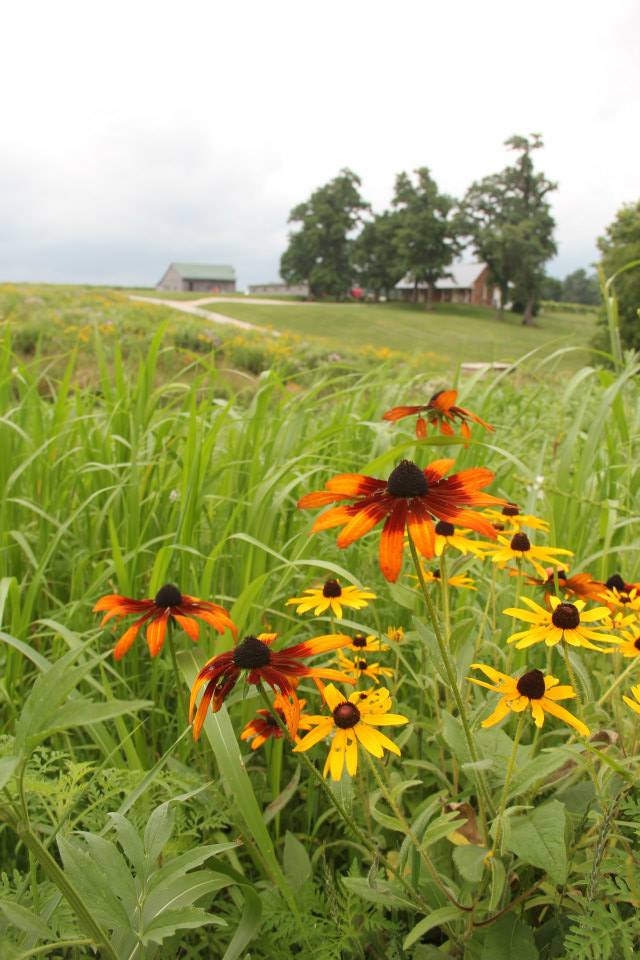
I got on the train back upstate and felt a wave of relief.  New York City is exciting but hard work.  I don’t know how you all do it down there in the City, day in and day out?  I picked up my car from my cousin’s house and took a meandering, semi-accidental tour of some of the orchards in the Hudson Valley / Catskills area.   Photos above are from my first stop at Dressel Orchard and Kettleborough Cider House, near New Paltz.

From there I proceeded towards the Gunks, passing another roadside orchard and some stunning views of pumpkin fields beneath the Gunks:

I then drove up to Stone Ridge Orchard and met up with a friend.  Pete, the guy manning the shop was really friendly and said he had been coming here for years before he started working there.  This orchard is operated by Elizabeth Ryan, maker of Hudson Valley Farmhouse Cider.  Check out also the Friends of Stone Ridge Orchard page. This orchard was really interesting, with lots of different varieties of fruit and styles of pruning in evidence.

Finally, I drove out to visit some cousins in the Catskills, where I went to photograph the old North Branch Cidery in western Sullivan County.  I spent several summers working at WJFF Catskill Community Radio and hoeing weeds at Gorzynski’s Organic Farm, and I passed by this place many times.  My cousins remember when it was still operating, but is has been years now since it closed.  You can see a few apple trees on the property beyond the rusting truck and the buildings.  Andy Brennan posted this in a comment to another post on the blog:

Hey Maria, I don’t know much about the North Branch cidery either except everyone in the county tells me they used to bring their apples there to press. It was an old German guy who everyone loved and he had hard cider too, but I don’t think he legally sold it. I believe the ecoli scare and pasteurization laws forced the shut down about 12 years ago. Someone was working on the building not long ago but it still looks abandoned. -Andy

And after that, I headed home to Indiana.  I did actually follow the address to Eve’s Cidery in Van Etten, NY as I drove along the southern tier past the Finger Lakes region.  I drove by a large barn several times, but there was no sign, it looked like they weren’t set up for visitors, and I still had 400 miles to drive that day.  So I went on my way without stopping.  Someone waved at me though, after I drove by for the 4th time.  Probably they were wondering if the weirdo in the yellow VW beetle was lost, which is kind of true.  I mean, who drives to obscure orchards in search of cider?  I guess that’s me!

NY Cider Week: Food Systems Network NYC, New York Apples and the Growing Hard Cider Industry

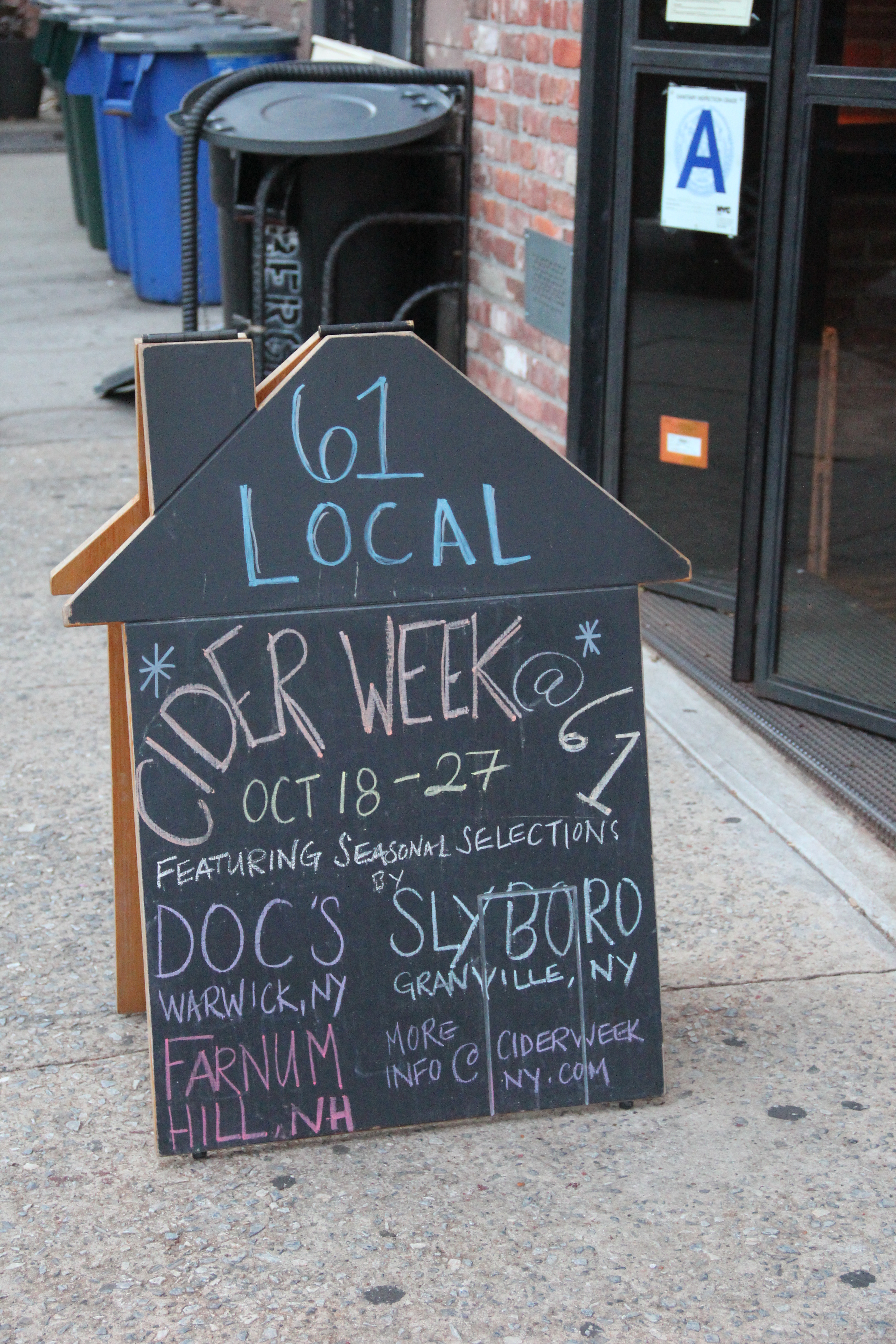
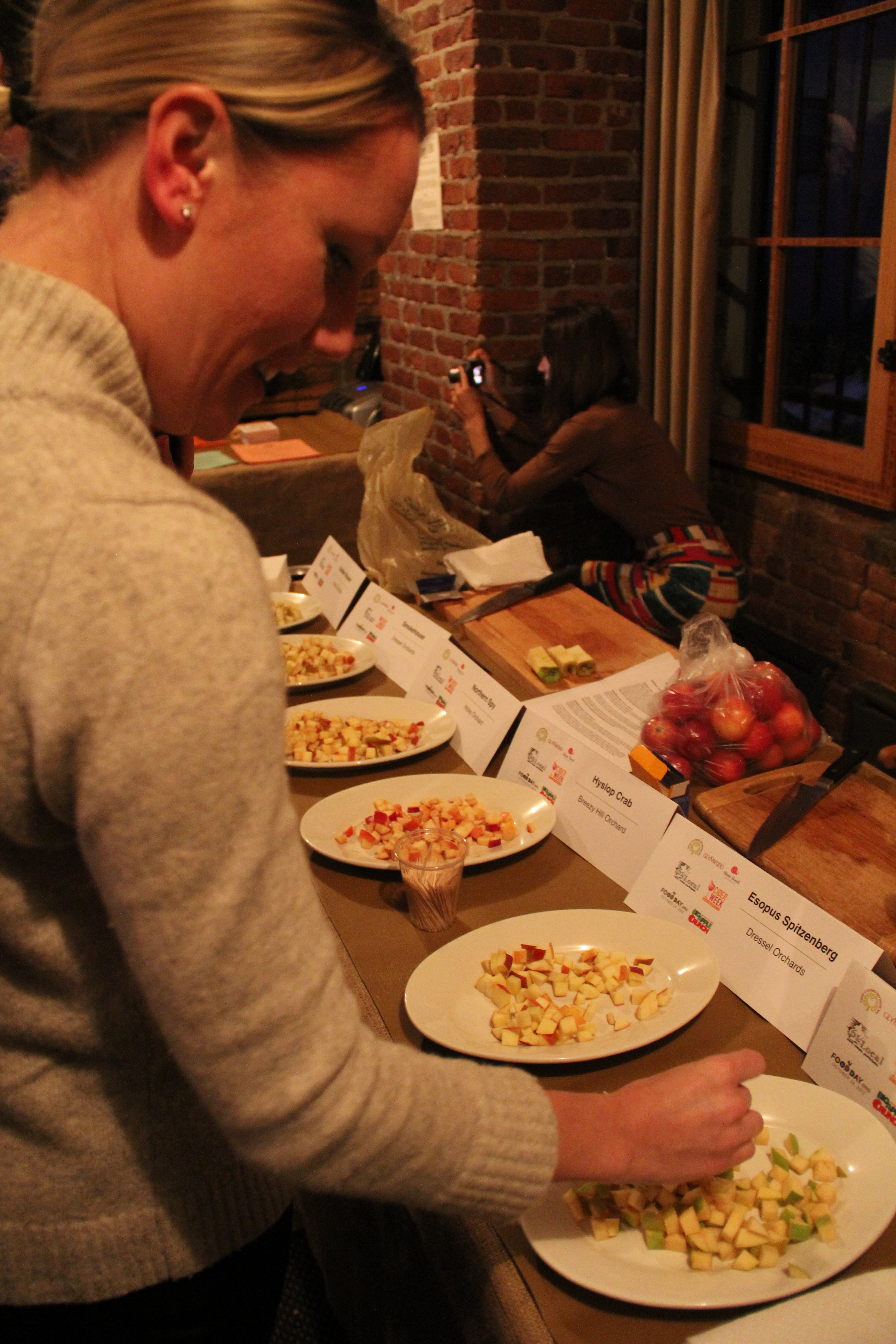
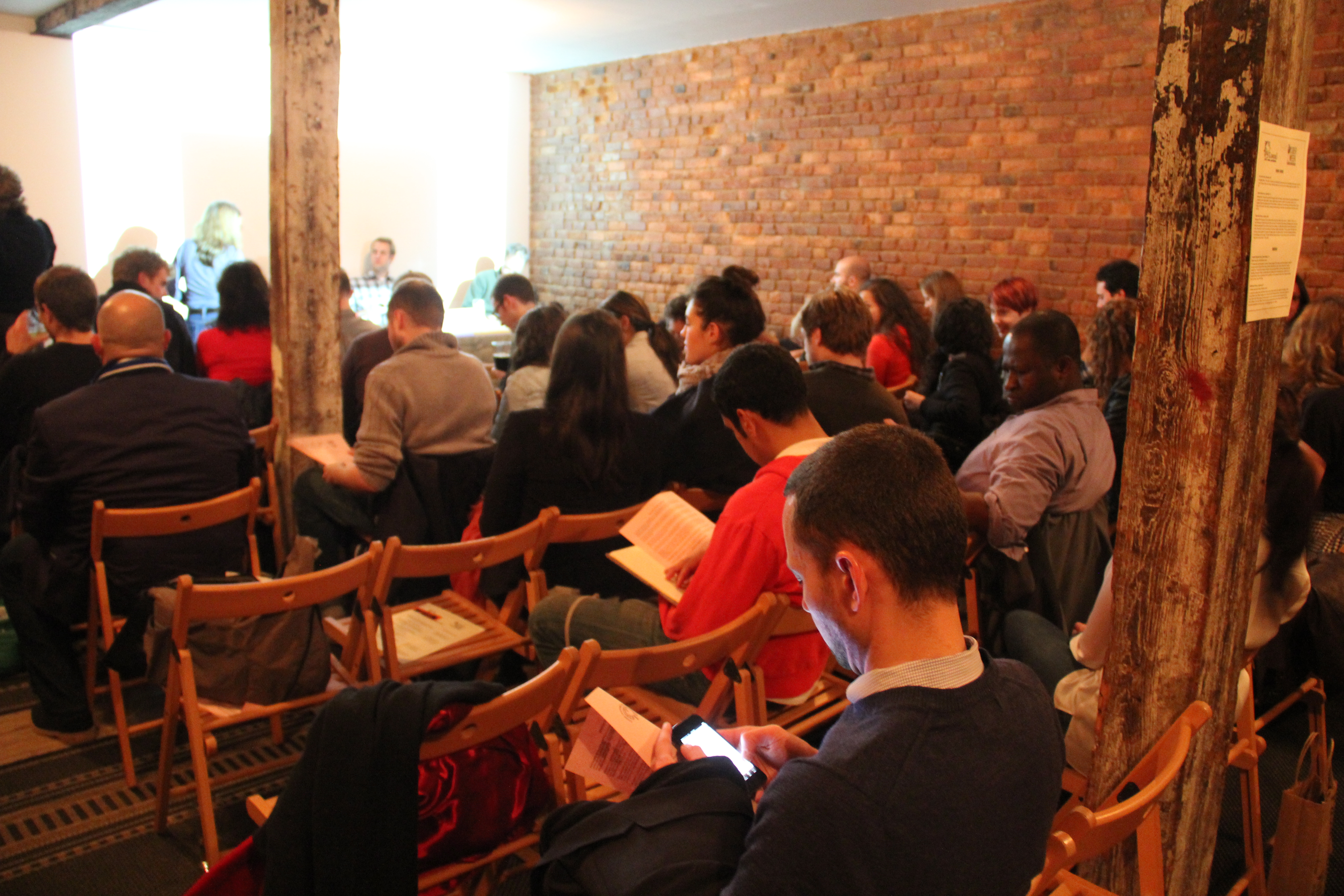
This Food Systems Network NYC event was co-Hosted by Glynwood, Slow Food NYC, and 61 Local. The event brought together Sara Grady from Glynwood and three orchardists and cider makers from the Hudson Valley region.

IMG_2135 IMG_2139IMG_2149

After a video presentation introducing the recent partnership and exchange between Hudson Valley cider producers and cider producers in Normandy, France through Glynwood’s Apple Project, Sara Grady moderated the panel, asking the panelists questions to illuminate some of the issues around Hudson Valley Orchards and cider production.  This summary is paraphrased from notes.  Corrections always welcome:

Q: How does hard cider production allow us to increase the viability of apple production in NY

E Ryan: Cider is the joy, the soul, and the essence of the apple.  Financially, cider production allows us to use fruit not pretty enough for market, to diversify and add value.  It is also a low/no-spray agricultural option with low input systems and the possibility of integrating animals.

D Wilson: We have the oldest pick your own orchard in the state operating for 108 years, a long history of relationship with the public.  80% of our annual income comes in a six week period with pick-your-own, and if the weather doesn’t cooperate – if it rains on the weekend and people don’t come out, we can be hurt.  Hard cider gives us something to broaden our base – more flexible and sustainable.

Q: What has been the impact of cider week for you?

E Ryan: We started making artisan cider in 1996.  I went to England and spent time with cider makers there.  At the marketing level – people didn’t know what to do with it.  The difference between then and now is amazing.  Restaurants who didn’t know what to do with it 10 years ago are seeking us out.  I just borrowed 1 million dollars to buy the farm I have been renting, so that tells you I have some confidence in the market.  During our visit to France, we saw the future there – an air of prosperity we want to build in the Hudson Valley.

D Wilson: Cider allows us to attract a different market than the family pick-your-own.  Cider week has allowed us to develop a relationship with a distributor.  Cider is becoming a much more substantial part of our overall business.  Production has tripled in the past few years.  It is a value-added thing for fruit you already have.  Now as the industry matures, we are planting specifically for cider purposes.

T Dressel: My family is a 4th generation apple growing family.  My grandfather is still working.  It’s been a change for him to take out his trees to plant trees for cider, apples he can’t put on a road side stand.  I came back from school hoping to open a winery and planted 4 acres of grape vines.  While they were growing I made some terrible ciders.  During that time things really started moving with the cider industry.  In 2009 the Cornell extension called me up and said they had a collection of cider trees that were going to be grubbed up and if I wanted them I had to come up right away to pick them up.  So I got some friends together with a truck, dug them up, and put them in the ground.  We have 60 trees, 10 European cider varieties.  That’s how I started growing cider apples.  It’s hard to get nursery trees for cider, few people carry them and you have to wait 5-8 years for them to be ready.  It is easier to top graft onto existing trees.  I have another half acre of American heirloom apple varieties as well.

Q: Could you talk a little more about cider varieties?

E Ryan: In Europe, cider makers grow hundreds of varieties for cider.  Makers in the town we visited in Normandy had catalogued 600 varieties.  We have a huge tradition ourselves of heirloom varieties grown here.  Some of the older orchards had Norther Spy, Golden Russet, etc, varieties people don’t know in Europe.  I am drawing mostly on these American varieties.

D Wilson: I am liking some of the ciders we are making from old Russet varieties – the Golden Russet and the Ashmeads Kernal, as well as English Bittersweets like Dabinette and Chisel Jersey, along with some crab apples.  Eating varieties have more sweetness and adicity to them.  Cider varieties add to the whole palette – different qualities of acid, bitterness, and astringency.  A really good cider rarely comes from a single apple variety.  To develop a balanced cider requires blending.

Q: Tell us about your experiences in La Perche, Normandy.  What did you bring back?

E Ryan: Cider is completely embedded in Norman culture, with their cider washed cheese and calvados.  They have achieved terroir.  We learned a lot of techniques, which you end up trying to re-interpret here with the kinds of varieties we have access to here.  I was most impressed with the cider culture and what the Hudson Valley could be.

T Dressel: For me it was the cultural experience.  As a commercial apple grower compliant with NY State laws and regulations, so much of what I saw there will never happen here: such as harvesting apples off the ground.  It set a goal for me that I wanted to be able to achieve – I wasn’t making cider yet at that time.  I was impressed with how different their craft cider is than ours, and that the tastes – more earthy and funky – they enjoy over there might not be transferable to an audience in the states.  One French cider maker asked me – “what is this word, funk? People keep telling me my ciders are funky?” I think education is first, so many people don’t understand what cider is.  My biggest emphasis is telling everyone everything I can to expand people’s horizons.

D Wilson: I was impressed by the value the French put on food – how food reflects an area.  Slow food, terroir, sense of place.  I came back with a sense of how the food they produce is a national treasure.  And the apples grown in that area are just for cider, not for eating.  Their techniques are extremely simple and yet sophisticated at the same time.  We could also become a culture that consumes cider as a common drink.

Q: Tell us how cider growing is a more low-input operation for ecological apple growing?  Most people here understand that organic production for apples is very difficult in the Northeast.

T Dressel: The system of grazing animals and harvesting apples off the ground, together with insects and rotten fruit might add to the funk of French cider!   We are not spraying nearly as much as we used to.  We use an integrated pest management system and are not organic.  Copper (used in organic apple production) is an organic substance but is not sustainable.  Up till now we had been using culled fruit from our eating apples.  But now, with blocks set aside for cider apples, we can spray less since it isn’t going to the fresh market and the appearance of the apple doesn’t matter as much.

D Wilson: An Apple orchard is a monoculture, perennial environment, making organic methods that work for other vegetable crops difficult.  Problems from pests range from cosmetic issues to tree death, and these things can effect trees in combination.  The focus of pest control is greatest between the blossom period till fruit is the size of a marble.  Growing fruit without the need to address cosmetic problems allows us to reduce spray.

T Dressel: We are now dealing with questions about how cider trees will be managed differently than eating apple orchards.  What tree density? What shape will we prune the trees?  Our value will shift to volume of apples rather than perfect big apples.  Fresh market apple trees are pruned very heavily.  When we started to grow cider varieties, father and gradfather’s pruning knowledge was not helpful.  I have talked to friends in Western New York who grow apples for the processing market about tree management.  I have had to relearn how to prune trees for cider

Q: Blending?  How much are decisions made based on tasting and how much on measuring tannin and acidity?

A: (conversation moved to fast for me to note who was saying what – this is a summary of answers from all participants)

  • We experimented by making single variety batches of every apple we grew – fermentation makes a difference in taste
  • In Europe, I sometimes saw people making very intuitive traditional decisions – one shovelfull of bittersharps, two shovels full of bittersweets
  • In England, I saw people doing a full crush of what was being harvested that week – mix of bittersweets and bittersharps.  Further blending of the juice happened later.
  • You need enough acid in a fermentation to make it keep

Q: Is there a long term interest in developing uniquely American varietals for cider, rather than depending on European ones?

D Wilson:  There are some great traditional American ciders.  My fantasy is that there might be a wild tree out there that has some great qualities we don’t know yet. (from audience – That’s what Andy Brennan is doing with Aaron Burr Cider).  I mentioned to a friend of mine at the big breeding program in Geneva that we might need some new cider varieties, and she said there were some discards from the eating apple breeding program that could be good cider varieties. We want to find out what our customers will enjoy.  The intense high acid of Spanish ciders or the funk of French ciders might now go down well here.  We need to find out what the American taste is.

NY Cider Week: Northern Spy Cider Dinner 2013

After our invigorating and intellectually stimulating tipple at Proletariat with Aaron Burr Cider, Challey and I proceeded on our way to the Northern Spy Cider Dinner.  I will spare you descriptions and simply post the link to the menu paired with ciders from Eve’s Cidery, Farnum Hill, and Eden Ice Cider.  I think we had quite animated conversations about New York and food culture, facilitated by the generous and samplings just prior.  And the food was superb.  I wish I could afford to eat and drink like this all the time.

Cider Foragers

Foraging Follow-up to the post about Aaron Burr Ciders:  As I was driving up NY 97 along the Delaware River, I noticed quite a lot of roadside apple trees laden with fruit just north of Hankins and south of Hancock.  I’m betting, due to their road-side locations, that they are the progeny of apple cores thrown out the car window.  Delaware valley scrumpers, get to it!

NY Cider Week: Meet the Cider Maker – Aaron Burr Cider’s Andy Brennan @ Proletariat

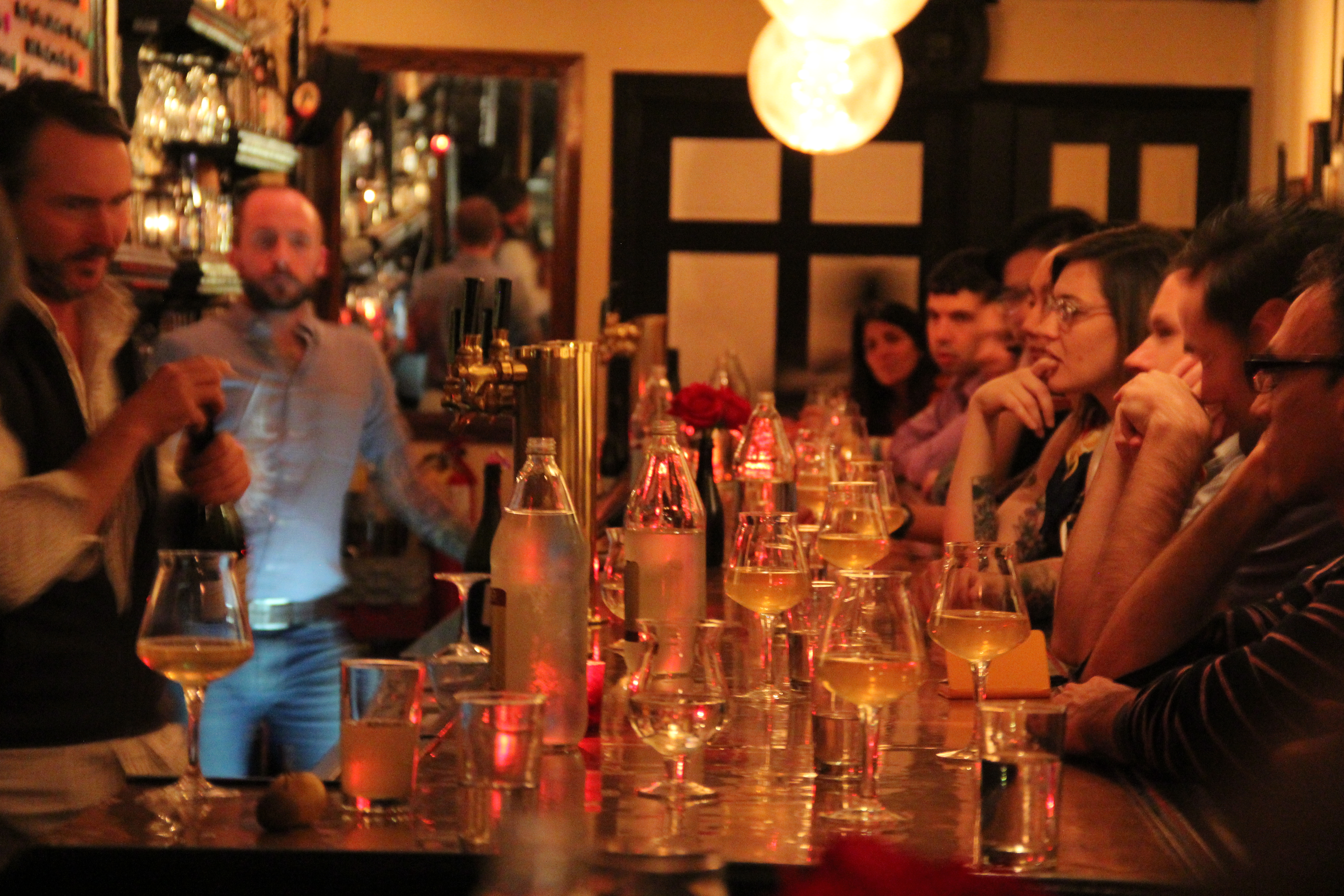
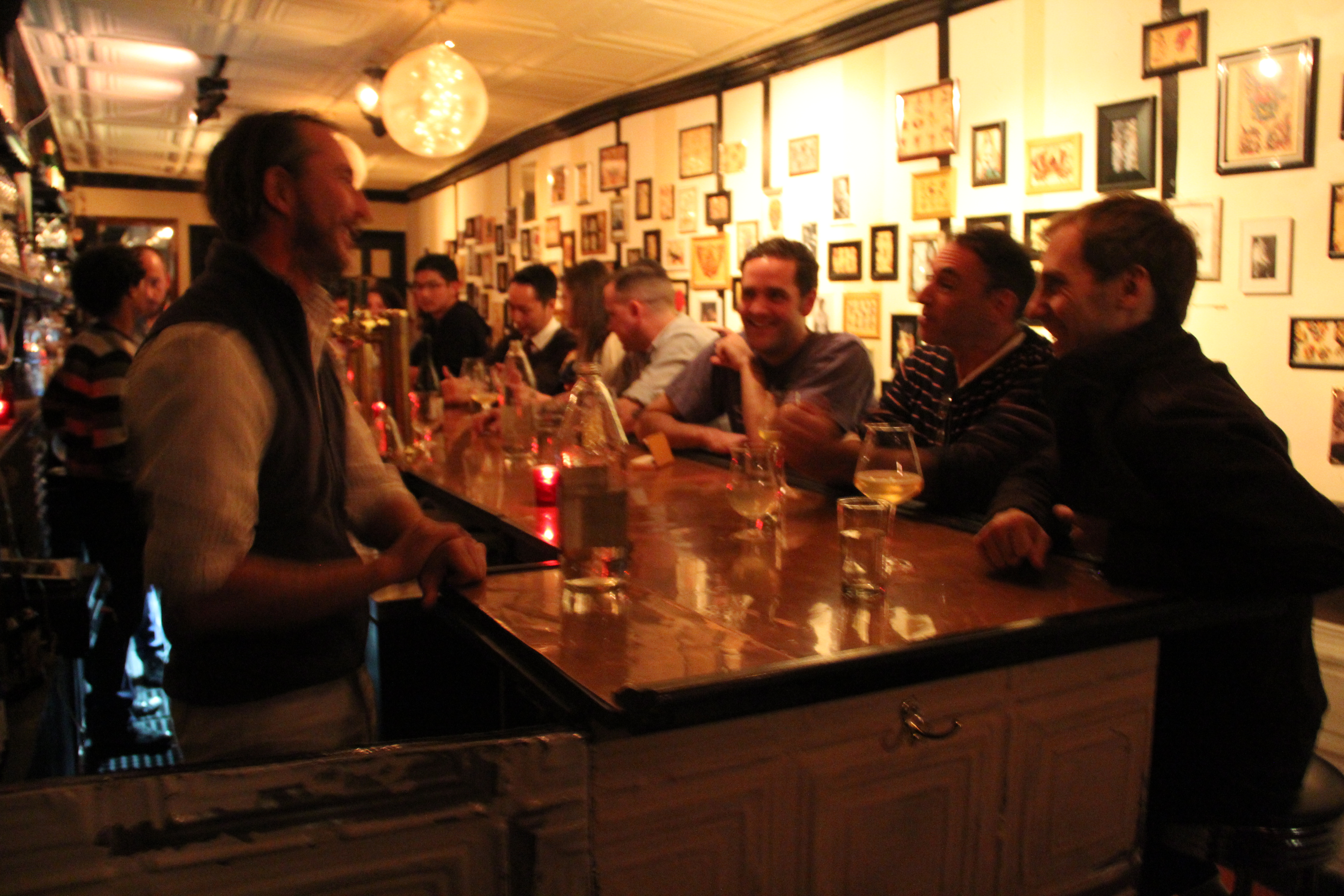
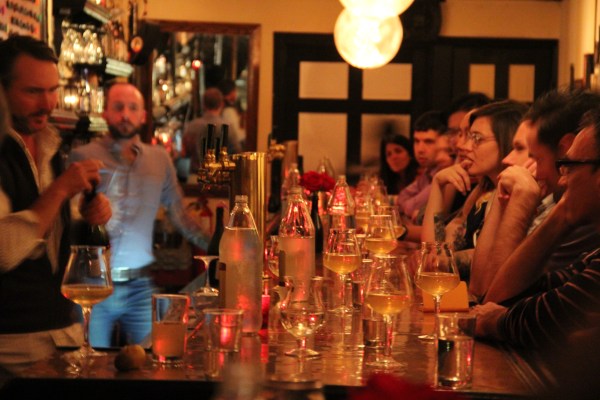
IMG_2060Crowded into a long narrow bar in the East Village called the Proletariat, where a steady stream of changing craft beers on tap lures beer geeks, a group of about 20-30 folks waited in the dim glow for the arrival of the hard-to-find and coveted ciders of Aaron Burr Cider.  Me, being the wide eyed Midwesterner that I am, had seen the event advertised in the NY Cider Week schedule and thought, oh, I will casually stop by at this event before dinner with my friend Challey.  Luckily, Challey knows the way NY works more the I, and she investigated further, messaged some people, found out the event was ticketed, tracked down the bar, and bought us the last two tickets.  I would have been OUT OF LUCK were it not for her keen City food scene skills.  Among the crowd were clearly some home cider makers, some people with a lot of knowledge about wine and beer but not about cider, and some totally new but enthusiastic folks who were devotees of the bar and trusted the bar staff when they said – come to this event.  I also was pleased to meet another cider blogger: United States of Cider.
IMG_2055So, I spend most of my time with academics, farmers, and craft producers, not urban foodies, and I have to say, urban foodies massively intimidate me, even though I probably can match them point for point on food, wine, and especially, cider knowledge .  It’s just the way they frame their questions (more like short soliloquies) with tones of assurance, peppered with casual references to nuggets of information indicating their level of taste, which makes me want to back wide-eyed into a corner with my notebook.  Luckily, my foodie friend Challey, who works as a director at the Greenmarket, is a fabulous champion of provincials like me and was instrumental in helping me navigate my sojourn into the foodie beast of NY Cider Week in the city.  Nonetheless, I sat in awe of the New Yorkers at this bar who were practically tripping over each other’s tongues to get in questions with Andy Brennan, who was winningly both modest, soft-spoken, eloquent, and a great story-teller of cider.
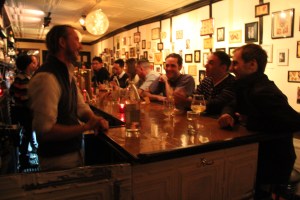
IMG_2077I’ve heard and read a lot about Aaron Burr Cider, and I think that the mystique of the foraged fruit touches a nerve for the American foodie that sends a certain exciting shiver up the culinary spine.  In fact, at another cider event, when I asked another panel of cider makers if there was any long term interest in developing uniquely American, regional cider apple varietals instead of turning to French, English, and Spanish origin fruit, one man said his fantasy was that there was some wild tree out there waiting to be discovered that had some amazing, yet-unknown flavors that would make a unique, wild, native American cider.  And a member of the audience said: “Well, that is just what Andy Brennan is doing with his foraging.”

There is something about the idea of an American wild apple, uncultivated apple that speaks to the American food imagination.  In this fantasy are the beginnings a new American cider mythology – one that taps into tales of Johnny Appleseed, our peripatetic tree-planting legend, and his semi-cultivation of wild landscapes.

The thing is, many of the landscapes settlers cultivated in the past, wresting farmland out of the forest, have become overgrown, taken back into the wild, as marginal land has become uneconomical to farm and farm economies have changed.  The Catskill / Hudson Valley area where Andy Brennan forages his fruit is one such landscape, where cultivated trees leftover from re-wilded farms dot the landscape and tell a story of un-cultivation that is little understood but ripe with mystery, full of the fruiting ghosts of farms past.

England has a similar story of orchards left-over from dead farm economies, but there is no wilderness in England to grow back over the land and around the apple trees.  Instead, these old trees become singular markers in grazed fields, or untended corners of a farmhouse property sold to urban professionals who like the view but know nothing about the apples.  There are foragers in England too, but they are looking for old, heritage fruits, instead of wild fruits, though the interest in roadside apple trees, grown from the pips of eating apples discarded out the car window, is also growing.

“Wild” apples are never entirely new though.  Even trees that sprout by the side of the road from a discarded apple have stories to tell about their origins in other cultivated or culinary pasts.  Brennan’s foraged ciders appeal to the American story of forging into the wilderness to carve out a culture of our own.  In a place where American cider history and culture has mostly been lost and forgotten, the idea of starting anew with unique, “wild” apples is appealing to many people in the sense that they seem to appear out of nature, independent of history and the hand of man.  It also suggests that America has a complex terroir to draw upon that does not simply mimic the European models. But to me, wild apples harbour their own mysterious agricultural pasts and speak to the re-discovery of our landscapes and our foods.

My friend Challey was even more excited than I was to go to this event, as she had been hearing about Aaron Burr Cider for awhile but had never had a chance to taste it until just a few weeks ago at a friend’s bridal shower.  We were treated to generous tastes of six different Aaron Burr ciders.  Here’s the rundown of what we tasted, with some of the commentary, questions, and answers that crossed the crowd, paraphrased and summarized:

Golden Russet. This cider is made from mostly golden russet apples, with a few Northern Spy thrown in.  Brennan commented that the Golden Russet lacks the acidity to be a total single variety cider on its own.  He described it as perfumey, with a high sugar content, explaining that the tannin content was higher from the russetting on the apple, and that the higher tannin and higher alcohol allowed the cider the possibility of more aging, which he liked. 

Q: What apples the first settlers were growing in America?

A: Besides the crab apples native to America, Andy explained, all apples we know for eating came over starting with the Mayflower, and all apples grown in the Northeast today are descendants of these European apples.

Q: Tannins?  Is it like red wine?  What are the varietals and how do you choose them?

A: “Every apple is a good apple to me.”  But Brennan went on to comment that he doesn’t put every cider he makes into his final blends.  He said he ferments over the winter, with the final change in flavors coming in the spring when a malo-lactic fermentation may occur.

Q: There are only a few varieties that can be single variety ciders?

A: Yes, it’s a lot like wine.  Only Americans are obsessed with single varieties.  Apples even more than grapes need to be balanced.  There are four things you are trying to balance: Acidity, Tanin, Sugar, Aroma.  It really is an art trying to bring those characters together – like bringing a still life together and letting all those objects live together.

If you grow an apple tree in a field, it has more sun, more nutrients.  I believe if you grow an apple tree in the wild, and its is competing with blackberry bushes an oak trees, that apple picks up those properties.  And the soil temperature is cooler in a wild environment than in a cultivated environment, which much influence the flavor.

Q: Do you blend different vintages?

A: Yes.  I am open to blending different years.  It’s like having an extra colour for next year’s cider.

Traminette.  Made from Golden Russet and four other apples, including MacIntosh for a floral note, this cider came about because Andy wanted something like a champagne – something like a picnic drink.  You could pair it with food, but it is great as a for walking around, a party drink.  It is very perfumey, a fruity taste almost like grapefruit and wonderfully bubbly, similar to the taste of Traminette wine, a white grape varietal related to Gewurztraminer.  Murmurs of delight wafted up from the crowd as they started to sip this beverage, and everyone seemed to be smiling and thinking of summer.  Brennan made a nod to the English invention of champagne method (which I think should be renamed the “Glasshouse method” in reference to the spot on May Hill in Gloucestershire where Huguenot glassmakers helped develop pressure-resistant bottle glass) and the efforts of Lord Scudamore as he outlined the details of the method to illustrate the craft method of carbonation as opposed to modern forced carbonation.

Q: I made cider at home and it turned out more like Chardonnay?  How do I get that apple essence that some of the more commercial ciders have?

A: Chardonnay has the same buttery characteristic that comes from the late spring fermentation – the malo-lactic fermentation.  If you bottle before that malo-lactic fermentation takes place, you can trap some of the apple fruit quality.  You can also back-sweeten by saving some of the juice frozen in reserve.

Homestead Apple. Made from foraged fruit. 

Q: What are you doing with the must?

A: We have one guy who distills but I use it mostly as a nursery for future trees.  I’ve got 400 trees planted.  I was buying cider trees from Europe but I decided we had all the varieties we needed and more right here.  Right now my nursery is trees I find in the wild that I want to keep, trees I find on property that isn’t mine that I want to save.  More than cider I want the trees.  I take the graft wood in the winter and put it on to our trees.  I keep finding trees I want to save.  It’s like our tree orphanage.

Elderberry.  This spicy aromatic drink had extra depth and rich flavour.  Brennan said this was what he made when he wanted a winter drink, something to go with chocolate, somethingthat felt woody and earthy and foresty.  It also includes a touch of sumac to enhace the lemony and acidic flavors.  He said that as the water level in the barrel shrinks over time, they add huckleberries to keep things spinning over in the fermentation.

Q: What strains of yeast do you use – are you afraid of using the wild yeasts?

A: I’ve messed up a lot of cider, but I am very much just, ‘let it go.’

Homestead Pear.  I think Brennan used the word “vulgar” to describe the scent of this perry, and he was right.  It was a ripe old aroma.  But the taste was wonderfully delicate and just like pear.  He described the fruit as a wild, foraged pear, with very delicate, sweet fruit inside a tannic, leathery shell – a smell in like a lion and a taste out like a lamb.

Ginger Apple.  Fermented on carrots, Brennan said he made this as a table wine, something to go with Thai food and sushi.  It really was the fresh spicy fruity taste you would expect from something you got at a juice bar, but much lighter.

New York Cider Stuff! – A taste of things to come

Finding Lots to share on the blog this week!  Here’s another interesting piece on a New York cider maker, stolen from the NY Cider Week feed.  I am really looking forward to going to New York Cider Week and will report back on my adventures there, so stay tuned.  It happened to coincide with a trip to Rhode Island for an academic conference – thus FATE strikes again, bringing me into another exciting cider happening. Enjoy the links!

Article on Aaron Burr Cider:

http://www.grubstreet.com/2013/10/andy-brennan-best-cider-producer.html

NY Cider Week page:

http://www.ciderweekny.com/

Preamble, With Feeling

I was encountering some writer’s block as I’ve been trying to work my way into writing, and today a conversation with a colleague unlocked some words for me.  Here’s the result.

ImageOne summer afternoon in July, 2013, I was sitting on the front porch of a 19th century farmhouse in southern Indiana, watching a terrific thunderstorm roll in from the northwest.  The slate blue clouds billowed across the sky, heavy with rain, as a preamble of cool wind swooped down through the heavy hot humid air in ferocious drifts, lifting the tendrils of the grape vines that lay in orderly rows across the rolling, hilly farmland.  I had been working all morning in the vineyard, but we were dismissed after lunch as the threat of the storm wiped out any possibility of continuing outdoors through the afternoon.  So I decided to watch the storm roll in on the farmhouse porch, set myself up with some books, and determined to accomplish some academic reading in a solitude away from the internet and other distraction, cut off from the rest of the world by a sheet of rain.  It was on this porch that I found myself entering into another rich landscape through the page – a landscape I had inhabited in England, living in the deep countryside of Herefordshire, where my habitat was an orchard instead of a vineyard, and the summer was cool and rainy instead of the heat-charged and electric climate of Midwestern thunderstorm.  To be in two places at once with such intensity was jarring.  Surrounded by the vineyard which I had grown to love through sweat drenched and exhausting work among the vines, accompanied by the camaraderie of the other vineyard workers, I attempted to burrow back into my memories of the English countryside through a dense academic rendering of theoretical conceptions of the rural.  But the Indiana vineyard had a physical hold on me in the present, even as I tried to rethink and replay the Herefordshire orchard I had loved so recently.  As so many ethnographers before have done, I felt deeply torn, emotionally and intellectually, between two places: trying to think and feel one place while thinking and feeling another place.  Perhaps some are better equipped for such multi-tasking, but for me, it was difficult – I felt a subterranean friction jarring the singular unity each place held in my emotional imagination.  One intense emotional place-memory recalled in the midst of another place, composed also of senses and feelings.  How can these compositions of experience coexist, one rupturing the wholeness of the other, simultaneously heightening the intensity of both, and then their loss.  Of such feelings is nostalgia born, but this is more than just nostalgia.  It is an attempt to hold two experiences intact, but their collision creates an excess of each, a calling forth of references and relations, so that one memory cascades from another.  In the midst of a Midwestern thunderstorm, I remember the floods on the River Wye, and all my days walking next to it, and all the farms and people on its banks.

It is feeling to which I turn in this preamble because feeling will play out in the remaining parts of this work frequently, and it is this deeply-felt connection to a unity of people and place which characterized both my fieldwork experience and my own evolving sense of the ways I uniquely and personally experience my world.  The reflexive turn in ethnography has allowed us to re-examine the personal lenses and biases which colour our own attempts to construct objective scientific study, and further has also allowed us to imagine and engage in critically emergent study – research in which we come to recognize our biases and the interesting questions they present in the course of our work.  Such research rejects the simple objective positivism of deductive reasoning, where a hypothesis is generated and then tested through a pre-conceived and vetted methodology.  Positivism has its uses and its place, but emergent and reflexive research suggests a series of discoveries about the types of questions we have asked, as well as the data generated by them.  This preamble of feeling then, is a first discovery, that my reactions to places are rooted essentially in deeply emotional connections to people in their places, connections that are experienced in a present-time rich and dense in the sensual perceptions which give texture to the social relationships enacted in the landscape.

Though these are my own personal tendencies, they are also windows into particular kinds of questions about social and cultural landscapes, perhaps questions which my proclivities can give particular insight into.  As academics, too often we forget to mention not only how our personal histories, biases, and experiences influence our research, but also our personal talents. It is as if our scholarly talents are a given, separate from our personal lives, a set of intellectual exercises refined by our scholarly disciplines.  Reflexive scholarship could increase its potential to enrich academic life by helping to inform students and professors alike not only of their intellectual, cultural, and political biases, but also how their personalities and talents contribute unique approaches to the questions we consider.  This would seem self-evident, and yet methodology does not usually require us to ask how we approach and process our experiences in highly personal ways dependent not only on unique social and cultural experiences, but on temperament, talent, and character.

Image

So what is the quality of feeling and affect on our experience of places and landscapes?  The following chapters will attempt to tease out a few strands of thought relating to the causes and consequences of feelings related to the landscape.  Feeling, emotion, and affect continue to be difficult subjects to attend to in scholarly study.  David Matless, in his essay “Doing the English Village, 1945-1990: An Essay on Imaginative Geography” organizes his argument around the importance of attending to beliefs, myths, feelings, and impressions related to place:

This essay, by contrast, critically embraces the many imagined realities of the English village – its sentiments, its fantasies, its dreams, even its sugar-sweet pond ducks – as things real, powerful, political and moral; things serious and of importance in the culture of the country.  Its purpose in doing so is in part to establish a complexity in the discourse of the rural. (Matless 1994, 8-9)

Writing against what he calls the “rhetoric of reality”, Matless foregrounds the imaginary construction of the landscape, including the affective and emotional aspects of the imagination, as real entities, no less important or powerful than the realities of poverty or isolation with which some sociological studies (useful and important in their own right) have dried to debunk the myth of the rural idyll.

So I walk through the vineyard, tying up vines, pruning, shaping the growth of the place, feeling the sun, the heat, the electric thunder and the enjoying the chatter that we toss to each other across the vines like so many clusters of grapes. And loving this place, I try to conjur up an orchard in England, in the valley of the Wye, and I try to unlock the feeling, the imagination of a place where the orchard pressed out cider and laughter too, where the river floods, and a glass is never empty for long.

Final Cider Con Catch-Up

Apologies for my week-late final post on Cider Con – I was laid low with a cold and moving into a new house, so I neglected my follow-up.

However, here is another summary / partial-transcript depicting Friday morning’s panel of Cider Makers.  Again, not an exact transcript, but my best attempt

Cider Market Review 2012-2013 Outlook – A Panel Hosted by Ben Watson

  • Tilted Shed Cider: California-based company, We started 2010.  We fell into cider because we loved to grow our own food, grow our own drink.  Scott is a fermentation mad scientist, and if he can make alcohol with something he will.  We had been doing some market farming at that time and something about cider captured us.  We couldn’t believe it could be good.  Took Peter Mitchell’s courses, read the cider books.  Moved to California.
  • Tieton Cider Works.  Washington. Started in 2009.  30,000cases this year, distributing to 7 states.  &th generation orchardists,  Wine background.  In 2008, Campbells decided to start propagating 40 varieties of trees to see how they would do.  Seattle or Portland area, not uncommon to see 4 taps out of 12 of cider.  A really good region.  Nation’s first cider bar in Portland.  We’ve been developing a brand that people enjoy, producing high end drinkable ciders that go well with the market trends that are pushing it.
  • Bantam Cider, Boston.  Very new cider company – two women.  Started a few years ago, launched product last January.  Family background in winemaking for one of us.  Being in Massachustettes, apples are really part of the culture.  There was awareness of cider, but in the past couple of years, cider has become more known.  We started making a little as a hobby, and it has evolved.  Mass is a pretty fantastic market – an interest in local, artisanal products, an entrepreneurial spirit. A thriving community focused on innovation, which has allowed us a great opportunity for collaborations with other local producers, as well as a thriving craft beer market.
  • Virtue Cider, Chicago.  First cider on the market in Chicago last April.  Started Goose Island many years ago in Chicago – long experience in the craft beer business.  I see a lot of similarities.  We chose to do our cider in Michigan, as it has a great history of apples.  Lot of great cider makers and craft beer scene there.  We look at craft cider very similar to the way the craft beer scene has grown.  I think this whole craft beer thing has gone so local, and I think the same thing will happen with cider.  There will always be room for the big national brands.  Beer guys and wholesalers and retailers are really excited about cider, because they see that is where the growth is.  In Chicago, we don’t have producers in the city, though there are outside and in the suburbs, but we think there is room.  We had Woodchuck on tap at Goose Island in the early years, because that was all we could get. I learned more about beer talking to other brewers, rather than at the institute.  I learned lot more about cider talking to other cider makers, rather than taking the Peter Mitchell class.

Ben Watson: What are the demographics of Cider?  Who are your customers?  At the Cider Salon, the crowd that waits in a long line outside of the church community center is getting younger and hipper every year.  What do you see?  Who are the new cider drinkers?

  • Virtue Cider: in the cateogry or 24-27 year olds, drink preference for cider has skyrocketed.  In Chicago, the bars who order our cider every week – At Hopleaf, we are always in the top 3 of the drinks they sell.  Going young and very very crafty with beer drinkers is where we will continue to go

Ben: Cider has always been the red-headed stepchild of beer or wine, and it is a fools errand to compare it to beer or wine.  What is everyone else’s perception

  • Bantam Cider: Our top selling accounts are the craft beer package stores and craft beer bars.  Not excluding wine drinkers, and we see all the time that the younger people are open to it.  The older side of the demographic is more cautious.
  • Tilted Shed: We make cider in wine country, so the culture there is heavily steeped in wine.  Our primary market is the Bay area.  I find there isn’t such a huge age split.  We get equal interest from the beer geeks as the the wine appreciators.  We are getting dedicated cider drinkers from both beer and wine drinkers, from both young and older drinkers, from people who are really into exploring.  We do get recognition of the food friendliness of our cider.  Alice Waters is our patron said of food and wine.  We have real appreciation for the localization of products.  People want to know the story of food.  It’s less about category and more about the connection to the land.  Our market is a bit younger – the majority of craft ciders in our market are in 750 mls – a lot of our drinkers are coming from the wine market.  For us, the wine drinkers are more apt to pick it up, which could be from the bottle format. We’ve decided to put it on tap to get hold of the craft beer drinkers.  I think as the bottle format changes, younger drinkers will come on.  The older crowd doesn’t know about it, whereas the younger crowd does have a preconceived notion of it.

What preconceived notions do people come to your cider with?

  • Tieton: people think of a fresh pressed cloudy juice, who think hard cider is going to be the same.  And when they taste dry cider, it is difficult.  It was a matter of getting people to understand that ciders aren’t alcho-pops, or Mike’s Hard Lemonade .
  • Tilted Shed: To help people understand that we are not a sweet fizzy pop – though there is a room for every style – we don’t do that.  Because we are in a wine region, and we are geeks about the cider apples, we compare to the way grape varietals make good wines.  By geeking out about it, people start thinking about it the way they do about craft beer or wine.

Audience Question: Are there solid numbers to tell our bankers where the cider market is going?

  • Virtue: I think that is something we can look forward to asking the conference and the association in the future.  Cider has grown 20% in a year according to someone in the craft brewing industry.  The preference data is even more exciting, because that is where it is going.  Supermarket and scan data from big chains doesn’t quite capture the on-premise numbers – it lags behind.

Audience Question: Where do you see the consolidation of the market and how does it compare to the craft brewing industry?

  • Virtue – With brewers, the vast majority don’t know where their product comes from.  I think part of the story of cider is that 40% are growing their own fruit and most know where their apples are coming from and are local.  I think that is really cool, and that makes us different and unique.  I like to call wine, “cider made from grapes.” But I think that is where the staying power of cider is going to be.  There is always room for the big guys, who can’t use local fruit, because they need to keep their supply chains.  And I think everyone in this room needs to respect that.  They’ve been at it much longer than any of us, with a few exceptions.  The big guys are the ones with the money who can help us get the legislative stuff going.  I saw this in craft beer, where the little guys thought the big guys were bad.  I think we all want to be successful.  We’ve got to act like a family.  We can have our disagreements in this room, but when we leave we need to say all cider is good.  I think all cider is good, and I’m really proud of being part of this new cider association.

___________

Apple Market Panel, with Greg Peck – Virginia Tech; Panel: David Watkins – Fruitsmart, Steve Wood – Farnum Hill Cider, Kevin Zielinsky –
E.Z. Orchards, Mike Beck – Uncle John’s

This spirited panel brought together professional commercial orchardists who are also cider makers to discuss the pressing issues of apple supply for the growing cider market.  With an overview of last year’s weather and apple crop, these folks launched into the uncharted territory concerning the development of an orcharding industry catering to the cider market’s desire for cider varieties.  The core issues remain ones of risk – who is going to take on the risk of trialing apple varieties in different US regions?  Who is going to take the risk of financing the propagation and planting of cider varieties as commercial ventures?  While all of these orchardists have taken on growing cider varieties in a small way through their own interest, they largely insist that the cider makers will need to take the step of ensuring a market for cider apples if growers are going to commit to the large investments necessary for planting and maintaining orchards over long periods of time.  Long term contracts seem to the buzz word on orchardists’ lips, though they also recognize that cider could be an alluring new market with far more dependability than the current pack-apple market.  Here’s some highlight points of discussion:

  • EZ Orchards, Oregon – Not a large producers of apples, more pears.  Those that are are Fresh.  Small acreages of cider varieties and older varieties such as Newton Pippin which are being used for cider
  • Uncle John’s Cider, Michigan – 2012 was tough.  US Apple data is different than MI apple data.  We estimate a 90% crop loss.  We bring 12 varieties to the market: Winesap, Northern Spies, Jonathan, Reds, Yellows, Galas, Breaburn, Fuji.  We are a processing state: 65% of total crop.  Lots of Manufacturing: Gerber, Sarah Lee, etc…  For a cider maker you aren’t going to find more varieties anywhere else.  2013 is looking great.  Processors have very low inventories.  As a grower, we are looking forward to good prices.
  • Steve Wood, Farnum Hill Cider,  New Hampshire –  2012 horrific early spring.  A lot of the cider fruit we grow is fairly late budding, so frost damage can be less for those.  Good Cider crop, despite erratic apple crop.  Market was as strange for processing fruit as for everything else, due to low availability.  We sold cider crop for 50 cents a pound.  Rest of the crop at 15-18 cents a pound. We could have sold much more for cider than we did sell.  Next year, hoping for a huge crop nation wide of cider fruit, so I can find out how much of the enthusiastic market that existed last year will be as interested this year.  What is encouraging to me, is that the cider fruit market had been calling me before the crop shortage – I am encouraged to think that the value of proper cider apples is high and supportable.  We may cut back on our high end specialty market for heirloom apples.  But I don’t think we would have been able to charge more for our premium apples the cider makers are interested in if they had been organic.

Questions

On investing in varietal specific production for the cider market

  • One of our big decisions is the long-term 20-year investment in the orchard.  We are looking at where cider will peak?  We want to do a long term contract.  I don’t want to speculate on putting in cider apples if there won’t be demand in a few years.  We are doing 1200 trees per acre.  It takes a lot of commitment for someone to grow them.  If you want commercial guys to grow you a lot of cider apples, I think you are looking at a contract.  It is a specialty type of growing.
  • There are a lot of question marks about these varieties as well.  We need a lot of investment from the universities as well, or a contract.
  • There are more commercial growers budding more bittersweets than ever.  But cider makers have to pay the growers.  For my money as a grower, I see this as a stable investment, because I see it going up for long time, compared to a pack apple.
  • The universities are not spending any money on cider or organics research.  They are sponsored by the Ag companies for high-end apples.
  • Fruit used for cider apples does not have a second use in the fresh market, so there is no other market stream for them, making it is a real risk for the grower
  • Growing cider apples is also still not very well understood and best practices not online for orchardists, especially the English and French varieties
  • Mass market ciders are not using bittersweet, because it isn’t available
  • How far along does the cider industry need to be before you will sign on to a 20 year contract?  Looking ahead?
  • A lot of the English cider varieties don’t do well in our area (Oregon).  We are looking at what will grow well and what we will use, but not to the extent that we will gamble on planting 500 acres.
  • To find what we could grow in New Hampshire, we trialed a few hundred varieties, and ended up with a handful.  This was private research.

On being a maker or a grower – pros and cons of growing your own apples, contracting, and sharing innovation risk

  • If you are a cider maker thinking of buying an orchard, think twice, because growing apples is a demanding business.  The growing of fruit to that standard will demand you be a good accomplished  grower who knows their soil and their climate.
  • (Audience member response) I know I will never be a commercial grower, but I want to plant an orchard to be a database for the growers in my area.  There is risk out there that people will need to take to put these trees in the ground.
  • The need for investment in targeted research in quality cider-apple growing
    • Do higher quality apples make higher quality cider?  One of the most important parts of fruit production is the level of production you can expect year to year.  Since Long Ashton, there hasn’t been any research about how micro-managment of growing can affect the qualities of apples.
    • If you are out-sourcing apples, you need to know about the situation of those apples – as a grower of our own apples, we watch all of those levels – sugar, nitrogen, ex – and we treat cider apple trees differently than we treat the fresh market apples to get optimum sugar in those apples for fermentation.

Cider Con Day 2 – Beer Market or Wine Market?

Day two of Cider Con has been perhaps even more energetic than day one, with general positive enthusiasm leading into some intense discussion of issues, problem solving, and networking.  One of the major themes I’ve encountered today has been the Beer vrs Wine issue.  While in the UK, cider has a culturally recognized place as a distinctive and individual drink (relatively speaking here – I know the same issues do still apply), here in America, people are dealing the issue that hard cider is essentially a non-entity, and many discussions today have revolved around how to fit your product into the appropriate beer and wine markets, how to communicate with distributors in those markets, and how to speak to them in a language they understand while educating them about the character of the drink you want to create.  Britons, you’ve probably dealt with all this too, but the thing that I can’t help but notice here is that AMERICANS LOVE TO SELL STUFF.  That’s right, I’ve come back home to the land of the aggressive, enthusiastic, and self-assured entrepreneur.  Americans love to sell stuff, and they know how to do it well.  The challenge I see people tackling here is not just developing product identity and creating markets to fit – which I am sure will happen in the long term – but rather harnessing the strengths of the wine and beer markets that already exist and channeling cider through those markets in the ways most beneficial to individual businesses and their products.  The strength of the distinction between the wine and beer markets, and the approaches to these markets in the United States was very striking, perhaps the more so because of the muscular approach these American cider makers have towards using and manipulating the markets to their best advantage, something I had not experienced in England.  This is possibly attributable to both the difference in cider culture itself between the countries, but also to the cultural differences in the approach to business practice and marketing.

Below, I include a rough transcript following an exchange during one of the workshops led by representatives from Virtue Cider, based in Chicago and run by folks with a successful history in the craft beer industry, and Farnum Hill Cider of New Hampshire, with a background in orcharding and a more wine market approach.  This is not an exact transcript – but an approximation of some interesting exchanges on these topics, with me typing as fast as possible while listening and trying to get as much of the words and the gist of it as possible:

What to say when you don’t know how to sell cider?

  • Farnum Hill Ciders: We are more wine-like in our behavior than beer like – we don’t want a sales associate to think if we run out of something that there will be more soon.  We want to create the sense that scarcity is good.  Beer reps find this difficult to understand
  • Virtue Ciders: We looked at cider within the craft beer market of Chicago.  We were able to use the momentum of craft beer here and in other regions, also with the craft beer expertise of me and Greg from Goose Island. We needed to educate our audience when we started with craft beer.  How to do this with cider?  With Virtue, we use a lot of beer yeasts and barrel age our ciders in wine, raw oak, and bourbon barrels.  For me, with the products that we have, we have been able to penetrate the craft beer business with cider.  I’m still learning the production side, so that we can put it out in the market. I have to let accounts know what is coming up next in production, and explain it to the consumers.  I do tastings in Chicago, not just as a rep for Virtue Cider, but to educate the public in general about styles of cider. 

Audience Question: What are the styles of cider?  Dick Dunn has created styles for use in the Great Lakes competition. 

  • Farnum Hill Ciders: I think that is a pile of horsefeathers, as there aren’t any defined styles now.  I don’t think we want to predefine styles by region too early – it took a long time to do in Europe, and it will take a long time to do here.  Same with single variety cider.  I think what is happening now happened in the American Wine market in the 50s 60s an 70s.
  • Audience Question: Dick Dunn is trying to satisfy the beer geek crowd –
  • Farnum: But you shouldn’t have to do that to satisfy people who don’t know anything about your product
  • Audience comment: let the consumers choose – tell them what is in the product and let them decide what they want out of it.
  • Virtue: If we are educating people about the variety of ciders in general, than we should have things to satisfy different parts of the market.
  • Farnum Hill: You have to get rid of the preconceptions the consumers might have about cider before they get the product in their mouths
  • Farnum Hill: The challenge of dealing with the beer market – they always expect something new ie Christmas beer etc?  And we don’t do that.  We make the same thing every year.  Like wine, our strength is terroir.
  • Virtue: with my experience in beer, we still have the flagship products, like the Redstreak.  Also we have accounts who are more interested in local than in new.  We are relaunching, in a sense, the 2012 harvest of the Redstreak to get a bit of hype about this year’s product.
  • Farnum: Wine people aren’t about what is new, but what is continuous. The culture of the beer world is hard on cider makers, and you have to decide what you want to take from the beer world and what you want to stamp out of your representatives. 
  • Farnum: As to styles: I’m against regional styles that tie styles to cultures that no longer exist and need to regenerate (idea of a New England style based on historical cider making to which there is little continuity).  As we become better cider makers, and establish orcharding traditions for cider, these styles will emerge.  In the meantime let’s talk about sensory style, so that people know what kind of taste experience we are going to take them through.

Stay tuned – I’ll post some more on other issues from today later on.