December on The Somerset Levels

It’s November, and we’ve had our first snow here in Indiana.  After the immersive and intensive dive into NY Cider Week, it’s been nice let my mind drift back to England as I spend time transcribing more interviews.  Somehow, I can’t seem to get the Somerset Levels out of my mind.  Maybe it’s the slant of light on the horizon that triggers the memory, or the temperature, dipping into the freezing temperatures.  It was about a year ago come December that I was visiting there, doing some interviews in the midst of a phenomenal flood. It’s a landscape famous for its orchards and its cider, but one I’ve only visited, not lived in.  This post is not about orchards and cider directly, but about a delicate landscape where they are part of a complex ecological and agricultural heritage.

I’ve been reading over Life on the Levels: Voices from a Working World, a collection of interviews with people whose lives are intimately connected to the unique landscape of the Levels, illustrated with elegant black and white photographs.  There is something about this particular landscape that I find personally extremely compelling, slightly mysterious.  The low-lying moors have been drained over the centuries, but the water still reigns here.  It is one of my favorite places to meander around the lanes, always slightly lost in the winding turns that take you around the moors, stumbling upon the high pieces of ground that have been prized spots for thousands of years, like the almost imperceptible hill on which stand the ruins of Muchelney Abbey, where the monks must have been really glad of dry land. Or the Glastonbury Tor, or the Burrow Mump, whose slopes are surrounded by the standard orchards of Burrow Hill Cider.  The apples, like the people, tend to cling to the high ground to keep their feet dry.

One interview in Life on the Levels, with RSPB Warden of West Sedgemoor John Humphrey in 1981, explores the myriad issues surrounding the relationship of ecological conservation and agriculture in the landscape with impressive breadth, opening with this quote:

“The progressive agriculturalist would see a traditional meadow here as really not being worth farming and would want to under-drain it, dry it out, plough it up and re-seed it….West Sedgemorr is a great mass of waterlogged peat which is…about fifteen feet deep.  And you’re supported by a skin of vegetation – that’s all that’s stopping you from sinking into this morass…”

This seems to be one of those delicate places where the environment pushes back relatively quickly – lets you know when you’ve pushed the boundaries of ecological manipulation too far, which is perhaps what gives it that sense of self-contained power and responsiveness.

This slideshow requires JavaScript.

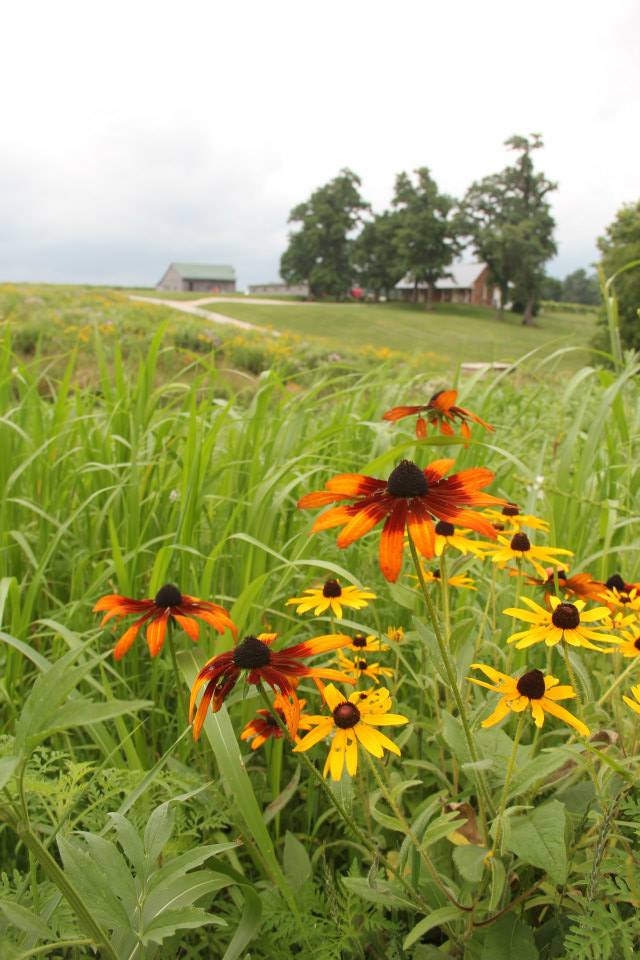
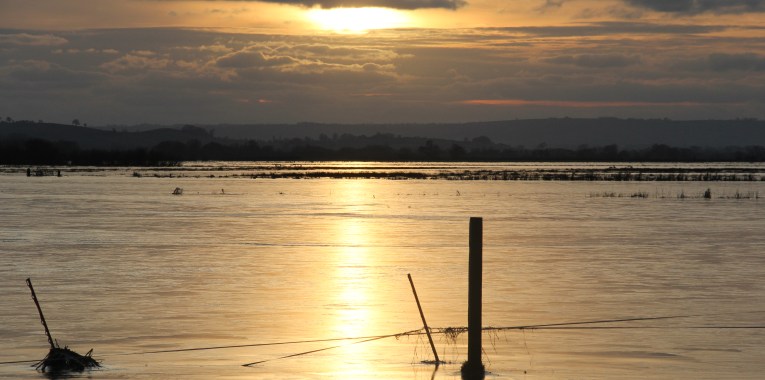
When I was driving there last December, it was with some trepidation, as just days and weeks before, local people had been marooned in their houses, the roads impassible to all but tractors in the midst of the flood.  When I came, the waters had receded enough that the main roads were passable, but many of the fields were still covered with water.  Or rather, they were covered with ice, as the weather had turned cold and turned sections of the moors into sheets of glass.  Birds flocked to the open places in the ice, and it was hard not to be awed by the quiet beauty of the mauve twilight settling gently over these great reflecting watery moors chilled to a frost -covered stillness.  Though one could not forget also the agricultural and personal loss from these same floods.  Here are some articles detailing the damage from the Guardian and the Somerset County Gazette.

I spied some orchards by the side of the road encased in the ice, their trunks sealed in.  I stopped by Burrow Hill Cider just to climb to the top of the hill and look out over the vast icy lake that had formed in the moors below.  Landscapes like this provoke us to consider how agricultural heritage has helped shape the landscape, but also forces us to face the limits of human change.  Further into the book, another interview with details how aggressive drainage practices designed to promote arable agriculture can permanently affect the balance of the peat, cause the land the sink, and further exacerbate the flooding problem.

Rhode Island: Vanishing Orchards Film

At the 2013 American Folklore Society annual conference held in Providence, Rhode Island two weeks ago, there was, miraculously, a session on Rhode Island orchard traditions.  Ann Hoog from the American Folklife Center at the Library of Congress was on hand to talk about some of the archival material.  Michael E Bell, retired from the Rhode Island Historical Preservation and Heritage Commission discussed the field research contributing to the film.  Alex Caserta, the producer, was also present to talk about the making of the film.

Here’s the abstract from the program:

Vanishing Orchards and the Rhode Island Folklife Project.  From July to December 1979, the American Folklife Center, in cooperation with several Rhode Island cultural agencies, conducted a field research project in Rhode Island concentrating on various ethnic, regional, and occupational traditions.  The resulting documentation includes audio interviews and photographs of the Steere family, owners and operators of a fruit orchard in Greenville, Rhode Island since 1930.  That orchard is featured in the new documentary film Vanishing Orchards: Apple Growing in Rhode Island.  This session includes an overview of the 1979 project followed by a showing of the film.  After the film, discussants will address the subject of family farms, agriculture, and changing neighborhoods; documentation of this changing landscape through fieldwork and archives; and the genesis of this documentation coming out of the collaboration of multiple Rhode Island cultural agencies.

The film was shown on Rhode Island PBS.  Unfortunately, I have not yet been able to find a full version of the film online.  However, there is a promo for the film available here: on the  website for the film project.  The film itself was full of interviews with Rhode Island orchardists discussing the challenges and opportunities facing orchards in the Ocean State as pressures on land from development make the economics and pragmatics of farming close to urban and suburban areas challenging.  The loss of orchards is definitely a theme – many people interviewed recall orchards no longer present on the landscape.  But the resilience and innovation of those who are continuing on is also impressive.  Two orchardists featured in the film joined the panel and fielded questions from the audience.  Surprisingly, hard cider did not seem to be an economic project for those present, nor did it feature in the traditions documented in the film.  It would be interesting to dig more into the archival information to find out if there is anything there.

Cider enthusiasts and researchers, be aware of the opportunity to seek out the collections of the American Folklife Center at the Library of Congress as a resource for information on orcharding and cider traditions.

New York Orchard and Cidery Car Trip

I got on the train back upstate and felt a wave of relief.  New York City is exciting but hard work.  I don’t know how you all do it down there in the City, day in and day out?  I picked up my car from my cousin’s house and took a meandering, semi-accidental tour of some of the orchards in the Hudson Valley / Catskills area.   Photos above are from my first stop at Dressel Orchard and Kettleborough Cider House, near New Paltz.

From there I proceeded towards the Gunks, passing another roadside orchard and some stunning views of pumpkin fields beneath the Gunks:

I then drove up to Stone Ridge Orchard and met up with a friend.  Pete, the guy manning the shop was really friendly and said he had been coming here for years before he started working there.  This orchard is operated by Elizabeth Ryan, maker of Hudson Valley Farmhouse Cider.  Check out also the Friends of Stone Ridge Orchard page. This orchard was really interesting, with lots of different varieties of fruit and styles of pruning in evidence.

Finally, I drove out to visit some cousins in the Catskills, where I went to photograph the old North Branch Cidery in western Sullivan County.  I spent several summers working at WJFF Catskill Community Radio and hoeing weeds at Gorzynski’s Organic Farm, and I passed by this place many times.  My cousins remember when it was still operating, but is has been years now since it closed.  You can see a few apple trees on the property beyond the rusting truck and the buildings.  Andy Brennan posted this in a comment to another post on the blog:

Hey Maria, I don’t know much about the North Branch cidery either except everyone in the county tells me they used to bring their apples there to press. It was an old German guy who everyone loved and he had hard cider too, but I don’t think he legally sold it. I believe the ecoli scare and pasteurization laws forced the shut down about 12 years ago. Someone was working on the building not long ago but it still looks abandoned. -Andy

And after that, I headed home to Indiana.  I did actually follow the address to Eve’s Cidery in Van Etten, NY as I drove along the southern tier past the Finger Lakes region.  I drove by a large barn several times, but there was no sign, it looked like they weren’t set up for visitors, and I still had 400 miles to drive that day.  So I went on my way without stopping.  Someone waved at me though, after I drove by for the 4th time.  Probably they were wondering if the weirdo in the yellow VW beetle was lost, which is kind of true.  I mean, who drives to obscure orchards in search of cider?  I guess that’s me!

Cider Foragers

Foraging Follow-up to the post about Aaron Burr Ciders:  As I was driving up NY 97 along the Delaware River, I noticed quite a lot of roadside apple trees laden with fruit just north of Hankins and south of Hancock.  I’m betting, due to their road-side locations, that they are the progeny of apple cores thrown out the car window.  Delaware valley scrumpers, get to it!

NY Cider Week: Meet the Cider Maker – Aaron Burr Cider’s Andy Brennan @ Proletariat

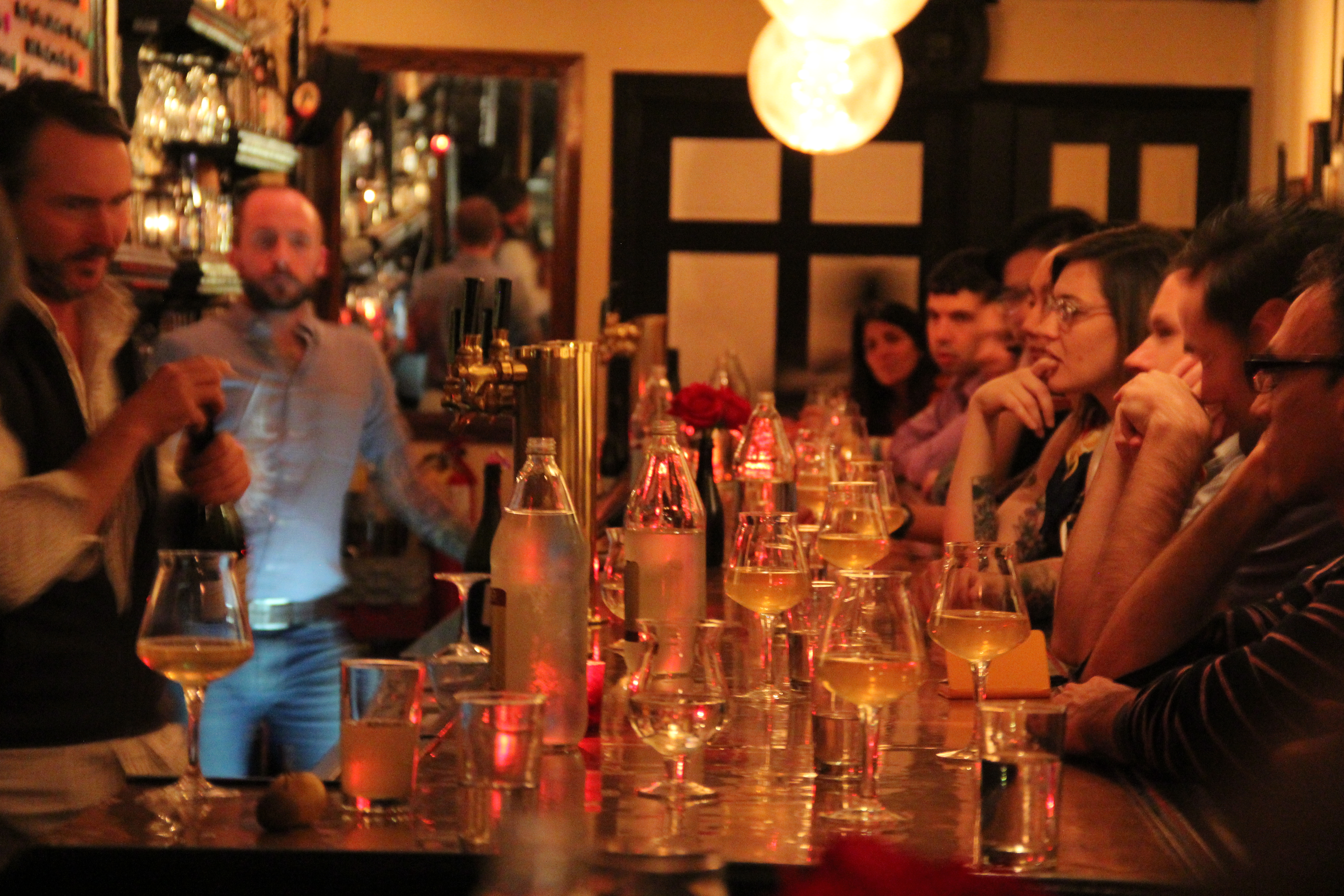
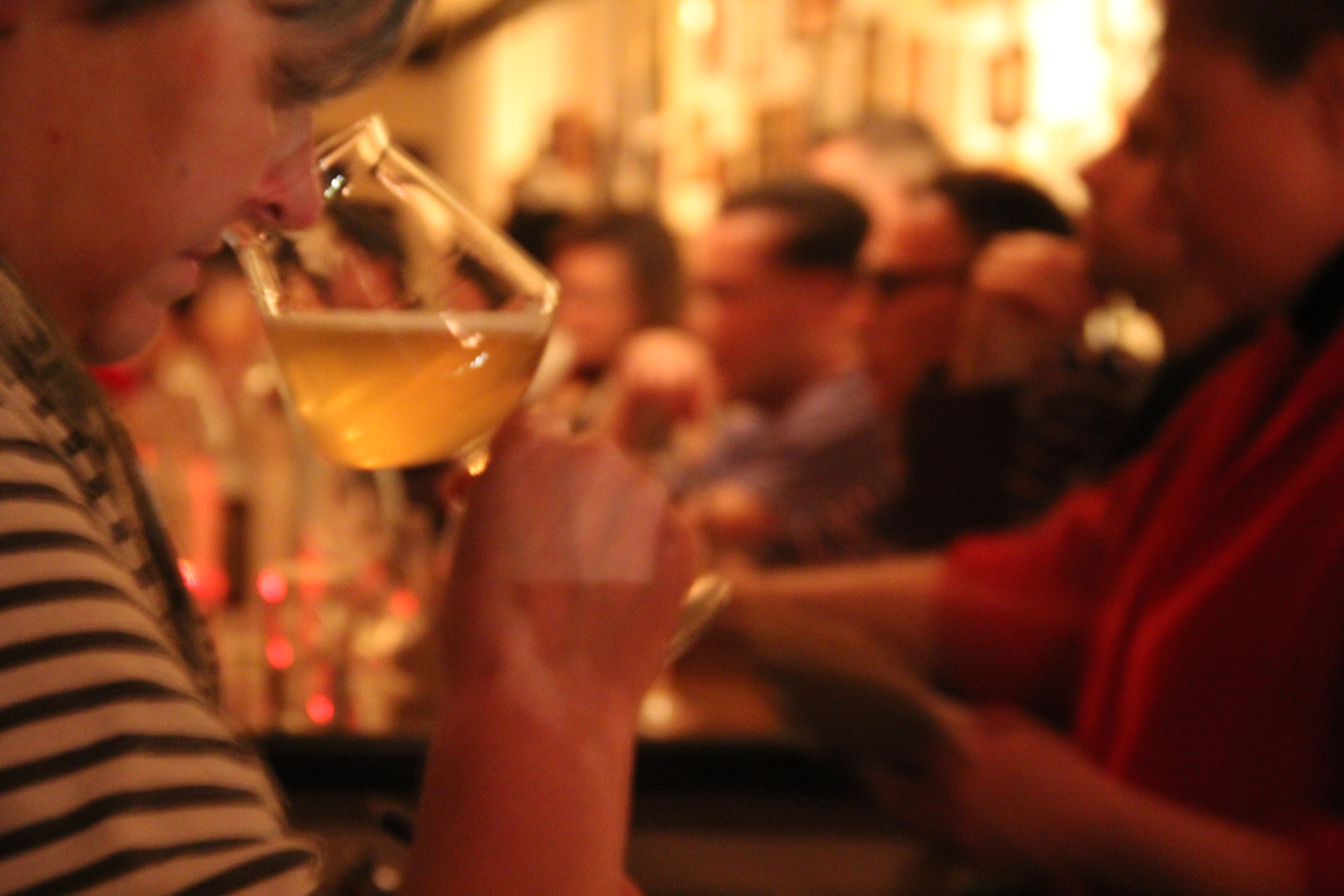
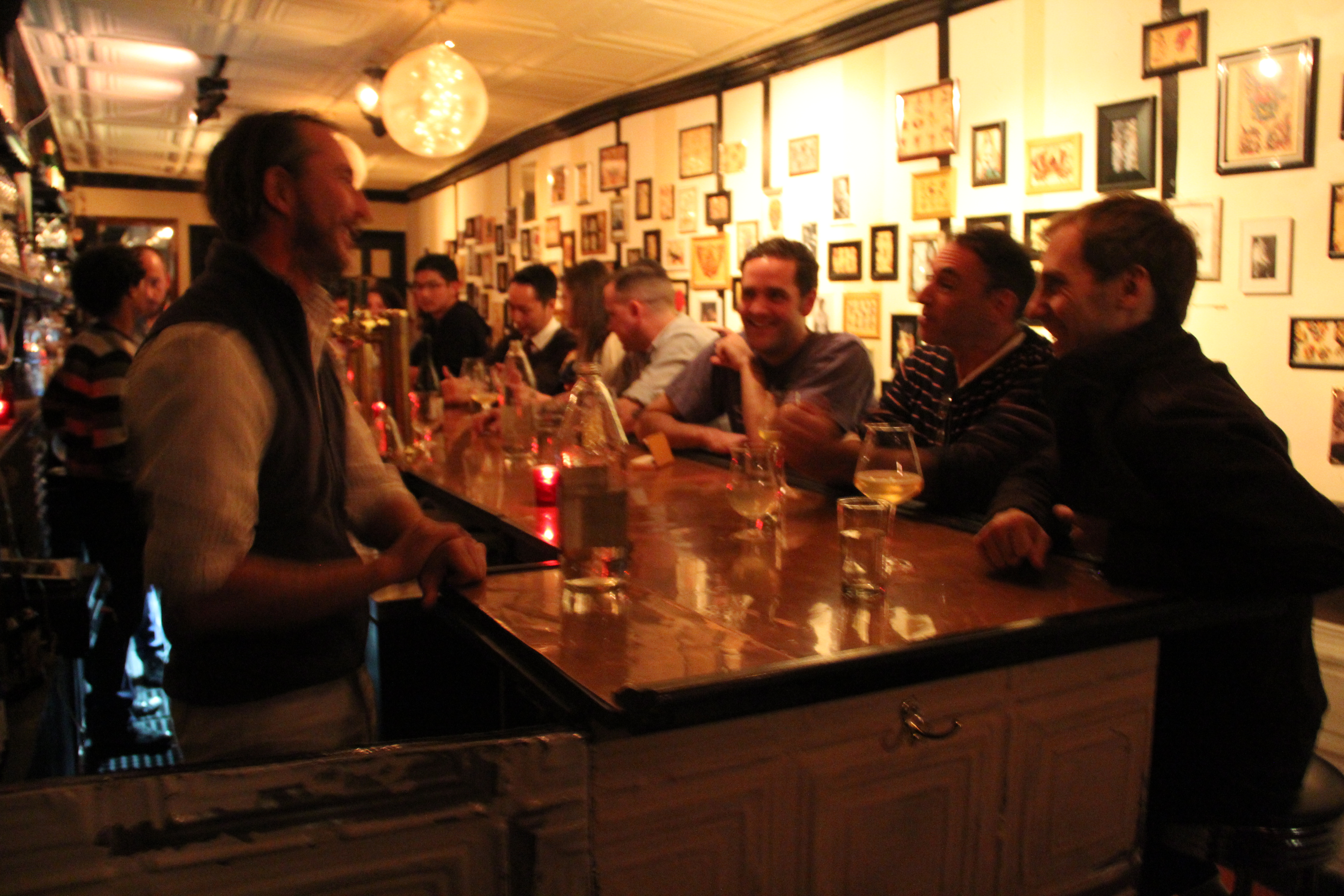
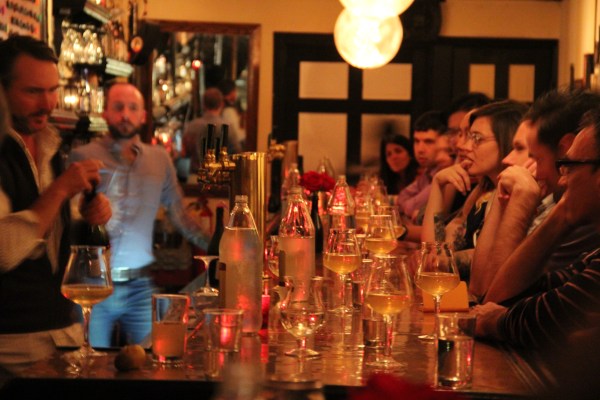
IMG_2060Crowded into a long narrow bar in the East Village called the Proletariat, where a steady stream of changing craft beers on tap lures beer geeks, a group of about 20-30 folks waited in the dim glow for the arrival of the hard-to-find and coveted ciders of Aaron Burr Cider.  Me, being the wide eyed Midwesterner that I am, had seen the event advertised in the NY Cider Week schedule and thought, oh, I will casually stop by at this event before dinner with my friend Challey.  Luckily, Challey knows the way NY works more the I, and she investigated further, messaged some people, found out the event was ticketed, tracked down the bar, and bought us the last two tickets.  I would have been OUT OF LUCK were it not for her keen City food scene skills.  Among the crowd were clearly some home cider makers, some people with a lot of knowledge about wine and beer but not about cider, and some totally new but enthusiastic folks who were devotees of the bar and trusted the bar staff when they said – come to this event.  I also was pleased to meet another cider blogger: United States of Cider.
IMG_2055So, I spend most of my time with academics, farmers, and craft producers, not urban foodies, and I have to say, urban foodies massively intimidate me, even though I probably can match them point for point on food, wine, and especially, cider knowledge .  It’s just the way they frame their questions (more like short soliloquies) with tones of assurance, peppered with casual references to nuggets of information indicating their level of taste, which makes me want to back wide-eyed into a corner with my notebook.  Luckily, my foodie friend Challey, who works as a director at the Greenmarket, is a fabulous champion of provincials like me and was instrumental in helping me navigate my sojourn into the foodie beast of NY Cider Week in the city.  Nonetheless, I sat in awe of the New Yorkers at this bar who were practically tripping over each other’s tongues to get in questions with Andy Brennan, who was winningly both modest, soft-spoken, eloquent, and a great story-teller of cider.
IMG_2077I’ve heard and read a lot about Aaron Burr Cider, and I think that the mystique of the foraged fruit touches a nerve for the American foodie that sends a certain exciting shiver up the culinary spine.  In fact, at another cider event, when I asked another panel of cider makers if there was any long term interest in developing uniquely American, regional cider apple varietals instead of turning to French, English, and Spanish origin fruit, one man said his fantasy was that there was some wild tree out there waiting to be discovered that had some amazing, yet-unknown flavors that would make a unique, wild, native American cider.  And a member of the audience said: “Well, that is just what Andy Brennan is doing with his foraging.”

There is something about the idea of an American wild apple, uncultivated apple that speaks to the American food imagination.  In this fantasy are the beginnings a new American cider mythology – one that taps into tales of Johnny Appleseed, our peripatetic tree-planting legend, and his semi-cultivation of wild landscapes.

The thing is, many of the landscapes settlers cultivated in the past, wresting farmland out of the forest, have become overgrown, taken back into the wild, as marginal land has become uneconomical to farm and farm economies have changed.  The Catskill / Hudson Valley area where Andy Brennan forages his fruit is one such landscape, where cultivated trees leftover from re-wilded farms dot the landscape and tell a story of un-cultivation that is little understood but ripe with mystery, full of the fruiting ghosts of farms past.

England has a similar story of orchards left-over from dead farm economies, but there is no wilderness in England to grow back over the land and around the apple trees.  Instead, these old trees become singular markers in grazed fields, or untended corners of a farmhouse property sold to urban professionals who like the view but know nothing about the apples.  There are foragers in England too, but they are looking for old, heritage fruits, instead of wild fruits, though the interest in roadside apple trees, grown from the pips of eating apples discarded out the car window, is also growing.

“Wild” apples are never entirely new though.  Even trees that sprout by the side of the road from a discarded apple have stories to tell about their origins in other cultivated or culinary pasts.  Brennan’s foraged ciders appeal to the American story of forging into the wilderness to carve out a culture of our own.  In a place where American cider history and culture has mostly been lost and forgotten, the idea of starting anew with unique, “wild” apples is appealing to many people in the sense that they seem to appear out of nature, independent of history and the hand of man.  It also suggests that America has a complex terroir to draw upon that does not simply mimic the European models. But to me, wild apples harbour their own mysterious agricultural pasts and speak to the re-discovery of our landscapes and our foods.

My friend Challey was even more excited than I was to go to this event, as she had been hearing about Aaron Burr Cider for awhile but had never had a chance to taste it until just a few weeks ago at a friend’s bridal shower.  We were treated to generous tastes of six different Aaron Burr ciders.  Here’s the rundown of what we tasted, with some of the commentary, questions, and answers that crossed the crowd, paraphrased and summarized:

Golden Russet. This cider is made from mostly golden russet apples, with a few Northern Spy thrown in.  Brennan commented that the Golden Russet lacks the acidity to be a total single variety cider on its own.  He described it as perfumey, with a high sugar content, explaining that the tannin content was higher from the russetting on the apple, and that the higher tannin and higher alcohol allowed the cider the possibility of more aging, which he liked. 

Q: What apples the first settlers were growing in America?

A: Besides the crab apples native to America, Andy explained, all apples we know for eating came over starting with the Mayflower, and all apples grown in the Northeast today are descendants of these European apples.

Q: Tannins?  Is it like red wine?  What are the varietals and how do you choose them?

A: “Every apple is a good apple to me.”  But Brennan went on to comment that he doesn’t put every cider he makes into his final blends.  He said he ferments over the winter, with the final change in flavors coming in the spring when a malo-lactic fermentation may occur.

Q: There are only a few varieties that can be single variety ciders?

A: Yes, it’s a lot like wine.  Only Americans are obsessed with single varieties.  Apples even more than grapes need to be balanced.  There are four things you are trying to balance: Acidity, Tanin, Sugar, Aroma.  It really is an art trying to bring those characters together – like bringing a still life together and letting all those objects live together.

If you grow an apple tree in a field, it has more sun, more nutrients.  I believe if you grow an apple tree in the wild, and its is competing with blackberry bushes an oak trees, that apple picks up those properties.  And the soil temperature is cooler in a wild environment than in a cultivated environment, which much influence the flavor.

Q: Do you blend different vintages?

A: Yes.  I am open to blending different years.  It’s like having an extra colour for next year’s cider.

Traminette.  Made from Golden Russet and four other apples, including MacIntosh for a floral note, this cider came about because Andy wanted something like a champagne – something like a picnic drink.  You could pair it with food, but it is great as a for walking around, a party drink.  It is very perfumey, a fruity taste almost like grapefruit and wonderfully bubbly, similar to the taste of Traminette wine, a white grape varietal related to Gewurztraminer.  Murmurs of delight wafted up from the crowd as they started to sip this beverage, and everyone seemed to be smiling and thinking of summer.  Brennan made a nod to the English invention of champagne method (which I think should be renamed the “Glasshouse method” in reference to the spot on May Hill in Gloucestershire where Huguenot glassmakers helped develop pressure-resistant bottle glass) and the efforts of Lord Scudamore as he outlined the details of the method to illustrate the craft method of carbonation as opposed to modern forced carbonation.

Q: I made cider at home and it turned out more like Chardonnay?  How do I get that apple essence that some of the more commercial ciders have?

A: Chardonnay has the same buttery characteristic that comes from the late spring fermentation – the malo-lactic fermentation.  If you bottle before that malo-lactic fermentation takes place, you can trap some of the apple fruit quality.  You can also back-sweeten by saving some of the juice frozen in reserve.

Homestead Apple. Made from foraged fruit. 

Q: What are you doing with the must?

A: We have one guy who distills but I use it mostly as a nursery for future trees.  I’ve got 400 trees planted.  I was buying cider trees from Europe but I decided we had all the varieties we needed and more right here.  Right now my nursery is trees I find in the wild that I want to keep, trees I find on property that isn’t mine that I want to save.  More than cider I want the trees.  I take the graft wood in the winter and put it on to our trees.  I keep finding trees I want to save.  It’s like our tree orphanage.

Elderberry.  This spicy aromatic drink had extra depth and rich flavour.  Brennan said this was what he made when he wanted a winter drink, something to go with chocolate, somethingthat felt woody and earthy and foresty.  It also includes a touch of sumac to enhace the lemony and acidic flavors.  He said that as the water level in the barrel shrinks over time, they add huckleberries to keep things spinning over in the fermentation.

Q: What strains of yeast do you use – are you afraid of using the wild yeasts?

A: I’ve messed up a lot of cider, but I am very much just, ‘let it go.’

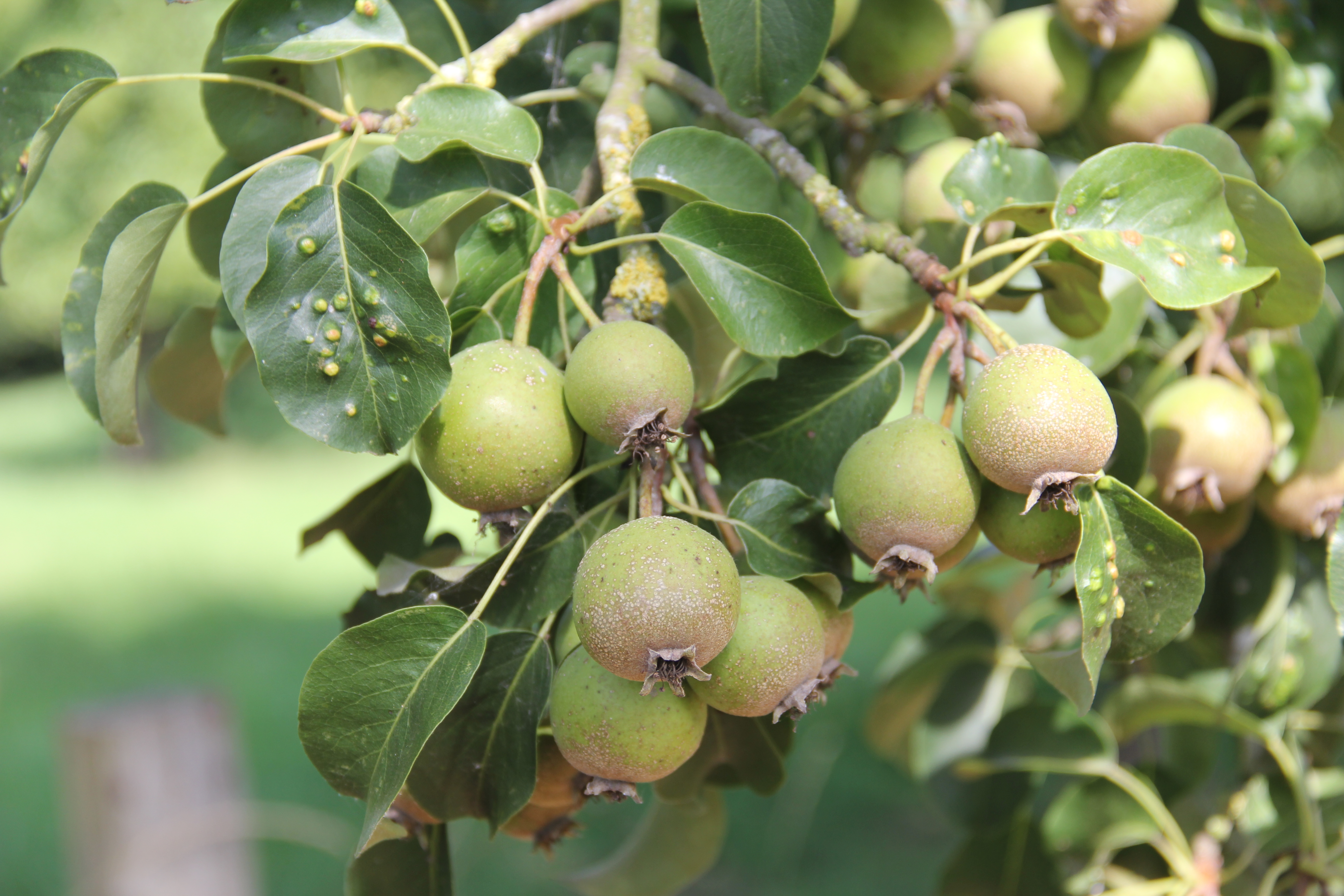
Homestead Pear.  I think Brennan used the word “vulgar” to describe the scent of this perry, and he was right.  It was a ripe old aroma.  But the taste was wonderfully delicate and just like pear.  He described the fruit as a wild, foraged pear, with very delicate, sweet fruit inside a tannic, leathery shell – a smell in like a lion and a taste out like a lamb.

Ginger Apple.  Fermented on carrots, Brennan said he made this as a table wine, something to go with Thai food and sushi.  It really was the fresh spicy fruity taste you would expect from something you got at a juice bar, but much lighter.
Lost Fruit

Sometimes you wish to curl up
Inside the skin of something lost, perhaps a grape
still hanging on the vine after the frost
where you can soak up the autumn sun
and sip its sweetness slowly past the equinox.

All the hands that missed you, all the birds,
all the wasps that flew by,
all the tiny microbes of mold and rot
did not find you all summer long…

The vines are almost bare, and wildlife retreats
into the ground, or to the south, except the winter birds,
Except the winter birds who sail the warmer tufts of air
and stare down the remnant vineyard fruits from high above.

There is always a predator, and the flesh of fruit
is hardly a good place to hide.
But for awhile at least, to hang onto the summer
is pleasure enough, to feel the drapes of falling leaves
graze against the skin as the cool wind comes slowing drifting,
winter wading, drifting in,
wading into the vineyard.

Back at the Broome

I have returned to Broome Farm for a visit about six months after my departure, and it’s almost like I never left.  So lovely to slip right back into drinking some amazing cider outside the cellar with the regulars at the end of the workday.  Folks report that, though the apple crop is not a bumper one as media reports have suggested, it is better than last year, and it is nice to see many of the apple and pear trees laden with fruit.

me in front of the Holmer Perry Tree at Broome Farm

One tree in particular, the old Holmer, is looking particularly laden with its tiny fruits.  Standing under it the other day, I asked how old it was, as it is the oldest and largest fruit tree on the farm.  Our friend John Teiser, cider maker (Springherne Cider), tree enthusiast, and orchard researcher, said it would probably date to about 1828.  I was taken aback by such accuracy of date, and John explained that it was in the decade between 1820 and 1830 that Thomas Andrew Knight, a local Herefordshire gentleman farmer who pioneered fruit breeding in the 19th century, popularized the variety of perry pear he had discovered in the vicinity of the village of Holmer, north of the city of Hereford.  According to John, many large old Holmers date back to this decade, as Knight convinced many people all over the county to plant them during that time.  Mike said he remembers several other large specimens of perry pears standing nearby when he was a boy, but they have died out long ago.  As we were admiring the majestic and craggy old tree, which has skeletal dead branches interspersed with the green boughs full of fruit, my friend Liz grimaced slightly and said it was the worst pear to pick up of all the pears in the orchard, due to its tiny size.  But one can’t help but respect such an old tree.

holmer pear
holmer pear

Meanwhile, I spent the afternoon over at Much Marcle at Westons Cider.  Somehow I had managed never to take their facility tour when I was here previously, so I decided now was the time.  The tour guide was very lovely, and she took us all round the busy facility, stopping frequently to let the Westons lorries pass by.  By far the most interesting part of the tour was the Vat room, where over 90 oak vats of huge proportions, some over 200 years old, stand holding vast quantities of cider during its aging process after fermentation.  Each of them have names, a tradition started by the founder of the company.  The vat room inspires feelings of awe and wonder, even more so than the equally massive holding tanks that loom outside over the distant Malvern Hills.

Oak Vats at Westons
Oak Vats at Westons

No, the vat room is dark, dank, and full of mysteriously huge and ancient vessels whose girth and age, not to mention their very names, seem to bestow upon them a sense of mythical and yet earthy personality.  Titans of cider – the kind of creatures that preceded gods.  You feel you have entered a temple inhabited by mischievious and montrous beings through which billions of litres of cider have flowed.

Well, after that, I needed a bit of a stroll, you know, to relax the mind.  So I drove down the lane to the Helens to visit the avenue of perry pears, trees even more ancient and craggy than the Holmer at Broome.  The avenue was planted to commemorate the coronation of Queen Anne in 1702, and some of the trees still hang on to life.  I’ve admired these trees in the past, and last fall at the Big Apple festival, which is held on the grounds of Hellens Manor, I got to taste the perry made from these pears, the Hellens Early and the Hellens Green, and it was lovely.  Somewhat sweet, with a honeysuckle nectar quality as I recall.  One vintage had a hint of woodiness as well.

More to come on further adventures in perry, cider, Broome Farm this trip.

Avenue of Perry trees at the Hellens, Much Marcle

Preamble, With Feeling

I was encountering some writer’s block as I’ve been trying to work my way into writing, and today a conversation with a colleague unlocked some words for me.  Here’s the result.

ImageOne summer afternoon in July, 2013, I was sitting on the front porch of a 19th century farmhouse in southern Indiana, watching a terrific thunderstorm roll in from the northwest.  The slate blue clouds billowed across the sky, heavy with rain, as a preamble of cool wind swooped down through the heavy hot humid air in ferocious drifts, lifting the tendrils of the grape vines that lay in orderly rows across the rolling, hilly farmland.  I had been working all morning in the vineyard, but we were dismissed after lunch as the threat of the storm wiped out any possibility of continuing outdoors through the afternoon.  So I decided to watch the storm roll in on the farmhouse porch, set myself up with some books, and determined to accomplish some academic reading in a solitude away from the internet and other distraction, cut off from the rest of the world by a sheet of rain.  It was on this porch that I found myself entering into another rich landscape through the page – a landscape I had inhabited in England, living in the deep countryside of Herefordshire, where my habitat was an orchard instead of a vineyard, and the summer was cool and rainy instead of the heat-charged and electric climate of Midwestern thunderstorm.  To be in two places at once with such intensity was jarring.  Surrounded by the vineyard which I had grown to love through sweat drenched and exhausting work among the vines, accompanied by the camaraderie of the other vineyard workers, I attempted to burrow back into my memories of the English countryside through a dense academic rendering of theoretical conceptions of the rural.  But the Indiana vineyard had a physical hold on me in the present, even as I tried to rethink and replay the Herefordshire orchard I had loved so recently.  As so many ethnographers before have done, I felt deeply torn, emotionally and intellectually, between two places: trying to think and feel one place while thinking and feeling another place.  Perhaps some are better equipped for such multi-tasking, but for me, it was difficult – I felt a subterranean friction jarring the singular unity each place held in my emotional imagination.  One intense emotional place-memory recalled in the midst of another place, composed also of senses and feelings.  How can these compositions of experience coexist, one rupturing the wholeness of the other, simultaneously heightening the intensity of both, and then their loss.  Of such feelings is nostalgia born, but this is more than just nostalgia.  It is an attempt to hold two experiences intact, but their collision creates an excess of each, a calling forth of references and relations, so that one memory cascades from another.  In the midst of a Midwestern thunderstorm, I remember the floods on the River Wye, and all my days walking next to it, and all the farms and people on its banks.

It is feeling to which I turn in this preamble because feeling will play out in the remaining parts of this work frequently, and it is this deeply-felt connection to a unity of people and place which characterized both my fieldwork experience and my own evolving sense of the ways I uniquely and personally experience my world.  The reflexive turn in ethnography has allowed us to re-examine the personal lenses and biases which colour our own attempts to construct objective scientific study, and further has also allowed us to imagine and engage in critically emergent study – research in which we come to recognize our biases and the interesting questions they present in the course of our work.  Such research rejects the simple objective positivism of deductive reasoning, where a hypothesis is generated and then tested through a pre-conceived and vetted methodology.  Positivism has its uses and its place, but emergent and reflexive research suggests a series of discoveries about the types of questions we have asked, as well as the data generated by them.  This preamble of feeling then, is a first discovery, that my reactions to places are rooted essentially in deeply emotional connections to people in their places, connections that are experienced in a present-time rich and dense in the sensual perceptions which give texture to the social relationships enacted in the landscape.

Though these are my own personal tendencies, they are also windows into particular kinds of questions about social and cultural landscapes, perhaps questions which my proclivities can give particular insight into.  As academics, too often we forget to mention not only how our personal histories, biases, and experiences influence our research, but also our personal talents. It is as if our scholarly talents are a given, separate from our personal lives, a set of intellectual exercises refined by our scholarly disciplines.  Reflexive scholarship could increase its potential to enrich academic life by helping to inform students and professors alike not only of their intellectual, cultural, and political biases, but also how their personalities and talents contribute unique approaches to the questions we consider.  This would seem self-evident, and yet methodology does not usually require us to ask how we approach and process our experiences in highly personal ways dependent not only on unique social and cultural experiences, but on temperament, talent, and character.

Image

So what is the quality of feeling and affect on our experience of places and landscapes?  The following chapters will attempt to tease out a few strands of thought relating to the causes and consequences of feelings related to the landscape.  Feeling, emotion, and affect continue to be difficult subjects to attend to in scholarly study.  David Matless, in his essay “Doing the English Village, 1945-1990: An Essay on Imaginative Geography” organizes his argument around the importance of attending to beliefs, myths, feelings, and impressions related to place:

This essay, by contrast, critically embraces the many imagined realities of the English village – its sentiments, its fantasies, its dreams, even its sugar-sweet pond ducks – as things real, powerful, political and moral; things serious and of importance in the culture of the country.  Its purpose in doing so is in part to establish a complexity in the discourse of the rural. (Matless 1994, 8-9)

Writing against what he calls the “rhetoric of reality”, Matless foregrounds the imaginary construction of the landscape, including the affective and emotional aspects of the imagination, as real entities, no less important or powerful than the realities of poverty or isolation with which some sociological studies (useful and important in their own right) have dried to debunk the myth of the rural idyll.

So I walk through the vineyard, tying up vines, pruning, shaping the growth of the place, feeling the sun, the heat, the electric thunder and the enjoying the chatter that we toss to each other across the vines like so many clusters of grapes. And loving this place, I try to conjur up an orchard in England, in the valley of the Wye, and I try to unlock the feeling, the imagination of a place where the orchard pressed out cider and laughter too, where the river floods, and a glass is never empty for long.