Our Own Midwest Wassail

I hosted a very modified wassail for about 15 of my friends here in Indiana.  No orchards, no bonfires, unfortunately, but as it was only about 15 degrees F, I think we were happy to stay inside.  But I got out the stash of cider I have been collecting and hoarding for a celebratory tasting.  I was really excited by all the questions my friends asked about cider!  It made me realize that even amongst my friends, who listen to me rattle on about it endlessly, there was a severe lack of information about cider.  It was not something they knew much about, beyond Woodchuck, Angry Orchard, and Strongbow.  We have lots of market education work to do cider community!

We did a geographical tour of Britain / France, the Northwest, the Northeast, and closed with a couple from the Midwest.  Here’s the line-up of emptied bottles:

IMG_2401

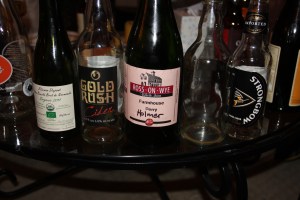
From across the pond, we started out with the commercial giant Strongbow*, moved onto the Virtue/Oliver collaboration Goldrush*, jumped the channel over to Normandy for Etienne Dupont Organic 2011*.  I then broke out a John Teiser special – a single variety Damelot cider as an example of a very tannic French variety.  Then we jumped back to England for a taste of Perry – the Holmer from Ross on Wye.  People generally really loved these ciders, with the exception of the Damelot, which was unsurprisingly palette challenging.  Special appreciation went to the Gold Rush – which surprised people with its  complex tannin, and to the Ross on Wye Holmer Perry, which was of course delightful and a new taste for most.

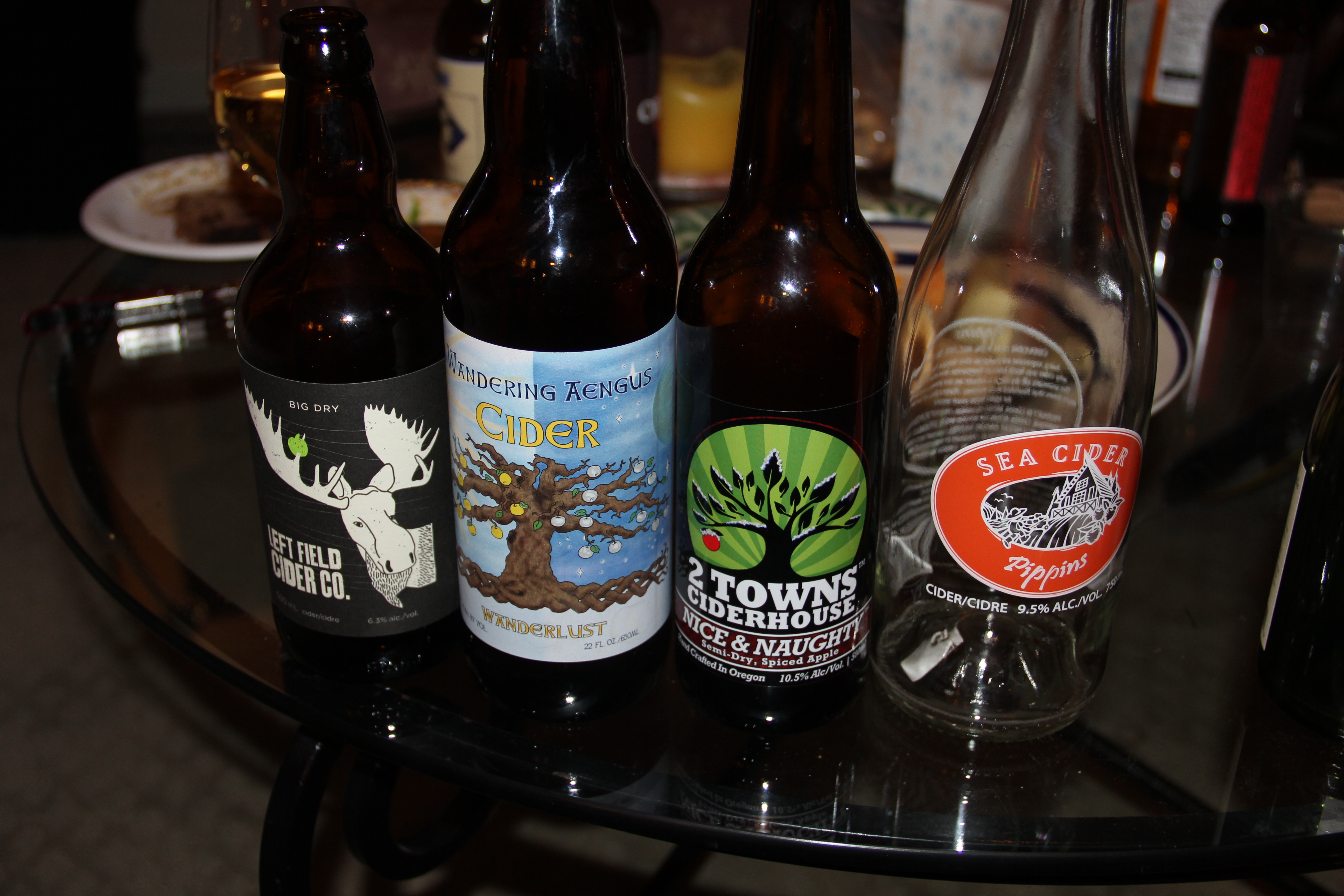
IMG_2402Next, we headed to the Northwest Coast of North America – two from British Columbia and two from Oregon.  We began with 2 Towns Ciderhouse Nice and Naughty from Oregon, which was a bit perplexing.  I think we weren’t quite sure about the spiced flavor.  Perhaps we just weren’t in the right holiday mood for it.  We then moved on to the Left Field Cider Big Dry from BC.  Some folks found the aroma a bit challenging.  I had tried the Little Dry while back in BC, and I believe I preferred that cider’s cleaner, more fruit forward taste.  We then opened the Sea Cider Pippins from BC, to which almost everyone responded with exclamations of enthusiasm.  One person said if they didn’t know it was cider, they would have assumed it was wine.  A very complex rich flavor.  Finally, the Wandering Aengus Wanderlust* from Oregon, which we found very simple and straightforward, which split the field between those who liked a more straightforward flavor and those who liked something more complex.

IMG_2398

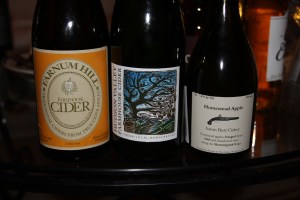
Then onto the Northeast.  We began with Farnum Hill from New Hampshire, moved onto Hudson Valley Farmhouse Cider from New York, and finished with Aaron Burr Homestead Apple from New York.  All were well liked, and my wine-distributor friend noted that they all improved with a bit of breathing.  The flavors in these three seemed to develop gradually, both with a little time in the glass and a little time on the tongue – first seeming quite simple and then unfolding on the palette.

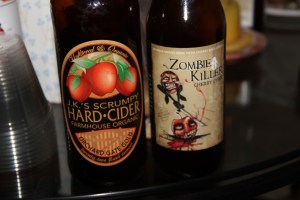
IMG_2400And then we came back to the midwest with two ciders from Michigan for a sweet finish.  First the J.K’s Scrumpy Farmhouse Organic* and then the Zombie Killer*.  Both ciders were quite sweet – and after a tasting full of dry ciders, response was mixed.  Many found these much too sweet, but the Zombie Killer – actually a Honey, Cherry Apple Cyser, was very interesting – something I can imagine sipping over ice on a hot summer day.
Thus finished our wassail!  It was a really great way to pass on the Gospel of Cider to friends and foodies in my neighborhood.  My cupboards might be a bit bare at the moment, but it was much more enjoyable to share these lovely ciders and enjoy them with other enthusiastic tasters.  Hopefully, I’ll collect some more at Cider Con 2014 next month.

*Asterix indicates ciders which were available at a retail outlet in Bloomington, IN.  All other ciders were acquired by me and lugged home in a suitcase from some travel adventure.

Wassail: An Unexpected Revival

Image
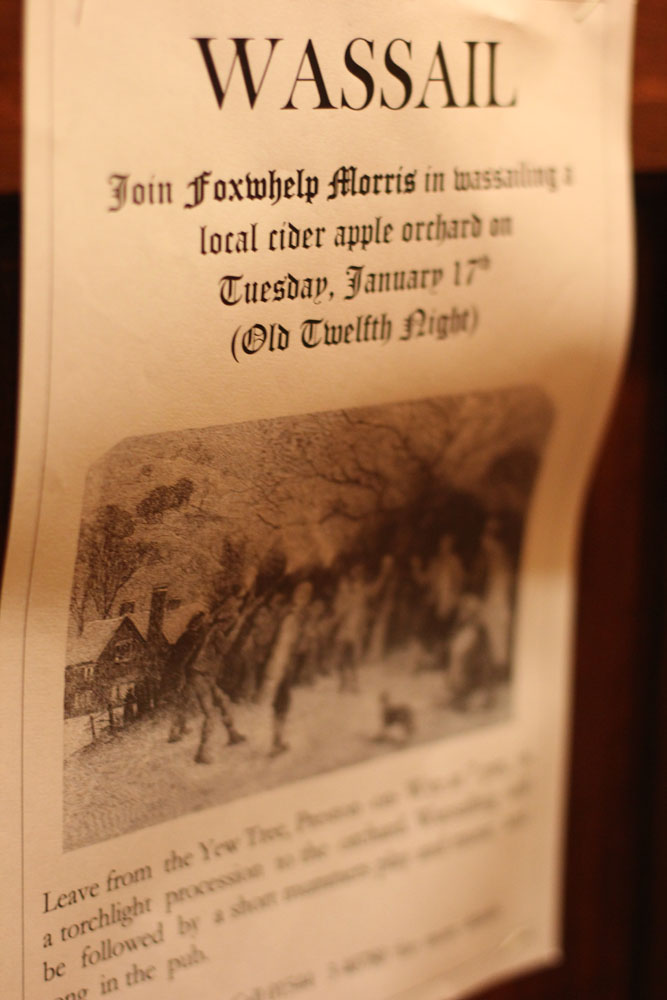
Flyer for the Foxwhelp Morris Wassail, Preston on Wye 2012

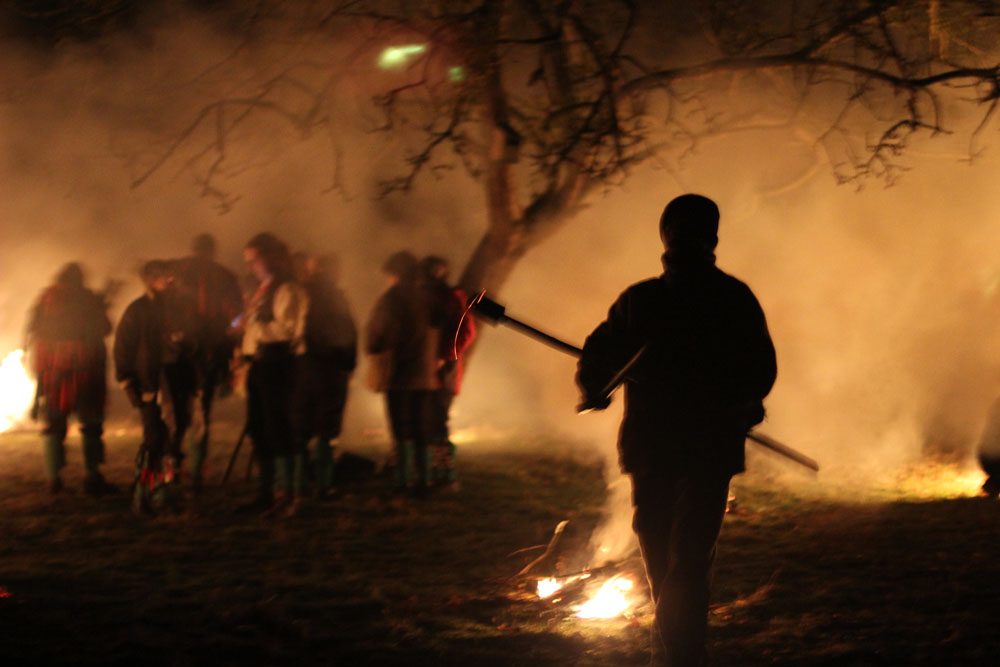
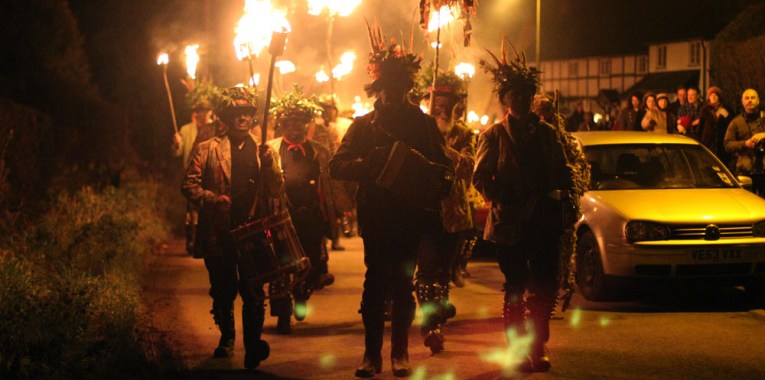
I was sitting in a pub in East Hackney, London one January night a few years ago trying to convince a young man from Portsmouth that English people did in fact practice the custom of wassail.  “Wassail?” he said.  “I’ve never heard of that.  English people don’t do that.  I don’t believe you.”  I parried his aura of certainty with my own indisputable fact: I had just travelled down to a remote corner of Devonshire to participate in a wassail.  I had seen it for myself.  We had traipsed round a village in the Blackdown Hills singing for cider and wishing good health to the farmhouse, the garage, the old vicarage, the pub, and finally the orchard itself. English people DO wassail. The young man’s incredulity about the existence of this custom is understandable, though.  With a few notable exceptions of wassail celebrations that claim to have survived unbroken into the present, such as the one at Carhampton, Somerset, the custom seems to have died out or disappeared most everywhere else, surviving only as a festive Christmas drink or an obsolete word in a carol.  In the past few years, however, a notable revival has been rising, and as several of my friends in England put it, everyone seems to want to have a wassail now. So why did wassailing die out in England, and why is it being revived now?  These were some of the questions I set out to answer when I first trekked out to torchlit winter processions on the twelfth night of Christmas in Devon, and later Somerset, Gloucestershire, Herefordshire, Shropshire, and Worcestershire. Many people think of Wassail as a remnant pagan custom, and it is easy to see why, when black-faced Morris men lead hordes of otherwise tame urbanites carrying torches through old orchards to sing to the apple trees and scare off witches with gunfire.  It’s an enthusiastic performance of what some might think of as a primitive, superstitious approach to life, which might seem refreshing after the daily grind of rational civility. Being outside after the endless indoor Christmas parties feels like a release, and the bonfires and torches light up the night in a way that wakes your tired soul from the dreary sleep of midwinter. And the cider, well the cider just makes you feel sublime, a bit euphoric.  The torches seem brighter.  The night seems blacker.  And it feels like anything is possible inside the circle of trees that almost seem alive.

Image
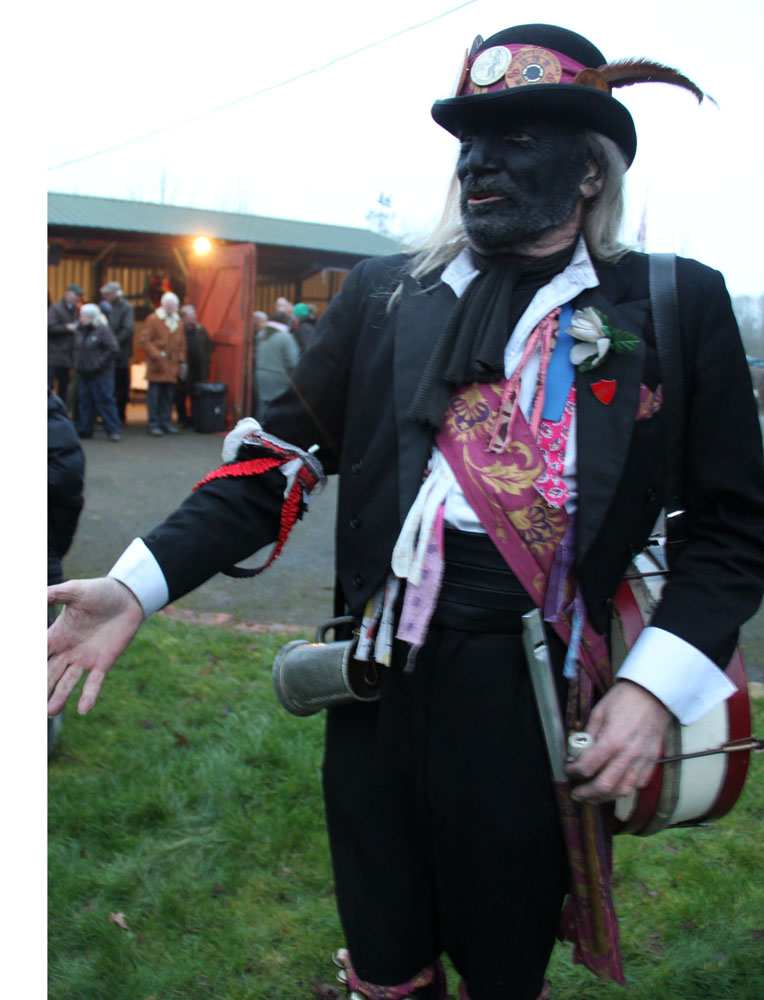
Morris Man from Silurian Morris at the Tenbury Wassail 2013

I think the custom’s visceral tactile appeal stems from the sensory stimulation of frost and fire and the imaginative tunnel of superstition usually silenced in a society based on scientific rationality.  It’s an opportunity to get out and be a little wild for a night, and that’s what rituals and festivals are often good for, shaking up our everyday habits and injecting the mundane world with mystery and significance we don’t usually feel. Some of the people I came to know who had helped revive wassail over the last twenty years had a much less superstitious orientation to the custom, though, and their perspectives shed light on some of the social realities of rural agricultural life and highlight the enormous social changes it has undergone in the past century.  Wassail, a custom historically based in rural society and food production, has something to teach us about the changing ways we work with each other, as well as the ways we interact with natural and agricultural resources. For Eric Freeman, a life-long farmer in the rural countryside of Gloucestershire, and his friends Pete Symonds, a former electrician from the Forest of Dean, and Albert Rixen, a plumber and engineer, wassail was a tribute to the work of the agricultural year and an emblem of the social contract between farmers and their agricultural workers. Pete Symonds is a skilled tradesman in a rural community whose livelihood suffered with the outsourcing of industrial work overseas.  He saw in wassail the opportunity to celebrate the social bonds of working men and commemorate the cooperative nature of agricultural labor in an era before industrialization. Albert Rixen, devoted to restoring old steam engines, including antique steam powered cider equipment, also lends his workman’s approach to wassail and cider making, keeping alive the mechanical heritage of agricultural work.  Eric Freeman, a tireless supporter of agriculturally-oriented social networks such as the Young Farmers and groups devoted to saving rare breeds of livestock, has dedicated much of his life to the practice of farming not just as a business or even a personal vocation, but a way of life still full of social and cultural richness.

Image
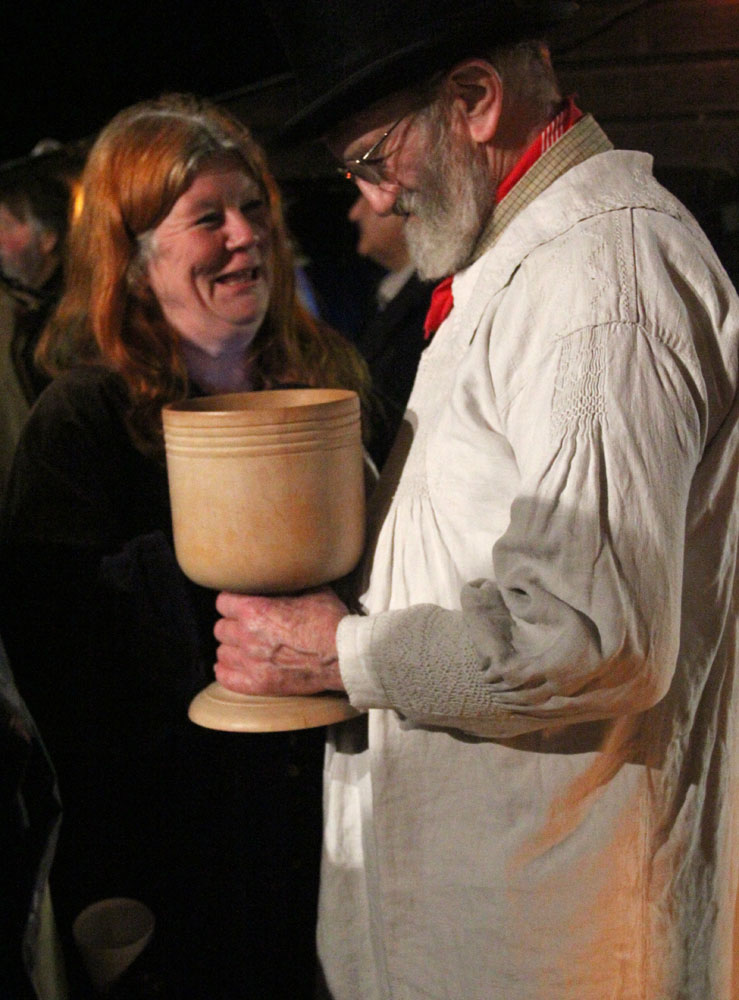
Eric Freeman holding the Wassail Cup at his annual Wassail in Huntley, Gloucestershire

For these men, the resurrection of the custom of wassail was not about superstition at all.  The considerable labor involved in preparing the bonfires and torches and orchestrating the festival mirrored the kind of labor they wanted to celebrate – shared labor, social labor, the kind of labor that was necessary to keep a pre-industrial farm going.  This is the kind of labor that makes work worthwhile, and which seems to be slipping away in a world of global markets, where labor is outsourced, rural communities are left slowly crumbling, and agriculture produces commodities instead of food. It’s also important to remember that the social contract didn’t always work, that standards of living for agricultural workers in the pre-industrial era were generally dire.  But wassail was a moment when the contract was tested, when the workers held the orchard and the farm hostage for a night, demanding food and drink from their employers in return for performing the wassail and ensuring a fertile crop in the year to come.  Superstition becomes bare social reality here, because without a satisfied workforce, the farm could not be productive.  Without workers, there would be no harvest, no fertility.  Wassail was a kind of symbolic labor negotiation, with the potential harvest hanging in the balance.  And the next Monday after twelfth night, known as Plough Monday, work started again.  The fields were ploughed for the coming year.

Image
Leominster Morris Wassail in Eardisley, Herefordshire 2013

It all seems a bit serious for a rowdy evening of cider drinking, morris dancing, and bonfire lighting.  And don’t get me wrong, sometimes one of the most obvious reasons to join in a wassail is simply for a good prank, a good drink, and an excuse to dress up in funny costumes and indulge in a little pyromania.  But the interplay of superstition, social history, and a walloping good time is what makes wassail a tradition with depth and complexity that can appeal to people on many levels, even as they face adapting to economic, social, and environmental change in their communities.

Can wassail take hold in North America?  A real, strong tradition here will depend on our own social needs and reasons for adopting a custom.  It will be exciting to see how it takes shape as we begin to re-invest attention in our agriculture, our orchards, and our cider.  In a way, the social contract we are now re-exploring with our food system, our environment, and our economies makes wassail all the more relevant, and the tables have turned.  Wassail, in all its irreverent topsy turvy midwinter glory, reminds us that agriculture and food production, even in our industrialized, exploitative, globalized era is still a social, and an environmental contract.  In an old-fashioned way, it poses the question “Are we in it together folks?”  And its pretty exciting to hear folks replying: “Here’s to thee old apple tree.”

Image
Orchard near Preston on Wye, Herefordshire, Foxwhelp Morris Wassail 2012

Wassail: Some Historical Reports and their Contexts

5710196-MHave you been dying for some historical sources for the custom of wassail?  Come on, I know you have.  Lucky for you I am the folklorist with the super folklore library collection a mere 30 minute walk from my doorstep.  So I made my way over to the stacks at the Wells Library at Indiana University to forage for some old folklore collections that document Wassail (and then I found some handy online google books versions to share with you!)  Some of the questions a folklorist asks when researching a custom like wassail are:

  • Where was this custom previously documented?
  • Why did people want to document it in the first place?
  • What does this tell us about the meaning of the custom?

So, a little history here: the study of folklore emerged at a time when the rationalism of the Renaissance and Enlightenment eras (roughly the late 1500s-1800s) created a class of educated men who, infused with the new scientific method, began to wonder why many of their fellow countrymen still believed in or practiced ‘superstitious’ customs.  Early on, this study was called Popular Antiquities, and some of the scholars engaged in collecting and documenting these customs were Protestant clerics, clergymen who were particularly unsettled by the continuation of superstitious beliefs and practices of Roman Catholicism.  They concluded that many of these beliefs and practices weren’t grounded in biblical texts at all (and therefore, not properly Christian), but leftover pagan customs that had been adopted into the Catholic Church.  Sometimes their aim was to discover the origins of these pagan customs in order to root them out.  It is interesting today that many of our modern popular interpretations of folklore customs still hinge on an explanation of their pagan origins, even though the original impetus of Protestant reform has long since disappeared. (For some other ways to interpret wassail other than pagan fertility ritual, stay tuned for my next post)

What does this mean?  Knowing this goes a little way to understanding the perspective of those who documented wassail in the early days of folklore and popular antiquities study.  It answers some of questions 1 and 2 above.

So what does this tell us about wassail, and what it meant to those who documented it?  It means we should always be a little wary of taking their descriptions at face value.  Is wassail actually a relic of a pagan fertility custom?  Or is that what the observers in the Enlightenment wanted it to be, due to their own biases of class, religion, and education?  Further, could their informants – the regular folks telling them about the customs – be yanking their chains or manipulating the information given to these early scholars for any reason? It is impossible to know anything for certain, but by reading between the lines, we can make more nuanced interpretations about the place of this custom in history.  History is not a case of fact and fiction, but of documents and interpretations of the content and creation of those documents.

Here is one selection from John Aubrey’s early collection of popular customs Remaines of Gentilisme and Judaisme written between 1687 and 1689.

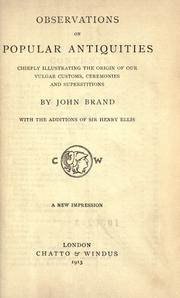
Writing slightly later, the antiquarian John Brand, one of the rationalist Protestant clerics, documented these wassail customs in his book Observations on Popular Antiquities: Chiefly Illustrating the Origin of Our Vulgar Customs, Ceremonies, and Superstitions, which was first written in 1777 enlarged and edited by Sir Henry Ellis in 1813.There’s lots more in the library, and you can wend your way around Google Books for many of the older texts.  For more information about the early Antiquarian folklorists in England, check out The British Folklorists: A History by Richard Dorson.

Wassail story from Radio Program: Living on Earth

We’re right smack in the middle of wassail season.  Twelfth Night (Jan 5) passed last week.  And Old Twelfth Night (Jan 17) comes this Friday.  I’m a bit behind on posts due to moving into a new house, but I will be posting a series of stories about wassail, including links to some guest posts I’ve been working on elsewhere on the web.  First up, I wanted to post a link to a wassail story I heard on the radio program Living on Earth, a weekly environmental news program that airs on my public radio station, and which I listen to fairly regularly and highly recommend.  I was excited to hear something about wassail, and  I’m happy to re-post it here.  Though I must say I’m not a fan of the accent the American storyteller attempts, and her interpretation of wassail is rather different than my own.  But all in all, how great to see wassail out and about in the American media in various interpretations!  The Wassail story, starts at 08:30 on the segment Stories of the Night Sky and an English Wassail (not the full show) and is preceded by another lovely Native American tale.  The whole broadcast is well worth listening to, especially if you are snowed in as I was last weekend.  Enjoy!

December on The Somerset Levels

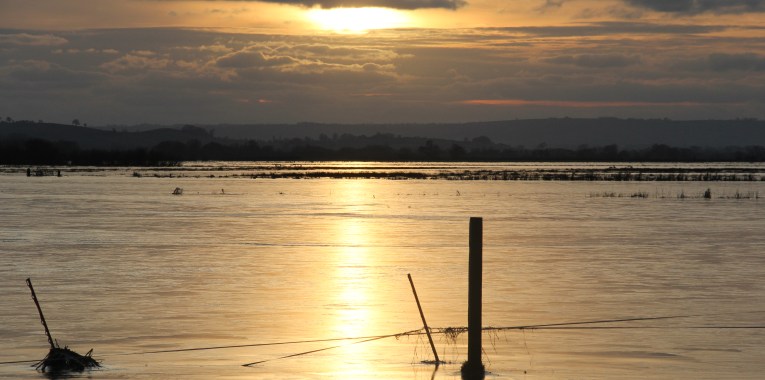
It’s November, and we’ve had our first snow here in Indiana.  After the immersive and intensive dive into NY Cider Week, it’s been nice let my mind drift back to England as I spend time transcribing more interviews.  Somehow, I can’t seem to get the Somerset Levels out of my mind.  Maybe it’s the slant of light on the horizon that triggers the memory, or the temperature, dipping into the freezing temperatures.  It was about a year ago come December that I was visiting there, doing some interviews in the midst of a phenomenal flood. It’s a landscape famous for its orchards and its cider, but one I’ve only visited, not lived in.  This post is not about orchards and cider directly, but about a delicate landscape where they are part of a complex ecological and agricultural heritage.

I’ve been reading over Life on the Levels: Voices from a Working World, a collection of interviews with people whose lives are intimately connected to the unique landscape of the Levels, illustrated with elegant black and white photographs.  There is something about this particular landscape that I find personally extremely compelling, slightly mysterious.  The low-lying moors have been drained over the centuries, but the water still reigns here.  It is one of my favorite places to meander around the lanes, always slightly lost in the winding turns that take you around the moors, stumbling upon the high pieces of ground that have been prized spots for thousands of years, like the almost imperceptible hill on which stand the ruins of Muchelney Abbey, where the monks must have been really glad of dry land. Or the Glastonbury Tor, or the Burrow Mump, whose slopes are surrounded by the standard orchards of Burrow Hill Cider.  The apples, like the people, tend to cling to the high ground to keep their feet dry.

One interview in Life on the Levels, with RSPB Warden of West Sedgemoor John Humphrey in 1981, explores the myriad issues surrounding the relationship of ecological conservation and agriculture in the landscape with impressive breadth, opening with this quote:

“The progressive agriculturalist would see a traditional meadow here as really not being worth farming and would want to under-drain it, dry it out, plough it up and re-seed it….West Sedgemorr is a great mass of waterlogged peat which is…about fifteen feet deep.  And you’re supported by a skin of vegetation – that’s all that’s stopping you from sinking into this morass…”

This seems to be one of those delicate places where the environment pushes back relatively quickly – lets you know when you’ve pushed the boundaries of ecological manipulation too far, which is perhaps what gives it that sense of self-contained power and responsiveness.

This slideshow requires JavaScript.

When I was driving there last December, it was with some trepidation, as just days and weeks before, local people had been marooned in their houses, the roads impassible to all but tractors in the midst of the flood.  When I came, the waters had receded enough that the main roads were passable, but many of the fields were still covered with water.  Or rather, they were covered with ice, as the weather had turned cold and turned sections of the moors into sheets of glass.  Birds flocked to the open places in the ice, and it was hard not to be awed by the quiet beauty of the mauve twilight settling gently over these great reflecting watery moors chilled to a frost -covered stillness.  Though one could not forget also the agricultural and personal loss from these same floods.  Here are some articles detailing the damage from the Guardian and the Somerset County Gazette.

I spied some orchards by the side of the road encased in the ice, their trunks sealed in.  I stopped by Burrow Hill Cider just to climb to the top of the hill and look out over the vast icy lake that had formed in the moors below.  Landscapes like this provoke us to consider how agricultural heritage has helped shape the landscape, but also forces us to face the limits of human change.  Further into the book, another interview with details how aggressive drainage practices designed to promote arable agriculture can permanently affect the balance of the peat, cause the land the sink, and further exacerbate the flooding problem.

Rhode Island: Vanishing Orchards Film

At the 2013 American Folklore Society annual conference held in Providence, Rhode Island two weeks ago, there was, miraculously, a session on Rhode Island orchard traditions.  Ann Hoog from the American Folklife Center at the Library of Congress was on hand to talk about some of the archival material.  Michael E Bell, retired from the Rhode Island Historical Preservation and Heritage Commission discussed the field research contributing to the film.  Alex Caserta, the producer, was also present to talk about the making of the film.

Here’s the abstract from the program:

Vanishing Orchards and the Rhode Island Folklife Project.  From July to December 1979, the American Folklife Center, in cooperation with several Rhode Island cultural agencies, conducted a field research project in Rhode Island concentrating on various ethnic, regional, and occupational traditions.  The resulting documentation includes audio interviews and photographs of the Steere family, owners and operators of a fruit orchard in Greenville, Rhode Island since 1930.  That orchard is featured in the new documentary film Vanishing Orchards: Apple Growing in Rhode Island.  This session includes an overview of the 1979 project followed by a showing of the film.  After the film, discussants will address the subject of family farms, agriculture, and changing neighborhoods; documentation of this changing landscape through fieldwork and archives; and the genesis of this documentation coming out of the collaboration of multiple Rhode Island cultural agencies.

The film was shown on Rhode Island PBS.  Unfortunately, I have not yet been able to find a full version of the film online.  However, there is a promo for the film available here: on the  website for the film project.  The film itself was full of interviews with Rhode Island orchardists discussing the challenges and opportunities facing orchards in the Ocean State as pressures on land from development make the economics and pragmatics of farming close to urban and suburban areas challenging.  The loss of orchards is definitely a theme – many people interviewed recall orchards no longer present on the landscape.  But the resilience and innovation of those who are continuing on is also impressive.  Two orchardists featured in the film joined the panel and fielded questions from the audience.  Surprisingly, hard cider did not seem to be an economic project for those present, nor did it feature in the traditions documented in the film.  It would be interesting to dig more into the archival information to find out if there is anything there.

Cider enthusiasts and researchers, be aware of the opportunity to seek out the collections of the American Folklife Center at the Library of Congress as a resource for information on orcharding and cider traditions.

New York Orchard and Cidery Car Trip

I got on the train back upstate and felt a wave of relief.  New York City is exciting but hard work.  I don’t know how you all do it down there in the City, day in and day out?  I picked up my car from my cousin’s house and took a meandering, semi-accidental tour of some of the orchards in the Hudson Valley / Catskills area.   Photos above are from my first stop at Dressel Orchard and Kettleborough Cider House, near New Paltz.

From there I proceeded towards the Gunks, passing another roadside orchard and some stunning views of pumpkin fields beneath the Gunks:

I then drove up to Stone Ridge Orchard and met up with a friend.  Pete, the guy manning the shop was really friendly and said he had been coming here for years before he started working there.  This orchard is operated by Elizabeth Ryan, maker of Hudson Valley Farmhouse Cider.  Check out also the Friends of Stone Ridge Orchard page. This orchard was really interesting, with lots of different varieties of fruit and styles of pruning in evidence.

Finally, I drove out to visit some cousins in the Catskills, where I went to photograph the old North Branch Cidery in western Sullivan County.  I spent several summers working at WJFF Catskill Community Radio and hoeing weeds at Gorzynski’s Organic Farm, and I passed by this place many times.  My cousins remember when it was still operating, but is has been years now since it closed.  You can see a few apple trees on the property beyond the rusting truck and the buildings.  Andy Brennan posted this in a comment to another post on the blog:

Hey Maria, I don’t know much about the North Branch cidery either except everyone in the county tells me they used to bring their apples there to press. It was an old German guy who everyone loved and he had hard cider too, but I don’t think he legally sold it. I believe the ecoli scare and pasteurization laws forced the shut down about 12 years ago. Someone was working on the building not long ago but it still looks abandoned. -Andy

And after that, I headed home to Indiana.  I did actually follow the address to Eve’s Cidery in Van Etten, NY as I drove along the southern tier past the Finger Lakes region.  I drove by a large barn several times, but there was no sign, it looked like they weren’t set up for visitors, and I still had 400 miles to drive that day.  So I went on my way without stopping.  Someone waved at me though, after I drove by for the 4th time.  Probably they were wondering if the weirdo in the yellow VW beetle was lost, which is kind of true.  I mean, who drives to obscure orchards in search of cider?  I guess that’s me!

NY Cider Week: Food Systems Network NYC, New York Apples and the Growing Hard Cider Industry

This Food Systems Network NYC event was co-Hosted by Glynwood, Slow Food NYC, and 61 Local. The event brought together Sara Grady from Glynwood and three orchardists and cider makers from the Hudson Valley region.

IMG_2135 IMG_2139IMG_2149

After a video presentation introducing the recent partnership and exchange between Hudson Valley cider producers and cider producers in Normandy, France through Glynwood’s Apple Project, Sara Grady moderated the panel, asking the panelists questions to illuminate some of the issues around Hudson Valley Orchards and cider production.  This summary is paraphrased from notes.  Corrections always welcome:

Q: How does hard cider production allow us to increase the viability of apple production in NY

E Ryan: Cider is the joy, the soul, and the essence of the apple.  Financially, cider production allows us to use fruit not pretty enough for market, to diversify and add value.  It is also a low/no-spray agricultural option with low input systems and the possibility of integrating animals.

D Wilson: We have the oldest pick your own orchard in the state operating for 108 years, a long history of relationship with the public.  80% of our annual income comes in a six week period with pick-your-own, and if the weather doesn’t cooperate – if it rains on the weekend and people don’t come out, we can be hurt.  Hard cider gives us something to broaden our base – more flexible and sustainable.

Q: What has been the impact of cider week for you?

E Ryan: We started making artisan cider in 1996.  I went to England and spent time with cider makers there.  At the marketing level – people didn’t know what to do with it.  The difference between then and now is amazing.  Restaurants who didn’t know what to do with it 10 years ago are seeking us out.  I just borrowed 1 million dollars to buy the farm I have been renting, so that tells you I have some confidence in the market.  During our visit to France, we saw the future there – an air of prosperity we want to build in the Hudson Valley.

D Wilson: Cider allows us to attract a different market than the family pick-your-own.  Cider week has allowed us to develop a relationship with a distributor.  Cider is becoming a much more substantial part of our overall business.  Production has tripled in the past few years.  It is a value-added thing for fruit you already have.  Now as the industry matures, we are planting specifically for cider purposes.

T Dressel: My family is a 4th generation apple growing family.  My grandfather is still working.  It’s been a change for him to take out his trees to plant trees for cider, apples he can’t put on a road side stand.  I came back from school hoping to open a winery and planted 4 acres of grape vines.  While they were growing I made some terrible ciders.  During that time things really started moving with the cider industry.  In 2009 the Cornell extension called me up and said they had a collection of cider trees that were going to be grubbed up and if I wanted them I had to come up right away to pick them up.  So I got some friends together with a truck, dug them up, and put them in the ground.  We have 60 trees, 10 European cider varieties.  That’s how I started growing cider apples.  It’s hard to get nursery trees for cider, few people carry them and you have to wait 5-8 years for them to be ready.  It is easier to top graft onto existing trees.  I have another half acre of American heirloom apple varieties as well.

Q: Could you talk a little more about cider varieties?

E Ryan: In Europe, cider makers grow hundreds of varieties for cider.  Makers in the town we visited in Normandy had catalogued 600 varieties.  We have a huge tradition ourselves of heirloom varieties grown here.  Some of the older orchards had Norther Spy, Golden Russet, etc, varieties people don’t know in Europe.  I am drawing mostly on these American varieties.

D Wilson: I am liking some of the ciders we are making from old Russet varieties – the Golden Russet and the Ashmeads Kernal, as well as English Bittersweets like Dabinette and Chisel Jersey, along with some crab apples.  Eating varieties have more sweetness and adicity to them.  Cider varieties add to the whole palette – different qualities of acid, bitterness, and astringency.  A really good cider rarely comes from a single apple variety.  To develop a balanced cider requires blending.

Q: Tell us about your experiences in La Perche, Normandy.  What did you bring back?

E Ryan: Cider is completely embedded in Norman culture, with their cider washed cheese and calvados.  They have achieved terroir.  We learned a lot of techniques, which you end up trying to re-interpret here with the kinds of varieties we have access to here.  I was most impressed with the cider culture and what the Hudson Valley could be.

T Dressel: For me it was the cultural experience.  As a commercial apple grower compliant with NY State laws and regulations, so much of what I saw there will never happen here: such as harvesting apples off the ground.  It set a goal for me that I wanted to be able to achieve – I wasn’t making cider yet at that time.  I was impressed with how different their craft cider is than ours, and that the tastes – more earthy and funky – they enjoy over there might not be transferable to an audience in the states.  One French cider maker asked me – “what is this word, funk? People keep telling me my ciders are funky?” I think education is first, so many people don’t understand what cider is.  My biggest emphasis is telling everyone everything I can to expand people’s horizons.

D Wilson: I was impressed by the value the French put on food – how food reflects an area.  Slow food, terroir, sense of place.  I came back with a sense of how the food they produce is a national treasure.  And the apples grown in that area are just for cider, not for eating.  Their techniques are extremely simple and yet sophisticated at the same time.  We could also become a culture that consumes cider as a common drink.

Q: Tell us how cider growing is a more low-input operation for ecological apple growing?  Most people here understand that organic production for apples is very difficult in the Northeast.

T Dressel: The system of grazing animals and harvesting apples off the ground, together with insects and rotten fruit might add to the funk of French cider!   We are not spraying nearly as much as we used to.  We use an integrated pest management system and are not organic.  Copper (used in organic apple production) is an organic substance but is not sustainable.  Up till now we had been using culled fruit from our eating apples.  But now, with blocks set aside for cider apples, we can spray less since it isn’t going to the fresh market and the appearance of the apple doesn’t matter as much.

D Wilson: An Apple orchard is a monoculture, perennial environment, making organic methods that work for other vegetable crops difficult.  Problems from pests range from cosmetic issues to tree death, and these things can effect trees in combination.  The focus of pest control is greatest between the blossom period till fruit is the size of a marble.  Growing fruit without the need to address cosmetic problems allows us to reduce spray.

T Dressel: We are now dealing with questions about how cider trees will be managed differently than eating apple orchards.  What tree density? What shape will we prune the trees?  Our value will shift to volume of apples rather than perfect big apples.  Fresh market apple trees are pruned very heavily.  When we started to grow cider varieties, father and gradfather’s pruning knowledge was not helpful.  I have talked to friends in Western New York who grow apples for the processing market about tree management.  I have had to relearn how to prune trees for cider

Q: Blending?  How much are decisions made based on tasting and how much on measuring tannin and acidity?

A: (conversation moved to fast for me to note who was saying what – this is a summary of answers from all participants)

  • We experimented by making single variety batches of every apple we grew – fermentation makes a difference in taste
  • In Europe, I sometimes saw people making very intuitive traditional decisions – one shovelfull of bittersharps, two shovels full of bittersweets
  • In England, I saw people doing a full crush of what was being harvested that week – mix of bittersweets and bittersharps.  Further blending of the juice happened later.
  • You need enough acid in a fermentation to make it keep

Q: Is there a long term interest in developing uniquely American varietals for cider, rather than depending on European ones?

D Wilson:  There are some great traditional American ciders.  My fantasy is that there might be a wild tree out there that has some great qualities we don’t know yet. (from audience – That’s what Andy Brennan is doing with Aaron Burr Cider).  I mentioned to a friend of mine at the big breeding program in Geneva that we might need some new cider varieties, and she said there were some discards from the eating apple breeding program that could be good cider varieties. We want to find out what our customers will enjoy.  The intense high acid of Spanish ciders or the funk of French ciders might now go down well here.  We need to find out what the American taste is.