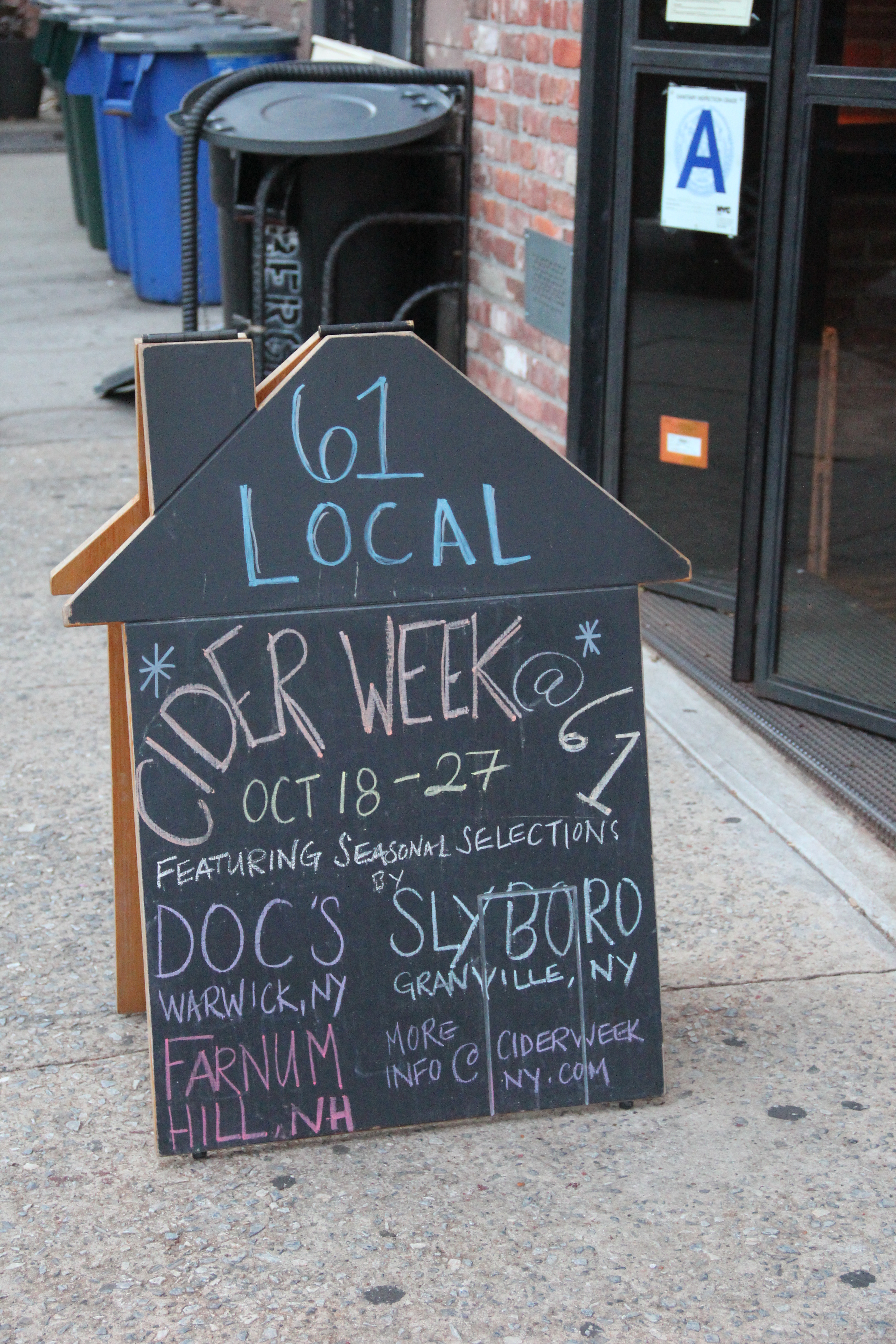
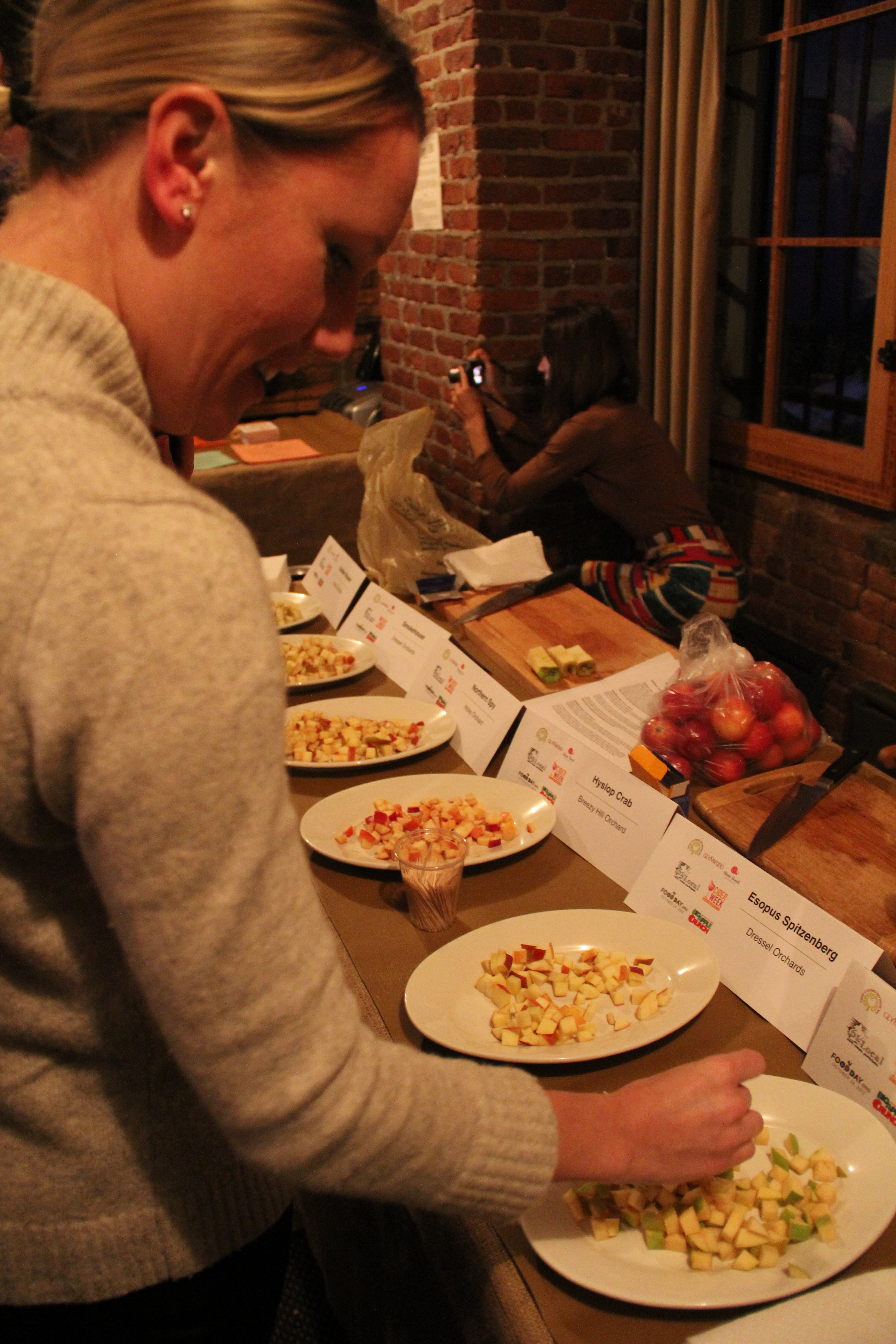
After our invigorating and intellectually stimulating tipple at Proletariat with Aaron Burr Cider, Challey and I proceeded on our way to the Northern Spy Cider Dinner. I will spare you descriptions and simply post the link to the menu paired with ciders from Eve’s Cidery, Farnum Hill, and Eden Ice Cider. I think we had quite animated conversations about New York and food culture, facilitated by the generous and samplings just prior. And the food was superb. I wish I could afford to eat and drink like this all the time.
Author: teapottipper
Cider Foragers
Foraging Follow-up to the post about Aaron Burr Ciders: As I was driving up NY 97 along the Delaware River, I noticed quite a lot of roadside apple trees laden with fruit just north of Hankins and south of Hancock. I’m betting, due to their road-side locations, that they are the progeny of apple cores thrown out the car window. Delaware valley scrumpers, get to it!
NY Cider Week: Meet the Cider Maker – Aaron Burr Cider’s Andy Brennan @ Proletariat
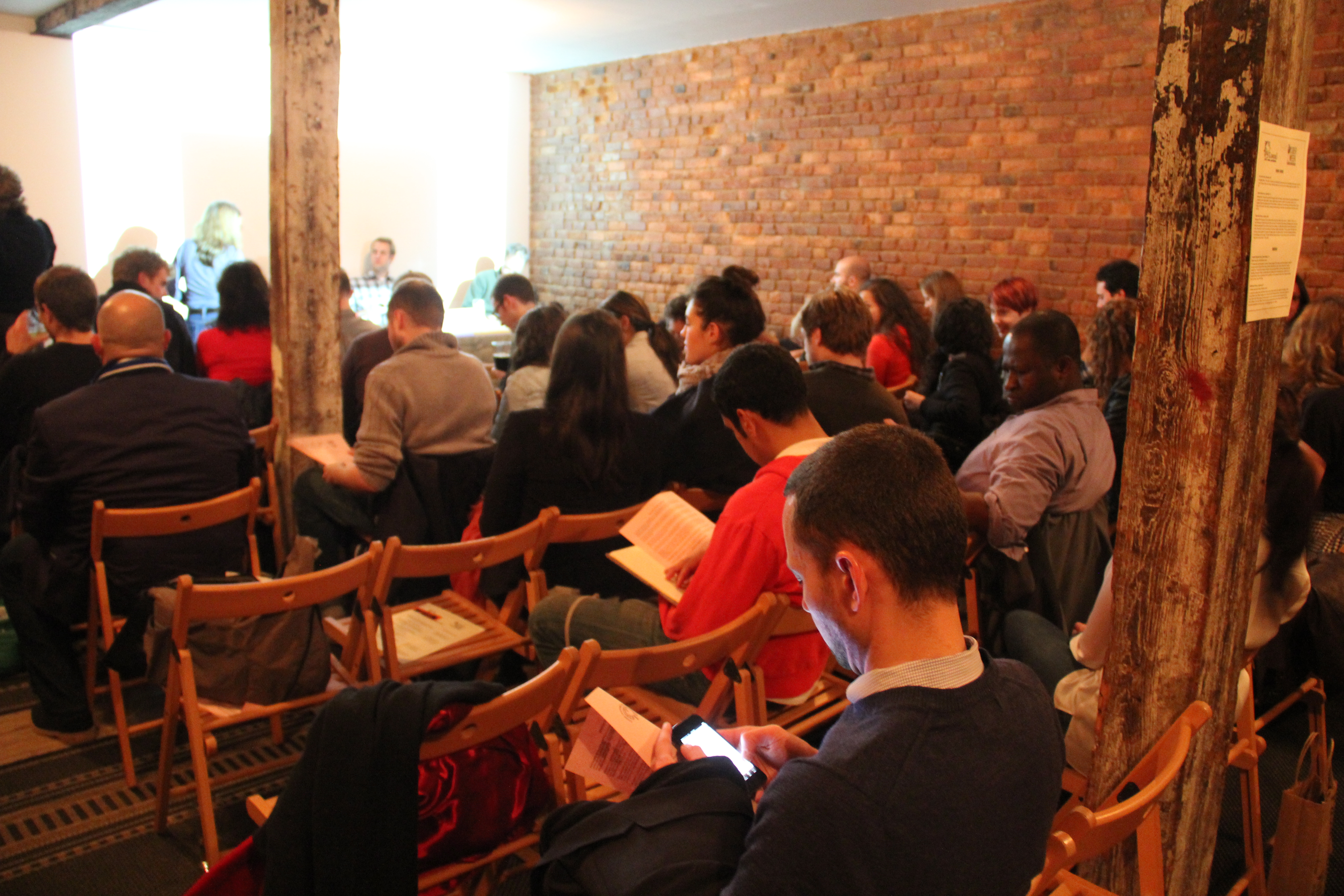
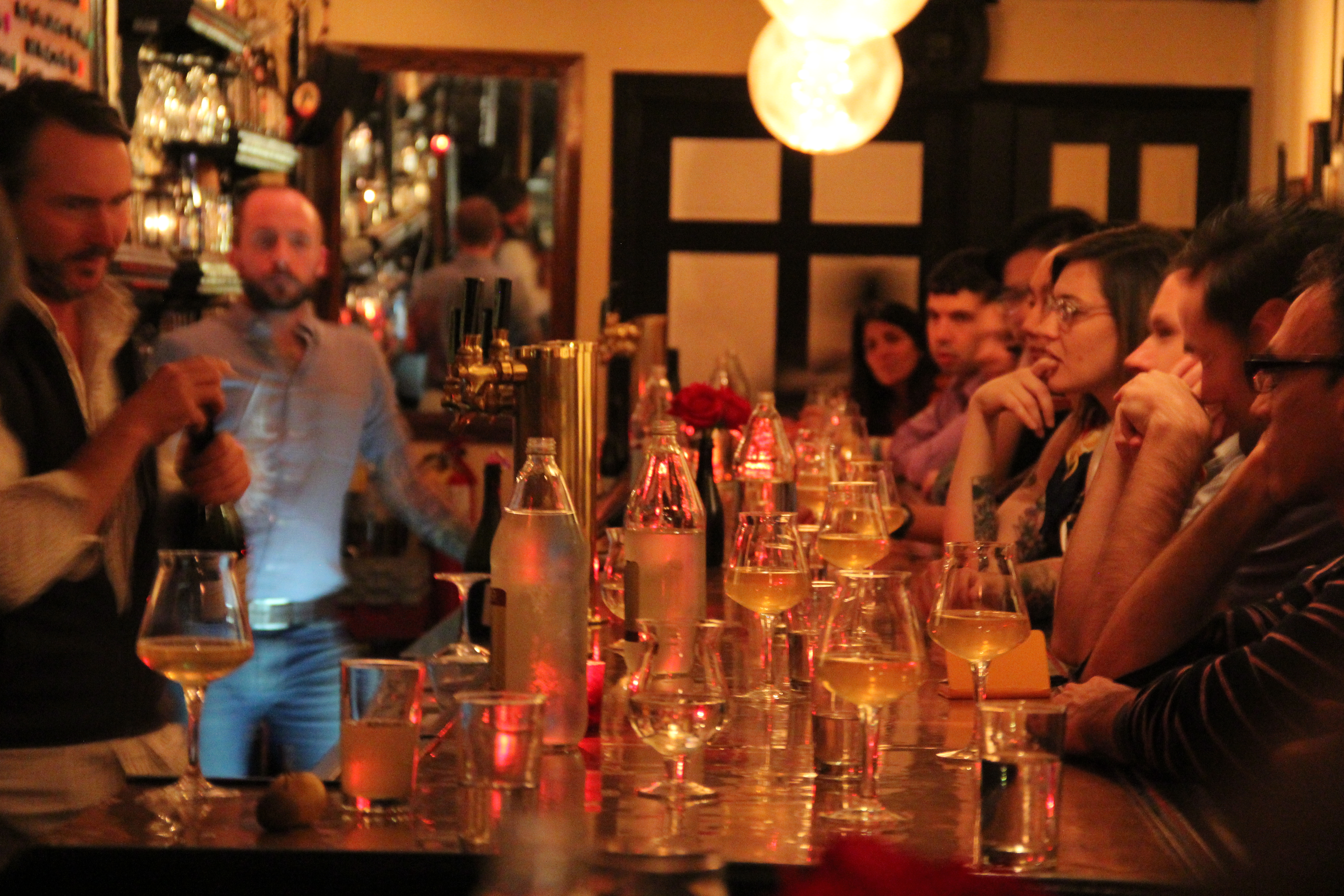
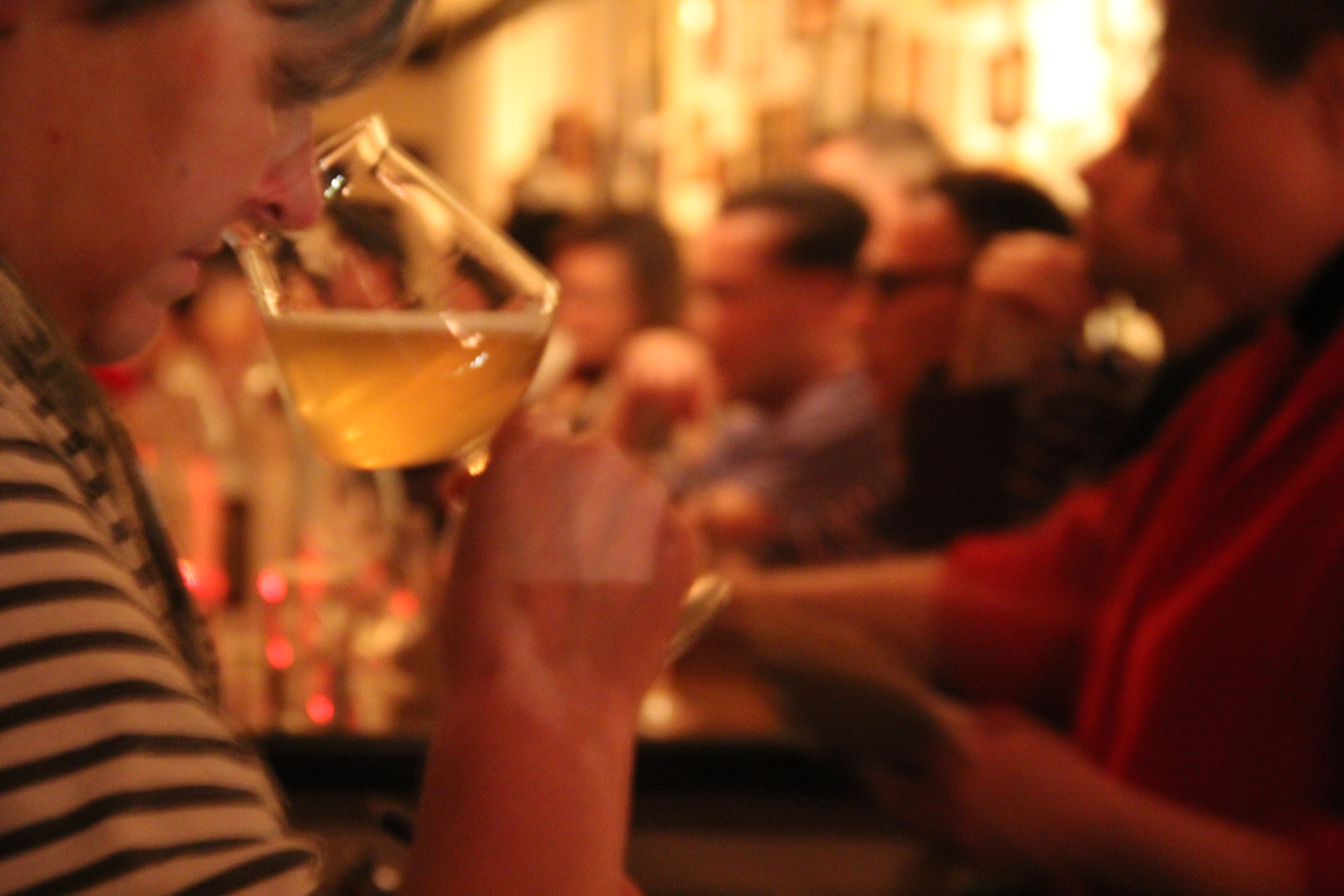
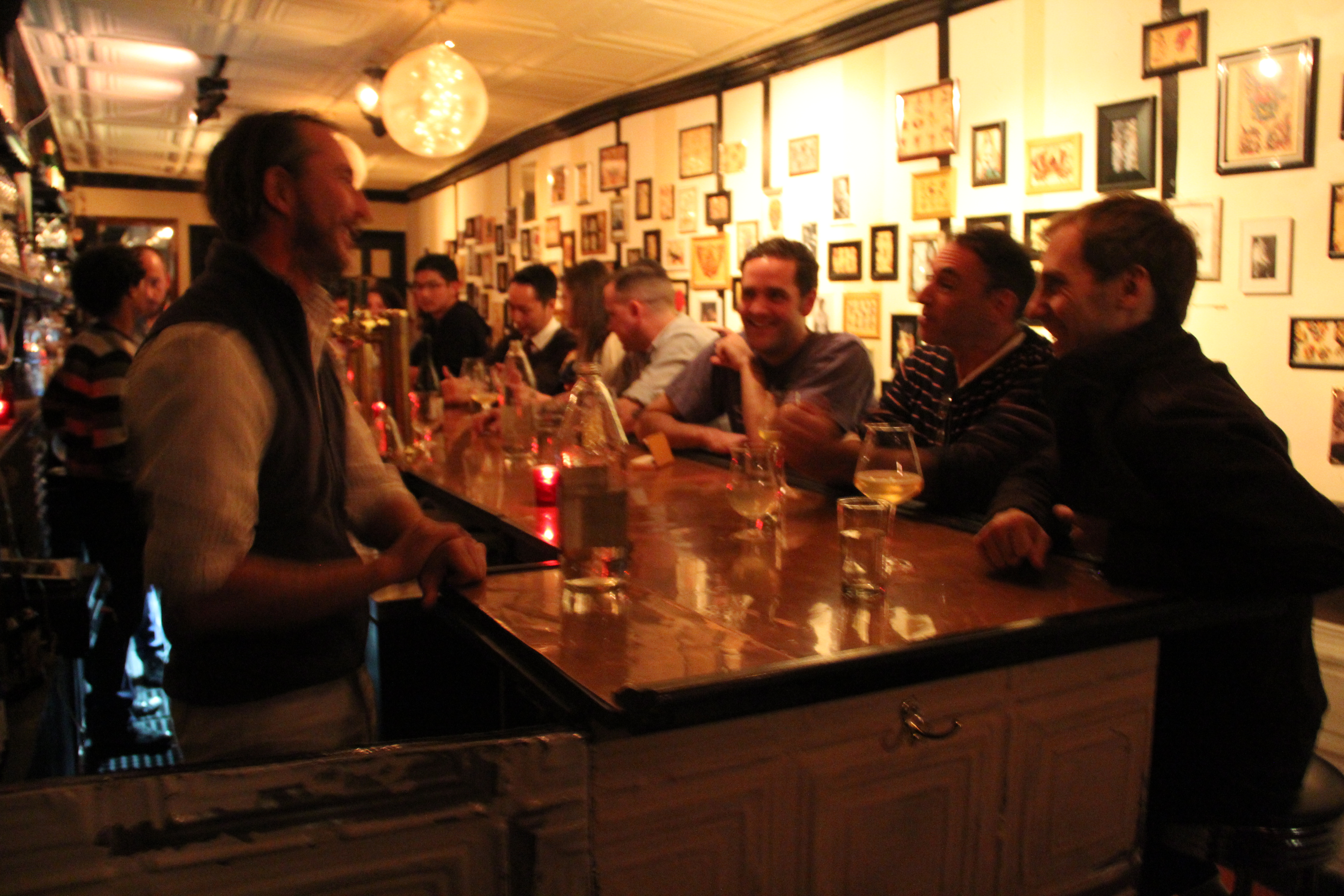
Crowded into a long narrow bar in the East Village called the Proletariat, where a steady stream of changing craft beers on tap lures beer geeks, a group of about 20-30 folks waited in the dim glow for the arrival of the hard-to-find and coveted ciders of Aaron Burr Cider. Me, being the wide eyed Midwesterner that I am, had seen the event advertised in the NY Cider Week schedule and thought, oh, I will casually stop by at this event before dinner with my friend Challey. Luckily, Challey knows the way NY works more the I, and she investigated further, messaged some people, found out the event was ticketed, tracked down the bar, and bought us the last two tickets. I would have been OUT OF LUCK were it not for her keen City food scene skills. Among the crowd were clearly some home cider makers, some people with a lot of knowledge about wine and beer but not about cider, and some totally new but enthusiastic folks who were devotees of the bar and trusted the bar staff when they said – come to this event. I also was pleased to meet another cider blogger: United States of Cider.
So, I spend most of my time with academics, farmers, and craft producers, not urban foodies, and I have to say, urban foodies massively intimidate me, even though I probably can match them point for point on food, wine, and especially, cider knowledge . It’s just the way they frame their questions (more like short soliloquies) with tones of assurance, peppered with casual references to nuggets of information indicating their level of taste, which makes me want to back wide-eyed into a corner with my notebook. Luckily, my foodie friend Challey, who works as a director at the Greenmarket, is a fabulous champion of provincials like me and was instrumental in helping me navigate my sojourn into the foodie beast of NY Cider Week in the city. Nonetheless, I sat in awe of the New Yorkers at this bar who were practically tripping over each other’s tongues to get in questions with Andy Brennan, who was winningly both modest, soft-spoken, eloquent, and a great story-teller of cider.
I’ve heard and read a lot about Aaron Burr Cider, and I think that the mystique of the foraged fruit touches a nerve for the American foodie that sends a certain exciting shiver up the culinary spine. In fact, at another cider event, when I asked another panel of cider makers if there was any long term interest in developing uniquely American, regional cider apple varietals instead of turning to French, English, and Spanish origin fruit, one man said his fantasy was that there was some wild tree out there waiting to be discovered that had some amazing, yet-unknown flavors that would make a unique, wild, native American cider. And a member of the audience said: “Well, that is just what Andy Brennan is doing with his foraging.”
There is something about the idea of an American wild apple, uncultivated apple that speaks to the American food imagination. In this fantasy are the beginnings a new American cider mythology – one that taps into tales of Johnny Appleseed, our peripatetic tree-planting legend, and his semi-cultivation of wild landscapes.
The thing is, many of the landscapes settlers cultivated in the past, wresting farmland out of the forest, have become overgrown, taken back into the wild, as marginal land has become uneconomical to farm and farm economies have changed. The Catskill / Hudson Valley area where Andy Brennan forages his fruit is one such landscape, where cultivated trees leftover from re-wilded farms dot the landscape and tell a story of un-cultivation that is little understood but ripe with mystery, full of the fruiting ghosts of farms past.
England has a similar story of orchards left-over from dead farm economies, but there is no wilderness in England to grow back over the land and around the apple trees. Instead, these old trees become singular markers in grazed fields, or untended corners of a farmhouse property sold to urban professionals who like the view but know nothing about the apples. There are foragers in England too, but they are looking for old, heritage fruits, instead of wild fruits, though the interest in roadside apple trees, grown from the pips of eating apples discarded out the car window, is also growing.
“Wild” apples are never entirely new though. Even trees that sprout by the side of the road from a discarded apple have stories to tell about their origins in other cultivated or culinary pasts. Brennan’s foraged ciders appeal to the American story of forging into the wilderness to carve out a culture of our own. In a place where American cider history and culture has mostly been lost and forgotten, the idea of starting anew with unique, “wild” apples is appealing to many people in the sense that they seem to appear out of nature, independent of history and the hand of man. It also suggests that America has a complex terroir to draw upon that does not simply mimic the European models. But to me, wild apples harbour their own mysterious agricultural pasts and speak to the re-discovery of our landscapes and our foods.
My friend Challey was even more excited than I was to go to this event, as she had been hearing about Aaron Burr Cider for awhile but had never had a chance to taste it until just a few weeks ago at a friend’s bridal shower. We were treated to generous tastes of six different Aaron Burr ciders. Here’s the rundown of what we tasted, with some of the commentary, questions, and answers that crossed the crowd, paraphrased and summarized:
Golden Russet. This cider is made from mostly golden russet apples, with a few Northern Spy thrown in. Brennan commented that the Golden Russet lacks the acidity to be a total single variety cider on its own. He described it as perfumey, with a high sugar content, explaining that the tannin content was higher from the russetting on the apple, and that the higher tannin and higher alcohol allowed the cider the possibility of more aging, which he liked.
Q: What apples the first settlers were growing in America?
A: Besides the crab apples native to America, Andy explained, all apples we know for eating came over starting with the Mayflower, and all apples grown in the Northeast today are descendants of these European apples.
Q: Tannins? Is it like red wine? What are the varietals and how do you choose them?
A: “Every apple is a good apple to me.” But Brennan went on to comment that he doesn’t put every cider he makes into his final blends. He said he ferments over the winter, with the final change in flavors coming in the spring when a malo-lactic fermentation may occur.
Q: There are only a few varieties that can be single variety ciders?
A: Yes, it’s a lot like wine. Only Americans are obsessed with single varieties. Apples even more than grapes need to be balanced. There are four things you are trying to balance: Acidity, Tanin, Sugar, Aroma. It really is an art trying to bring those characters together – like bringing a still life together and letting all those objects live together.
If you grow an apple tree in a field, it has more sun, more nutrients. I believe if you grow an apple tree in the wild, and its is competing with blackberry bushes an oak trees, that apple picks up those properties. And the soil temperature is cooler in a wild environment than in a cultivated environment, which much influence the flavor.
Q: Do you blend different vintages?
A: Yes. I am open to blending different years. It’s like having an extra colour for next year’s cider.
Traminette. Made from Golden Russet and four other apples, including MacIntosh for a floral note, this cider came about because Andy wanted something like a champagne – something like a picnic drink. You could pair it with food, but it is great as a for walking around, a party drink. It is very perfumey, a fruity taste almost like grapefruit and wonderfully bubbly, similar to the taste of Traminette wine, a white grape varietal related to Gewurztraminer. Murmurs of delight wafted up from the crowd as they started to sip this beverage, and everyone seemed to be smiling and thinking of summer. Brennan made a nod to the English invention of champagne method (which I think should be renamed the “Glasshouse method” in reference to the spot on May Hill in Gloucestershire where Huguenot glassmakers helped develop pressure-resistant bottle glass) and the efforts of Lord Scudamore as he outlined the details of the method to illustrate the craft method of carbonation as opposed to modern forced carbonation.
Q: I made cider at home and it turned out more like Chardonnay? How do I get that apple essence that some of the more commercial ciders have?
A: Chardonnay has the same buttery characteristic that comes from the late spring fermentation – the malo-lactic fermentation. If you bottle before that malo-lactic fermentation takes place, you can trap some of the apple fruit quality. You can also back-sweeten by saving some of the juice frozen in reserve.
Homestead Apple. Made from foraged fruit.
Q: What are you doing with the must?
A: We have one guy who distills but I use it mostly as a nursery for future trees. I’ve got 400 trees planted. I was buying cider trees from Europe but I decided we had all the varieties we needed and more right here. Right now my nursery is trees I find in the wild that I want to keep, trees I find on property that isn’t mine that I want to save. More than cider I want the trees. I take the graft wood in the winter and put it on to our trees. I keep finding trees I want to save. It’s like our tree orphanage.
Elderberry. This spicy aromatic drink had extra depth and rich flavour. Brennan said this was what he made when he wanted a winter drink, something to go with chocolate, somethingthat felt woody and earthy and foresty. It also includes a touch of sumac to enhace the lemony and acidic flavors. He said that as the water level in the barrel shrinks over time, they add huckleberries to keep things spinning over in the fermentation.
Q: What strains of yeast do you use – are you afraid of using the wild yeasts?
A: I’ve messed up a lot of cider, but I am very much just, ‘let it go.’
Homestead Pear. I think Brennan used the word “vulgar” to describe the scent of this perry, and he was right. It was a ripe old aroma. But the taste was wonderfully delicate and just like pear. He described the fruit as a wild, foraged pear, with very delicate, sweet fruit inside a tannic, leathery shell – a smell in like a lion and a taste out like a lamb.
Ginger Apple. Fermented on carrots, Brennan said he made this as a table wine, something to go with Thai food and sushi. It really was the fresh spicy fruity taste you would expect from something you got at a juice bar, but much lighter.
NY Cider Week: Beacon
New York Cider Week is here! I rolled into the great state of New York after a lovely drive through New England on business, and I coasted down interstate 84 from Connecticut towards the Hudson Valley amidst a sea of red and gold leaves, stopping along the way for some farmstand fresh cider and donuts. In a way, this is home ground for me, at least in an ancestral-extended family sort of way. My extended family of great aunts, uncles, and second cousins lives right across the river from Beacon, and though I’ve never lived here myself, I’ve come out to visit over the years, making my way to the red brick house my ancestors built beside a mill stream, which is still inhabited by fellow Kennedys. I’ve always loved the Hudson Valley, and I’d love to have a reason to settle in here someday.
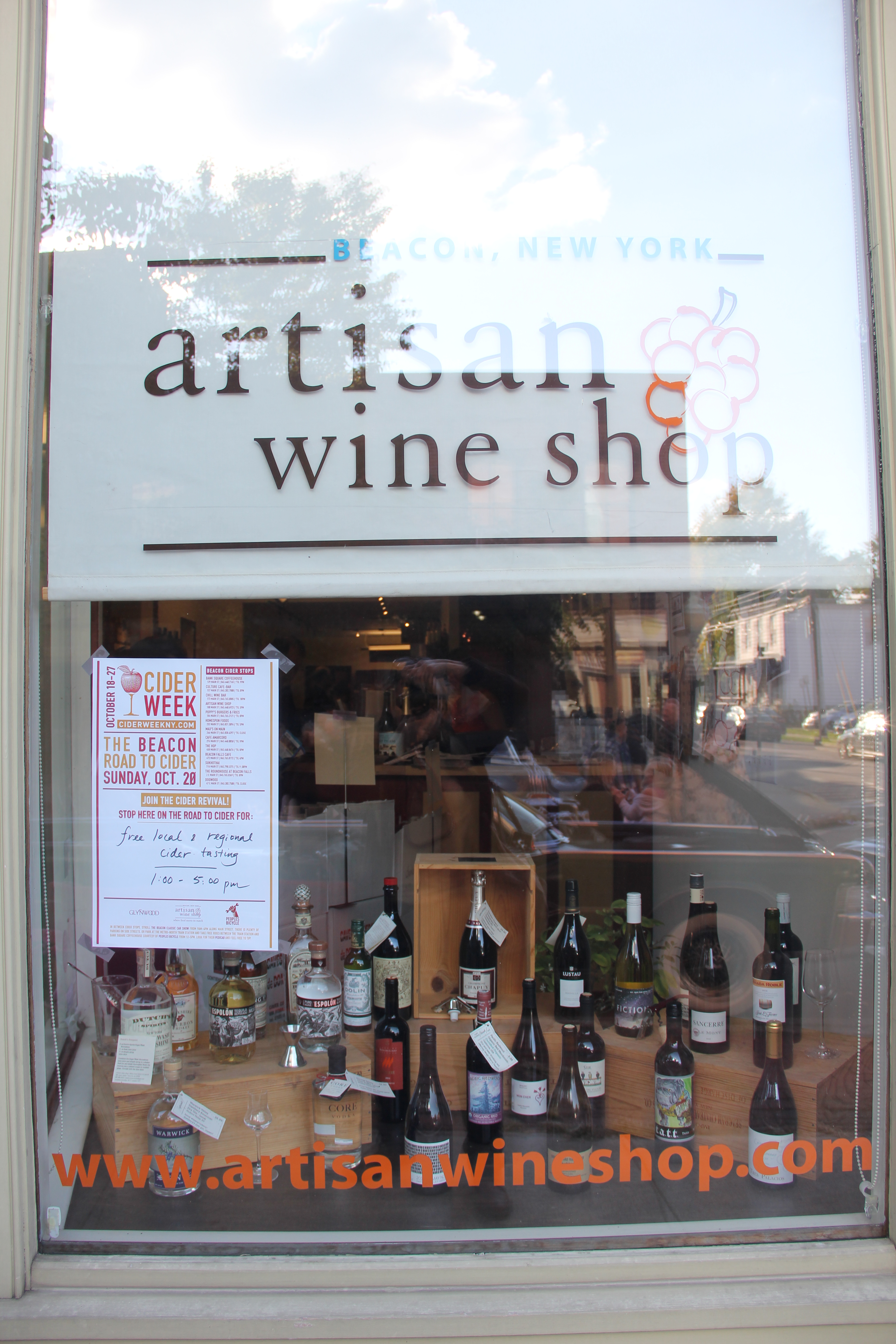
As I drove into the little town of Beacon, I was surprised to find a full Sunday afternoon street fair winding down. There were antique cars parked along the street for people to admire and bands playing. As I made it into the Artisan Wine Shop,
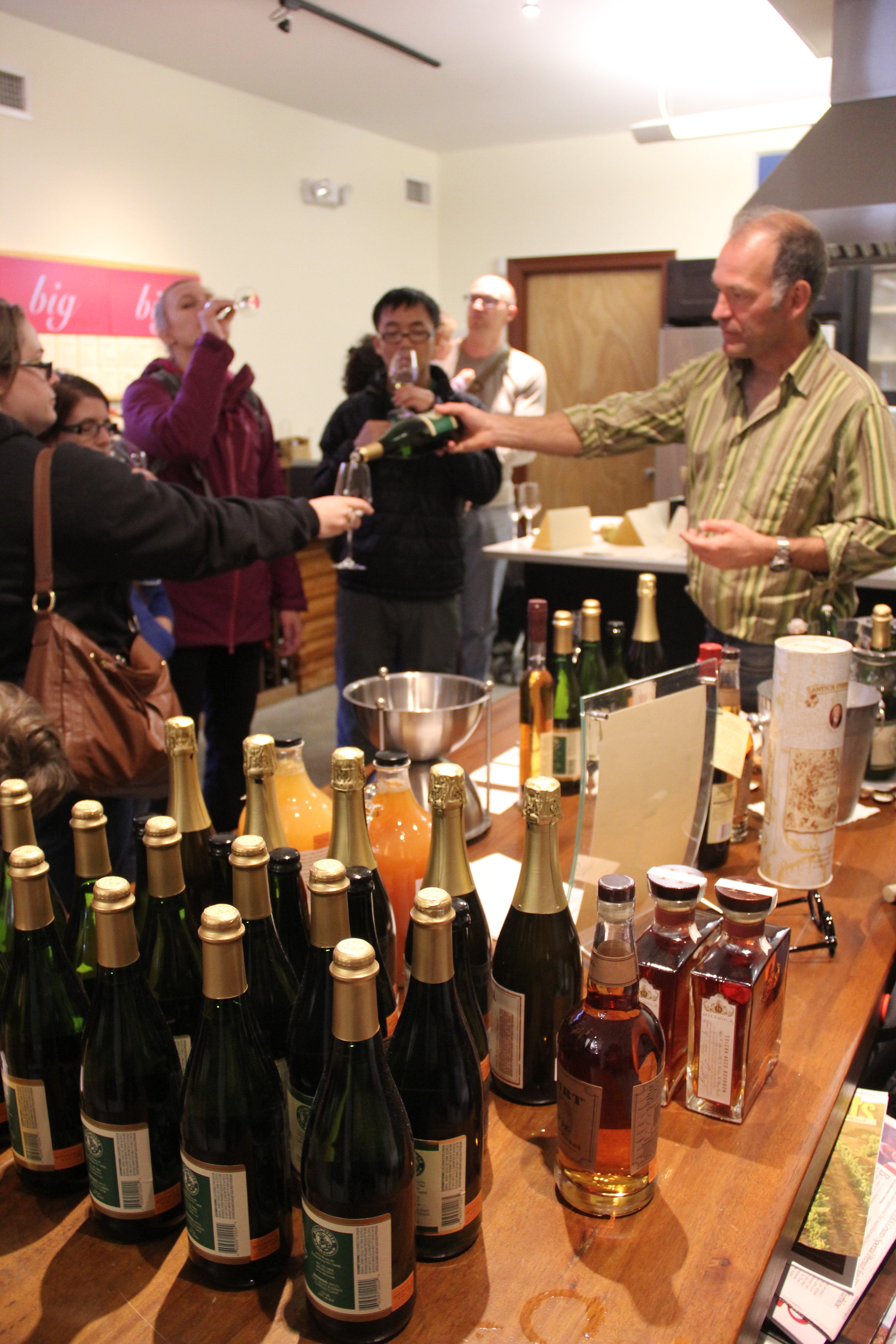
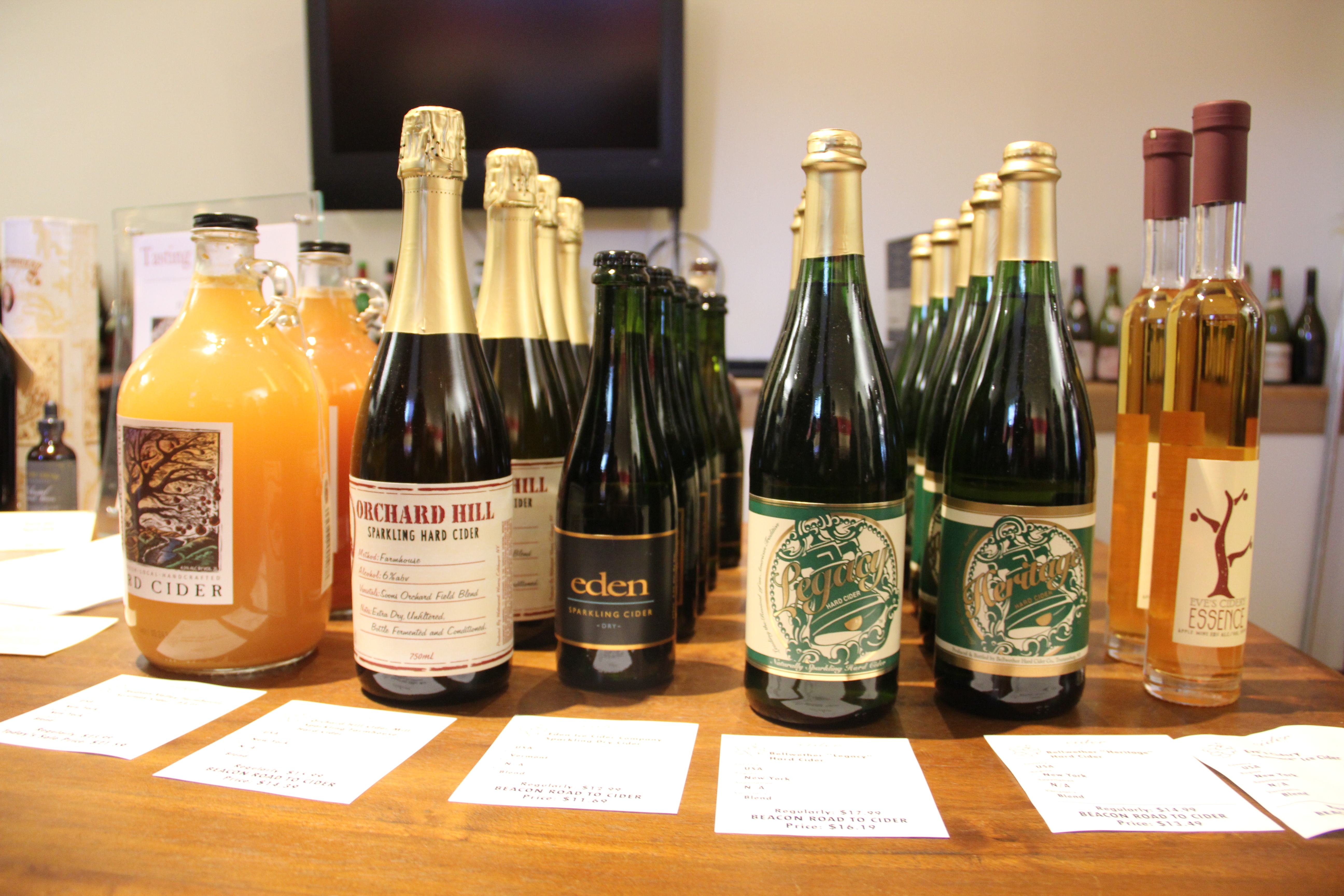
I found an enthusiastic crowd of folks lining up for the free cider tasting. It was the last half hour before close, and the people behind the counter seemed pleasantly harried – they said they’d expected to be busy, but not THIS busy. I tasted Orchard Hill, Eden, Bellwether, and Eve’s Ice Cider. All very nice – I particularly liked the Bellwether “Heritage” which was a still version. Sometimes I think the American ciders get really carried away with carbonation, both bottle condition / champagne style and forced carbonation. Some of the really delicate and rich flavors are much more enjoyable in still cider, in my opinion. Carbonation can either hide mediocre cider or really enhance a lovely cider. But sometimes I think enthusiasm for carbonated flare gets in the way of really good flavour. Something to consider. I found that the Bellwether Legacy sparkling cider was nice, but the Heritage still cider was even nicer. The shopkeepers said they were hoping that the event would help promote hard cider for their customers, and it sure seemed like they were doing a good job. I found their selection of other ciders (beyond the special sampling selection for the afternoon tasting) to be really great. A fairly wide display of east coast and Hudson Valley ciders – more than I have yet seen elsewhere.
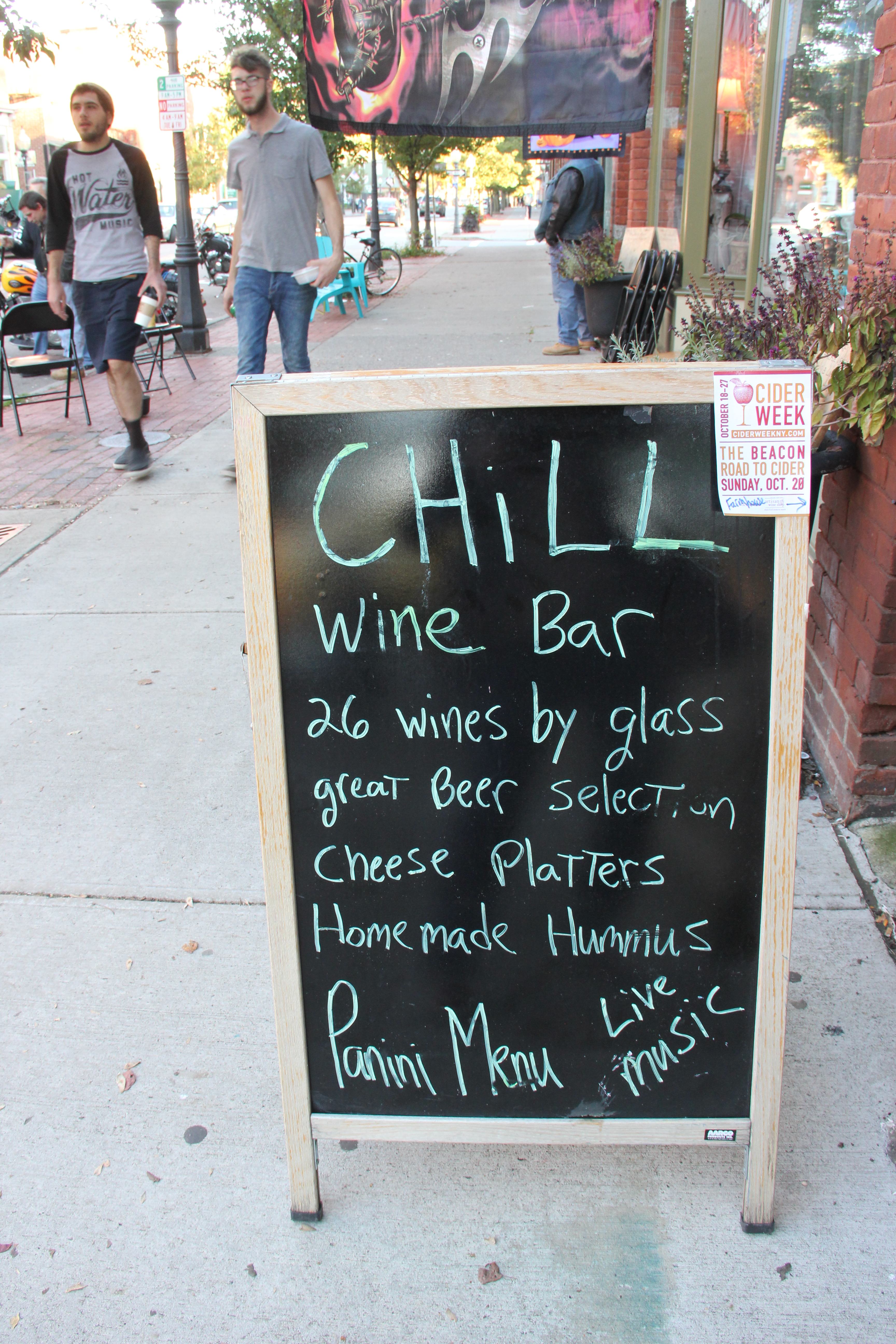
After making a rather eye-popping purchase (all in the name of research, my friends) I wandered over to the Chill Wine Bar, which was serving a few ciders as well. I opted for the Hudson Valley Farmhouse Cider from Breezy Hill Orchard. The wine shop had almost run out and didn’t have any left for sampling, so I was glad to get a chance to taste it at the bar. I’d noticed the bottles at the wine shop – growlers really – were bubbling away steadily, and the label indicated they should be refrigerated. I have never seen anyone sell cider that is clearly still fermenting before, so I was curious. I am almost certain it must have been pressed a few weeks ago – does anyone else drink cider this young? I admit I was perplexed. When I ordered it at the bar, I was surprised that it tasted almost exactly like sweet non-alcoholic cider, with a slight kick. I have never encountered a style like this before – especially in England where almost always cider is fermented over winter, ready at Christmas at the earliest and usually April or May. I would love some feedback. Is this a style or just an anomalous product? When I asked the shopkeepers at the wine shop, they said it was “scrumpy.” Friends, I have not encountered sweet partially fermented scrumpy before, but I am open to being corrected. Please enlighten me.
At any rate, the Chill Wine Bar had gone through almost two growlers of this cider since 2pm, so it was doing good business. As I sat sipping my drink I overheard a couple – also drinking the cider – chatting about their attempts at cider making at home. Clearly the cider buzz is about at the home-makers are coming out for Cider Week.
New York Cider Stuff! – A taste of things to come
Finding Lots to share on the blog this week! Here’s another interesting piece on a New York cider maker, stolen from the NY Cider Week feed. I am really looking forward to going to New York Cider Week and will report back on my adventures there, so stay tuned. It happened to coincide with a trip to Rhode Island for an academic conference – thus FATE strikes again, bringing me into another exciting cider happening. Enjoy the links!
Article on Aaron Burr Cider:
http://www.grubstreet.com/2013/10/andy-brennan-best-cider-producer.html
NY Cider Week page:
Perry in Austria – Courtesy Bill Bradshaw
If you don’t already read Bill Bradshaw’s great cider blog, take a look at this description of his trip to the perry producing region in Austria.
Lost Fruit
Sometimes you wish to curl up
Inside the skin of something lost, perhaps a grape
still hanging on the vine after the frost
where you can soak up the autumn sun
and sip its sweetness slowly past the equinox.
All the hands that missed you, all the birds,
all the wasps that flew by,
all the tiny microbes of mold and rot
did not find you all summer long…
The vines are almost bare, and wildlife retreats
into the ground, or to the south, except the winter birds,
Except the winter birds who sail the warmer tufts of air
and stare down the remnant vineyard fruits from high above.
There is always a predator, and the flesh of fruit
is hardly a good place to hide.
But for awhile at least, to hang onto the summer
is pleasure enough, to feel the drapes of falling leaves
graze against the skin as the cool wind comes slowing drifting,
winter wading, drifting in,
wading into the vineyard.
Too many pears, Too little labour
Check out this NPR story on the enormous pear crop and labour shortage in the Pacific Northwest.
http://www.npr.org/2013/10/07/230023629/pacific-northwest-farmers-in-search-of-more-workers
The 17th Century is the Best Century
Back at my desk in Indiana, I have been reading and taking notes on a really lovely chapter in a book called A Pleasing Sinne: Drink and Conviviality in Seventeenth-century England. The chapter “Drinking Cider in Paradise: Science, Improvement, and the Politics of Fruit Trees”, by Dr. Vittoria Di Palma, has lots to offer the historically minded and those cider and orchard enthusiasts who have delved into the texts on the subject by the likes Evelyn, Beale, Worlidge, and Austen. I had the opportunity to go to the British Library during my stay in England, and I signed up for a reading room card, checked out a period copy of Eveyln’s Pomona, and spent a lovely afternoon turning its seventeenth century pages, replete with beautiful fonts and prints. Di Palma’s chapter analyzes the many works on cider in the 17th and 18th centuries within the context of the larger discourse of “Improvement.” Citing one of the earliest tracts during this era advocating the planting of fruit trees, a letter by Sir Richard Child written to Samuel Hartlib, Di Palma says:
“…fruit tree cultivation and the production of fruit wines became central to the advancement of English husbandry. In the 1650s, Child’s letter acted as a spur to other publications by members of Hartlib’s circle; in the 1660s it was used as a blueprint for early scientific efforts to describe, understand, and exploit the English landscape by Fellows of the Royal Society. And although orchards and cider had only formed a small part of Child’s enterprise, they soon became subjects of a plethora of specialized publications, recognizable components of the seventeenth century discourse of improvement.” (Di Palma,164)
I’ve always thought the 17th century was one of the most interesting periods in English and North American history – arguably the birth of modernity as social and political life transitioned out of the medieval era and towards the world as we know it today, a world which privileges individualism, scientific method, and representative government.
Many authors who write on cider today often refer back to this era as a golden era for cider, when it was the drink of gentlemen, a subject to be discussed in the high circles of scientific inquiry. In my studies, I am interested in teasing out the meanings embedded in the way we talk about and represent cider. As Di Palma’s lovely paper shows, the 17th century writers were invested in a rhetoric of improvement, a rhetoric which ultimately positioned “England as Eden”:
“The widespread cultivation of apple trees would mean, in effect, recreating paradise in England, redeeming the country’s sins, and populating it with moral, healthy, and wealthy denziens, drinking cider in their very own Elysium Britannicum. Not merely fit for Adam and Eve, or the heathen gods for that matter, through the discourse of improvement, cider was proclaimed the tipple of choice for the English citizen” (Di Palma 177)
It’s interesting to think about how similar the 17th century discourse of improvement is to many of our modern concerns about sustainability, localized economies, and ecologically sensitive agriculture. There are many differences, of course, but that is where interesting analysis can be made. Just how do people who want to make arguments about these contemporary issues borrow from older texts to make their points? But also, how does this obscure some of the differences between contemporary and historical realities? This is something I will be looking at in greater depth as I write the dissertation.
Take a look at the rest of the articles in this book for other scholarly approaches to drinks of all sorts in 17th century England.
Rare Variety Cider Tasting with John Teiser

Possibly one of the most interesting, lovely, and helpful people I have met during my cider travels has been the incomparable John Teiser, producer of Springherne Cider. John introduced me to Broome Farm and has helped in many ways to set me on the path of cider and perry. John is one of the true scholars of cider and perry, a man who goes searching through archival records of Bulmers farm plantings while also driving and walking through the countryside in search of old orchards and rare trees.
John is also, however, an amazing producer, not only for the quality of his ciders and perrys, but also because of his meticulous experimentation with rare fruit varieties. John invited me and Kate Garthwaite, another former Broome Farm apprentice who now produces her own Left Field Cider in British Columbia, Canada, accompanied by Mike and Phil from Broome Farm, to come over to his cider house on the side of hill overlooking the Wye Valley to taste some rare variety ciders.
Most modern cider orchards produce vast quantities of a few varieties (Dabinette, Michelin) that have proven to be good annual producers (avoiding bi-annual variation of crops common to many apples), and which have disease resistance and good growth habits, as well as good cider qualities. However, there are many rarer varieties, which for various reasons didn’t make it into our current system of production. Often, these are found in old orchards, and even if no one can remember them anymore, they can be identified through a combination of comparison with documented variety characteristics and – if they exist – planting records from Bulmers contracts for orchards planted in their schemes. It’s a bit of cider detective work.
John Teiser, however, has been using apples from a very interesting old orchard – one which was an early trial bush orchard in the 1930s for Bulmers. Here, bush tree cultivation was trialled on many varieties which never made it out into the agricultural system and some of which only survive now, in England, in this particular orchard. The ciders we sampled with John were made from some of these trees.

The ciders were, for the most part, all bittersweets, and many were French varieties. Some of the highlights included the Collington Big Bitters, which Mike recalled as also being called the Mincemeat apple. The Damelot had a very light and floral fragrant taste. My personal favorite was the St. Laurent, which John tells us looks almost as dark as Guinness when it is pressed. Not only did this cider have the tannic qualities of a bittersweet, it also had a rich body, with a hint of nuttiness and butteriness. John also poured for us what he believes is the actual Hagloe Crab (a rare tree of disputed identity and provenance). Another fascinating taste experience was a Medaille D’Or, which was the most astringent tannic cider I have ever tasted. I couldn’t imagine drinking more than a sip. John handed it to us and said – this is one of the ones you wonder – why did anyone ever plant this? But John theorized that these very tannic French varieties might have been desirable to maintain tannin in the drink through the keeving process, which often precipitates much of the tannin along with the yeast, leaving a much sweeter drink. It was certainly an educational tasting moment, if not the most enjoyable one. (Stay tuned for a more accurate list of variety names – I forgot my notebook and was overcome by flavors and sunshine).
Many thanks to John Teiser for a really amazing afternoon of tasting, blessed by the sun, and overlooking his young plantation of rare cider trees. May these rare varieties continue to be propagated, pressed, and poured into glasses for many years to come. Thanks also to Mike for being our driver and Phil for….being Phil – always the best of company.