December on The Somerset Levels

It’s November, and we’ve had our first snow here in Indiana.  After the immersive and intensive dive into NY Cider Week, it’s been nice let my mind drift back to England as I spend time transcribing more interviews.  Somehow, I can’t seem to get the Somerset Levels out of my mind.  Maybe it’s the slant of light on the horizon that triggers the memory, or the temperature, dipping into the freezing temperatures.  It was about a year ago come December that I was visiting there, doing some interviews in the midst of a phenomenal flood. It’s a landscape famous for its orchards and its cider, but one I’ve only visited, not lived in.  This post is not about orchards and cider directly, but about a delicate landscape where they are part of a complex ecological and agricultural heritage.

I’ve been reading over Life on the Levels: Voices from a Working World, a collection of interviews with people whose lives are intimately connected to the unique landscape of the Levels, illustrated with elegant black and white photographs.  There is something about this particular landscape that I find personally extremely compelling, slightly mysterious.  The low-lying moors have been drained over the centuries, but the water still reigns here.  It is one of my favorite places to meander around the lanes, always slightly lost in the winding turns that take you around the moors, stumbling upon the high pieces of ground that have been prized spots for thousands of years, like the almost imperceptible hill on which stand the ruins of Muchelney Abbey, where the monks must have been really glad of dry land. Or the Glastonbury Tor, or the Burrow Mump, whose slopes are surrounded by the standard orchards of Burrow Hill Cider.  The apples, like the people, tend to cling to the high ground to keep their feet dry.

One interview in Life on the Levels, with RSPB Warden of West Sedgemoor John Humphrey in 1981, explores the myriad issues surrounding the relationship of ecological conservation and agriculture in the landscape with impressive breadth, opening with this quote:

“The progressive agriculturalist would see a traditional meadow here as really not being worth farming and would want to under-drain it, dry it out, plough it up and re-seed it….West Sedgemorr is a great mass of waterlogged peat which is…about fifteen feet deep.  And you’re supported by a skin of vegetation – that’s all that’s stopping you from sinking into this morass…”

This seems to be one of those delicate places where the environment pushes back relatively quickly – lets you know when you’ve pushed the boundaries of ecological manipulation too far, which is perhaps what gives it that sense of self-contained power and responsiveness.

This slideshow requires JavaScript.

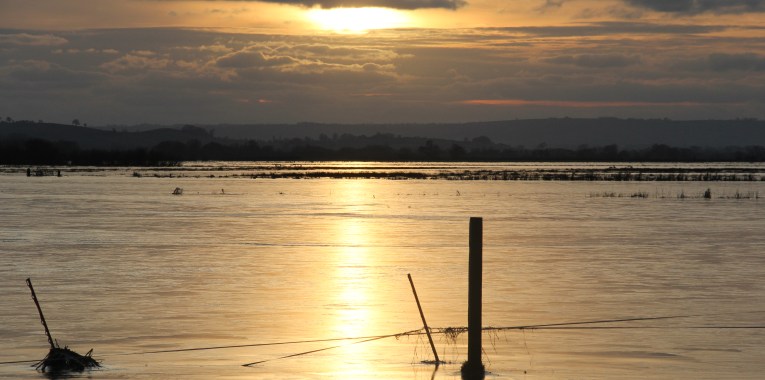
When I was driving there last December, it was with some trepidation, as just days and weeks before, local people had been marooned in their houses, the roads impassible to all but tractors in the midst of the flood.  When I came, the waters had receded enough that the main roads were passable, but many of the fields were still covered with water.  Or rather, they were covered with ice, as the weather had turned cold and turned sections of the moors into sheets of glass.  Birds flocked to the open places in the ice, and it was hard not to be awed by the quiet beauty of the mauve twilight settling gently over these great reflecting watery moors chilled to a frost -covered stillness.  Though one could not forget also the agricultural and personal loss from these same floods.  Here are some articles detailing the damage from the Guardian and the Somerset County Gazette.

I spied some orchards by the side of the road encased in the ice, their trunks sealed in.  I stopped by Burrow Hill Cider just to climb to the top of the hill and look out over the vast icy lake that had formed in the moors below.  Landscapes like this provoke us to consider how agricultural heritage has helped shape the landscape, but also forces us to face the limits of human change.  Further into the book, another interview with details how aggressive drainage practices designed to promote arable agriculture can permanently affect the balance of the peat, cause the land the sink, and further exacerbate the flooding problem.

The 17th Century is the Best Century

Back at my desk in Indiana, I have been reading and taking notes on a really lovely chapter in a book called A Pleasing Sinne: Drink and Conviviality in Seventeenth-century England.  The chapter “Drinking Cider in Paradise: Science, Improvement, and the Politics of Fruit Trees”, by Dr. Vittoria Di Palma, has lots to offer the historically minded and those cider and orchard enthusiasts who have delved into the texts on the subject by the likes Evelyn, Beale, Worlidge, and Austen.  I had the opportunity to go to the British Library during my stay in England, and I signed up for a reading room card, checked out a period copy of Eveyln’s Pomona, and spent a lovely afternoon turning its seventeenth century pages, replete with beautiful fonts and prints.  Di Palma’s chapter analyzes the many works on cider in the 17th and 18th centuries within the context of the larger discourse of “Improvement.”  Citing one of the earliest tracts during this era advocating the planting of fruit trees, a letter by Sir Richard Child written to Samuel Hartlib, Di Palma says:

“…fruit tree cultivation and the production of fruit wines became central to the advancement of English husbandry.  In the 1650s, Child’s letter acted as a spur to other publications by members of Hartlib’s circle; in the 1660s it was used as a blueprint for early scientific efforts to describe, understand, and exploit the English landscape by Fellows of the Royal Society.  And although orchards and cider had only formed a small part of Child’s enterprise, they soon became subjects of a plethora of specialized publications, recognizable components of the seventeenth century discourse of improvement.” (Di Palma,164)

I’ve always thought the 17th century was one of the most interesting periods in English and North American history – arguably the birth of modernity as social and political life transitioned out of the medieval era and towards the world as we know it today, a world which privileges individualism, scientific method, and representative government. 

Many authors who write on cider today often refer back to this era as a golden era for cider, when it was the drink of gentlemen, a subject to be discussed in the high circles of scientific inquiry.  In my studies, I am interested in teasing out the meanings embedded in the way we talk about and represent cider.  As Di Palma’s lovely paper shows, the 17th century writers were invested in a rhetoric of improvement, a rhetoric which ultimately positioned “England as Eden”:

The widespread cultivation of apple trees would mean, in effect, recreating paradise in England, redeeming the country’s sins, and populating it with moral, healthy, and wealthy denziens, drinking cider in their very own Elysium Britannicum.  Not merely fit for Adam and Eve, or the heathen gods for that matter, through the discourse of improvement, cider was proclaimed the tipple of choice for the English citizen” (Di Palma 177)

It’s interesting to think about how similar the 17th century discourse of improvement is to many of our modern concerns about sustainability, localized economies, and ecologically sensitive agriculture.  There are many differences, of course, but that is where interesting analysis can be made.  Just how do people who want to make arguments about these contemporary issues borrow from older texts to make their points?  But also, how does this obscure some of the differences between contemporary and historical realities?  This is something I will be looking at in greater depth as I write the dissertation. 

Take a look at the rest of the articles in this book for other scholarly approaches to drinks of all sorts in 17th century England.

Rare Variety Cider Tasting with John Teiser

Kate, John Teiser, Maria

Possibly one of the most interesting, lovely, and helpful people I have met during my cider travels has been the incomparable John Teiser, producer of Springherne Cider.  John introduced me to Broome Farm and has helped in many ways to set me on the path of cider and perry.  John is one of the true scholars of cider and perry, a man who goes searching through archival records of Bulmers farm plantings while also driving and walking through the countryside in search of old orchards and rare trees.

John is also, however, an amazing producer, not only for the quality of his ciders and perrys, but also because of his meticulous experimentation with rare fruit varieties.  John invited me and Kate Garthwaite, another former Broome Farm apprentice who now produces her own Left Field Cider in British Columbia, Canada, accompanied by Mike and Phil from Broome Farm, to come over to his cider house on the side of hill overlooking the Wye Valley to taste some rare variety ciders.

Most modern cider orchards produce vast quantities of a few varieties (Dabinette, Michelin) that have proven to be good annual producers (avoiding bi-annual variation of crops common to many apples), and which have disease resistance and good growth habits, as well as good cider qualities.  However, there are many rarer varieties, which for various reasons didn’t make it into our current system of production.  Often, these are found in old orchards, and even if no one can remember them anymore, they can be identified through a combination of comparison with documented variety characteristics and – if they exist – planting records from Bulmers contracts for orchards planted in their schemes.  It’s a bit of cider detective work.

John Teiser, however, has been using apples from a very interesting old orchard – one which was an early trial bush orchard in the 1930s for Bulmers.  Here, bush tree cultivation was trialled on many varieties which never made it out into the agricultural system and some of which only survive now, in England, in this particular orchard.  The ciders we sampled with John were made from some of these trees.

John Teiser in his Orchard

The ciders were, for the most part, all bittersweets, and many were French varieties.  Some of the highlights included the Collington Big Bitters, which Mike recalled as also being called the Mincemeat apple.   The Damelot had a very light and floral fragrant taste.   My personal favorite was the St. Laurent, which John tells us looks almost as dark as Guinness when it is pressed.  Not only did this cider have the tannic qualities of a bittersweet, it also had a rich body, with a hint of nuttiness and butteriness.  John also poured for us what he believes is the actual Hagloe Crab (a rare tree of disputed identity and provenance). Another fascinating taste experience was a Medaille D’Or, which was the most astringent tannic cider I have ever tasted.  I couldn’t imagine drinking more than a sip.  John handed it to us and said – this is one of the ones you wonder  – why did anyone ever plant this?  But John theorized that these very tannic French varieties might have been desirable to maintain tannin in the drink through the keeving process, which often precipitates much of the tannin along with the yeast, leaving a much sweeter drink.  It was certainly an educational tasting moment, if not the most enjoyable one.  (Stay tuned for a more accurate list of variety names – I forgot my notebook and was overcome by flavors and sunshine).

Many thanks to John Teiser for a really amazing afternoon of tasting, blessed by the sun, and overlooking his young plantation of rare cider trees.  May these rare varieties continue to be propagated, pressed, and poured into glasses for many years to come.  Thanks also to Mike for being our driver and Phil for….being Phil – always the best of company.

Back at the Broome

I have returned to Broome Farm for a visit about six months after my departure, and it’s almost like I never left.  So lovely to slip right back into drinking some amazing cider outside the cellar with the regulars at the end of the workday.  Folks report that, though the apple crop is not a bumper one as media reports have suggested, it is better than last year, and it is nice to see many of the apple and pear trees laden with fruit.

me in front of the Holmer Perry Tree at Broome Farm

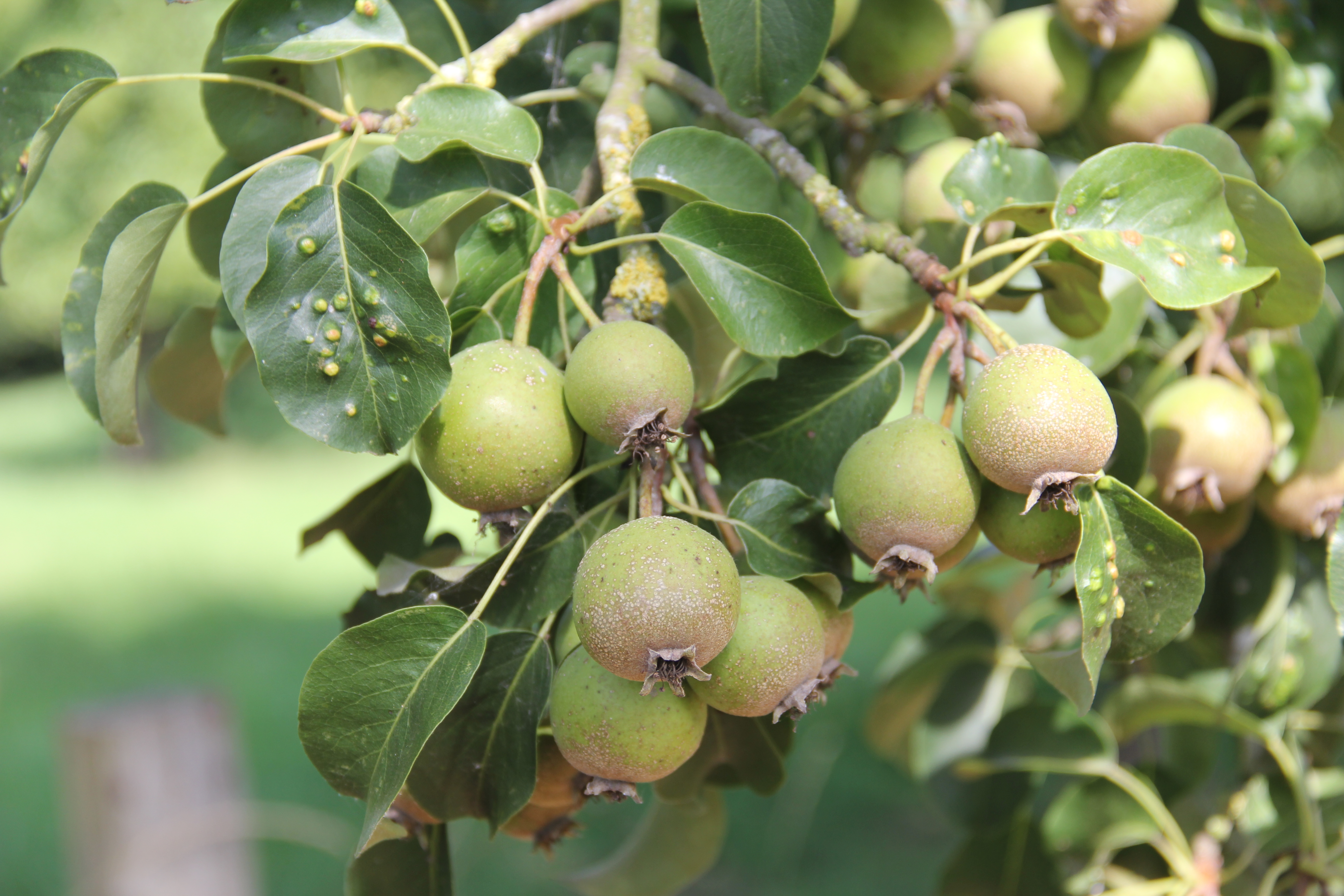
One tree in particular, the old Holmer, is looking particularly laden with its tiny fruits.  Standing under it the other day, I asked how old it was, as it is the oldest and largest fruit tree on the farm.  Our friend John Teiser, cider maker (Springherne Cider), tree enthusiast, and orchard researcher, said it would probably date to about 1828.  I was taken aback by such accuracy of date, and John explained that it was in the decade between 1820 and 1830 that Thomas Andrew Knight, a local Herefordshire gentleman farmer who pioneered fruit breeding in the 19th century, popularized the variety of perry pear he had discovered in the vicinity of the village of Holmer, north of the city of Hereford.  According to John, many large old Holmers date back to this decade, as Knight convinced many people all over the county to plant them during that time.  Mike said he remembers several other large specimens of perry pears standing nearby when he was a boy, but they have died out long ago.  As we were admiring the majestic and craggy old tree, which has skeletal dead branches interspersed with the green boughs full of fruit, my friend Liz grimaced slightly and said it was the worst pear to pick up of all the pears in the orchard, due to its tiny size.  But one can’t help but respect such an old tree.

holmer pear
holmer pear

Meanwhile, I spent the afternoon over at Much Marcle at Westons Cider.  Somehow I had managed never to take their facility tour when I was here previously, so I decided now was the time.  The tour guide was very lovely, and she took us all round the busy facility, stopping frequently to let the Westons lorries pass by.  By far the most interesting part of the tour was the Vat room, where over 90 oak vats of huge proportions, some over 200 years old, stand holding vast quantities of cider during its aging process after fermentation.  Each of them have names, a tradition started by the founder of the company.  The vat room inspires feelings of awe and wonder, even more so than the equally massive holding tanks that loom outside over the distant Malvern Hills.

Oak Vats at Westons
Oak Vats at Westons

No, the vat room is dark, dank, and full of mysteriously huge and ancient vessels whose girth and age, not to mention their very names, seem to bestow upon them a sense of mythical and yet earthy personality.  Titans of cider – the kind of creatures that preceded gods.  You feel you have entered a temple inhabited by mischievious and montrous beings through which billions of litres of cider have flowed.

Well, after that, I needed a bit of a stroll, you know, to relax the mind.  So I drove down the lane to the Helens to visit the avenue of perry pears, trees even more ancient and craggy than the Holmer at Broome.  The avenue was planted to commemorate the coronation of Queen Anne in 1702, and some of the trees still hang on to life.  I’ve admired these trees in the past, and last fall at the Big Apple festival, which is held on the grounds of Hellens Manor, I got to taste the perry made from these pears, the Hellens Early and the Hellens Green, and it was lovely.  Somewhat sweet, with a honeysuckle nectar quality as I recall.  One vintage had a hint of woodiness as well.

More to come on further adventures in perry, cider, Broome Farm this trip.

Avenue of Perry trees at the Hellens, Much Marcle