
Query
I’m working on a story about the origin of the Christmas spider. I was wondering if you might be able to answer a few questions to be quoted as an expert source in this story given your background in folklore. I have a few quick questions below — any insight is much appreciated!
- Why do people hang spiders on their Christmas trees?
- What are some of the legends of the Christmas spider?
- How is the Christmas spider related to tinsel?
- Are there any other Christmas ornaments/decor/objects that are said to bring good luck?
Answer
The Christmas Spider? This was another query I was surprised by, and a tradition I had never heard of. But the answer was closer at hand than I imagined. A quick search keyed me into the fact that this was an eastern European tradition, with particular popularity in Western Ukraine (see this very helpful wikipedia page for an overview and citations). Then all I had to do was query some of my Ukrainian American friends from the choir I sing with Ukrainian Village Voices, and the details started to emerge. Thank you to all my Ukrainian friends who provided many of the resources below.
The Ukrainian pavuchky, or spider, is a traditional Christmas decoration and accompanying tale. In some of the stories, the Christmas spider visits a house on Christmas eve and decorates the family’s Christmas tree with cobwebs, which shine like the sun on Christmas morning. The spider is a helper and protector of the house and family. In various retellings, the wife is decorating for Christmas under difficult circumstances, including poverty or the absence of the husband due to war. And sometimes it is Santa, the Christ Child, or St. Nicholas who visit and bless the work of the spiders. Decorations related to this story involved making spiders and cobwebs to decorate the tree, and it is sometimes used to explain the decoration of trees with tinsel. However, an older decorative tradition involves the creation of elaborate straw ornaments that hang from the ceiling like a chandelier, a beautiful abstraction of the spider’s web using the material – straw – that forms many other decorative and ritual purposes in the Ukrainian home and is a symbol of a country renowned for its agricultural heritage as the breadbasket of Europe.
Personal Anecdotes: Here are some of the personal responses I received about this tradition:
“You will find Christmas stories pertaining to spiders “decorating” the tree with their web. Definitely a story I had heard growing up. Spiders were distant “friends” in my family!” ~ Lilia Pavlovsky
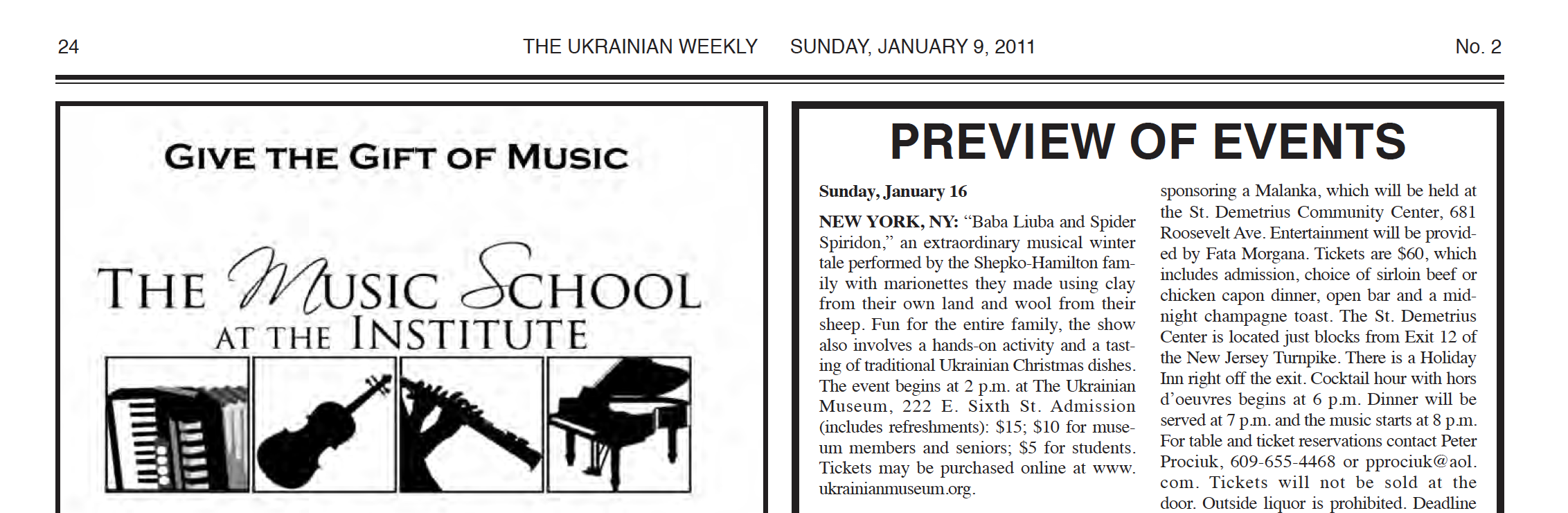
“Ooh I love this tradition. My mom had us perform a puppet show that had the spider involved growing up” ~ Zoya Shepko (See the adjacent write-up in the Ukrainian Weekly as evidence!)
“My family still puts some old school handmade pavuchky on our tree – walnut shells with wire and bead legs all spray painted gold and silver lol, but I don’t remember learning any of their lore growing up” ~Larissa Szyszka
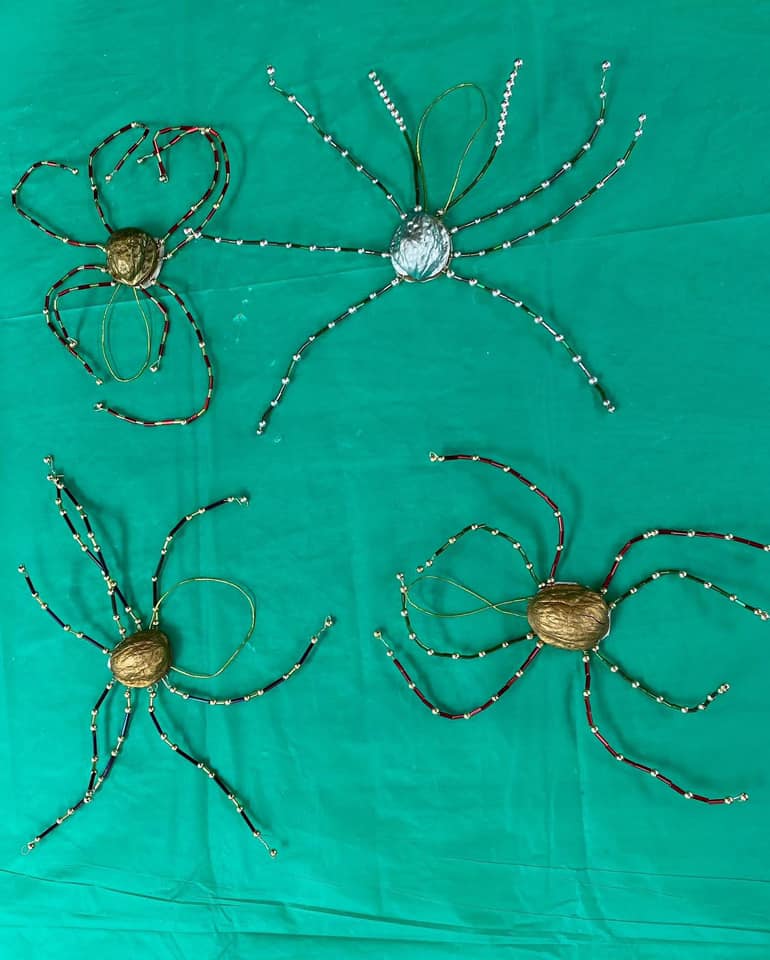
“For years I led workshops at the Ukrainian Museum on how to make the traditional spiders and we had a story to go along with it […] By the way this workshop is still run every year.” ~Laryssa Czebiniak (image provided by Laryssa)
“So from what I know- each different shape in the spider symbolizes something- the place where it came from, geographical markers and objects. My Ukrainian teacher told me (and I didn’t know this) that the spider is a protector- because Ukrainians believe that there were spiders at the crucifixion of Jesus- and that they stationed themselves near Jesus’ wounds- so they would look like nails- and it stopped the Romans from putting more nails into his flesh.” – Katie Pawluk
“We have them in Poland too.” ~ Rita Krawczyk (see this fascinating blog post on the Polish tradition) https://lamusdworski.wordpress.com/2016/10/23/pajaki/
Publications of the Legend of the Christmas Spider
There are many versions of this story. I have included a few of note here, which were published by Ukrainian or Ukrainian American authors:
A fairly recent publication brought this story to a wider audience. The Spider’s Gift: A Ukrainian Christmas Story by Eric A Kimmel, illustrated by Katya Krenina, was published in 2010.
There have been many earlier publications of the legend. A fascinating compendium of Ukrainian diaspora traditions, Ukrainian Christmas: Traditions, Folk Customs, and Recipes by Mary Ann Woloch Vaughn was part of the Ukrainian Culinary Heritage Project: Seeds and Roots, published by Communications Printing in Coralville, Iowa in 1982 and is available online at the specific link above, which is part of https://diasporiana.org.ua an online library of Ukrainian materials. This publication includes a retelling of the story itself and some instructions for making Christmas tree decorations, which I have screenshot below:

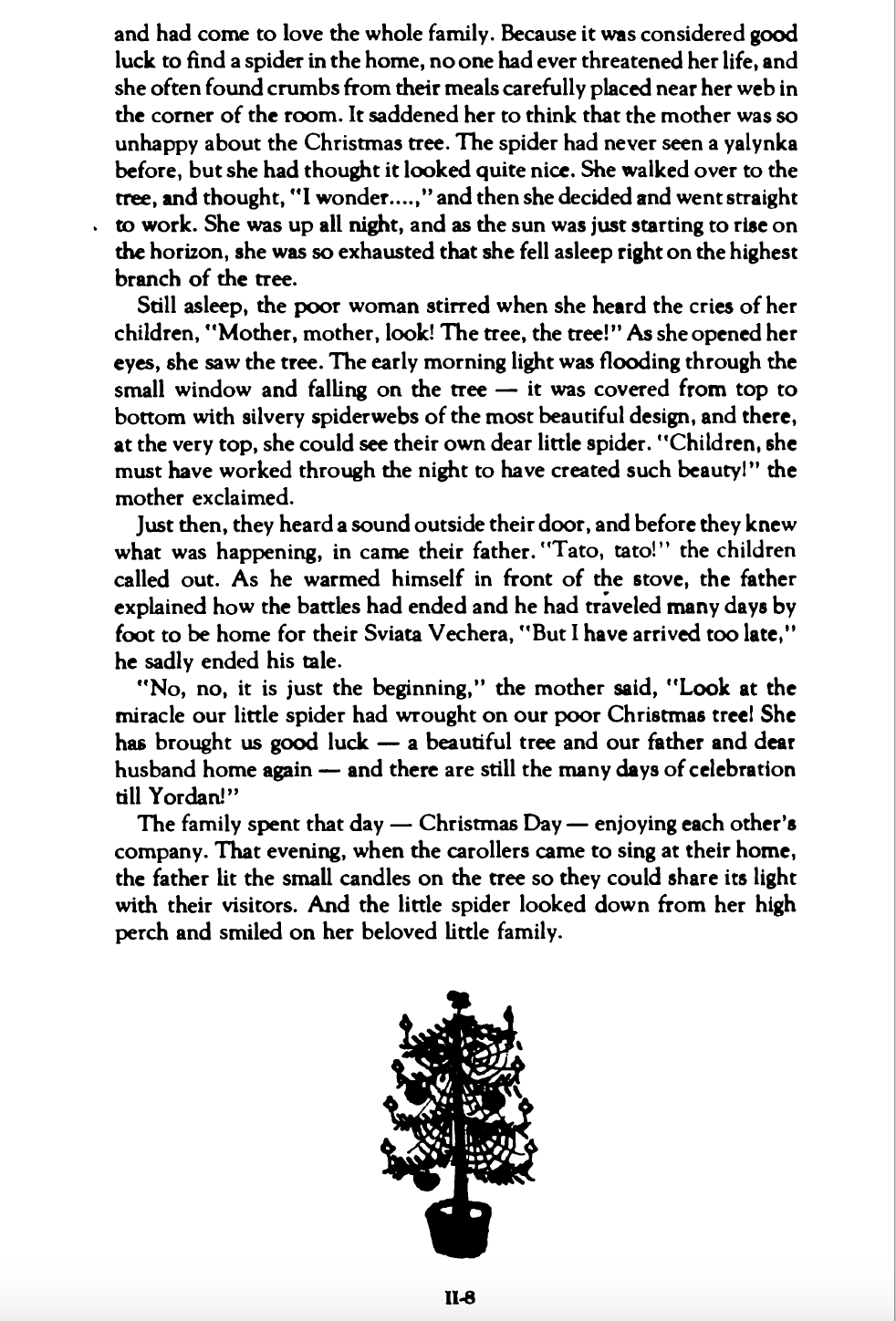
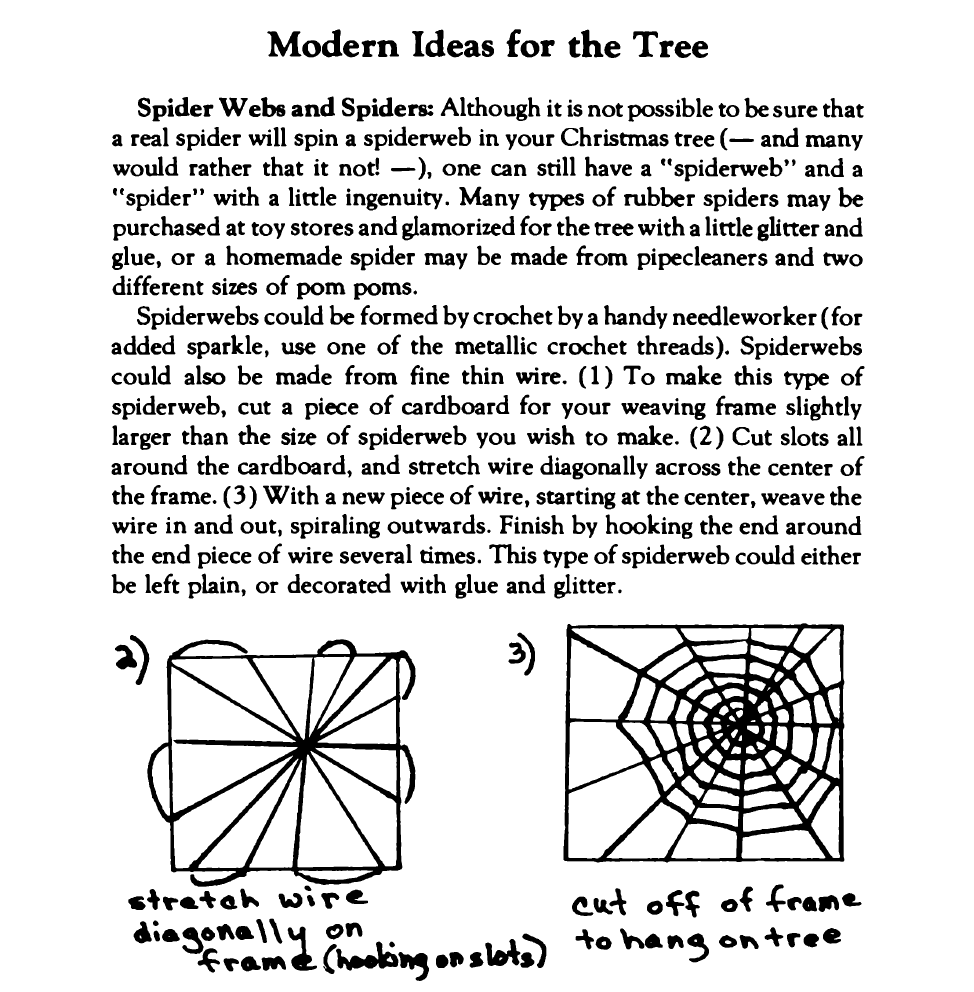
A children’s book Silver Threads published in 1994 by Marsha Forchuk Skrypuch and illustrated by Michael Martchenko retells this story of a benevolent spider assisting a distraught wife who longs for her husband’s return from war in the context of the Canadian Ukrainian diaspora and World War 1.
Another children’s book reinterpreting the legend , The Golden Spider, was published in Ukraine in 2009 by Ivan Malovych, illustrated by Kateryna Shtanko. This was published by A-BA-BA-HA-LA-MA-HA, which describes itself as “Ukraine’s finest children’s book publisher and one of the most esteemed producers of children’s literature in Central and Eastern Europe. The first privately owned children’s publishing house to be established in an independent Ukraine.”
You can even buy Christmas Spider decorations from the Ukrainian Museum https://shop.theukrainianmuseum.org/products/7
The Traditional Straw Pavuk
Somewhat separately from the story of spiders decorating the Christmas tree, which seems to be a more recent phenomenon, is an ornament also called a “Pavuk” or “spider” that hangs from the ceiling and is meant to bring good luck and protection. According to the St. Volodymr Institute’s website, “A pavuk, meaning “spider” in Ukrainian, is a traditional geometric mobile with deep cultural roots. These handcrafted talismans are traditionally believed to trap negative energy and bring blessings and protection to households. Their web-like forms, made from harvest straw, reflect the interconnectedness of community and the cycles of life.” The Institute is hosting an exhibition”Pavuky for 100 Days” in 2024 commemorating 1000 days of occupation since the beginning of the war with Russia: https://www.stvolodymyr.org/news/pavuky-for-1000-days
The pavuk exists alongside other very traditional Ukrainian ornaments made of straw, especially the “Didukh“, or “forefather”, a sheaf of grain which commemorated the family ancestors and was carried into the house and placed in a space of honor near other icons during the holiday season.
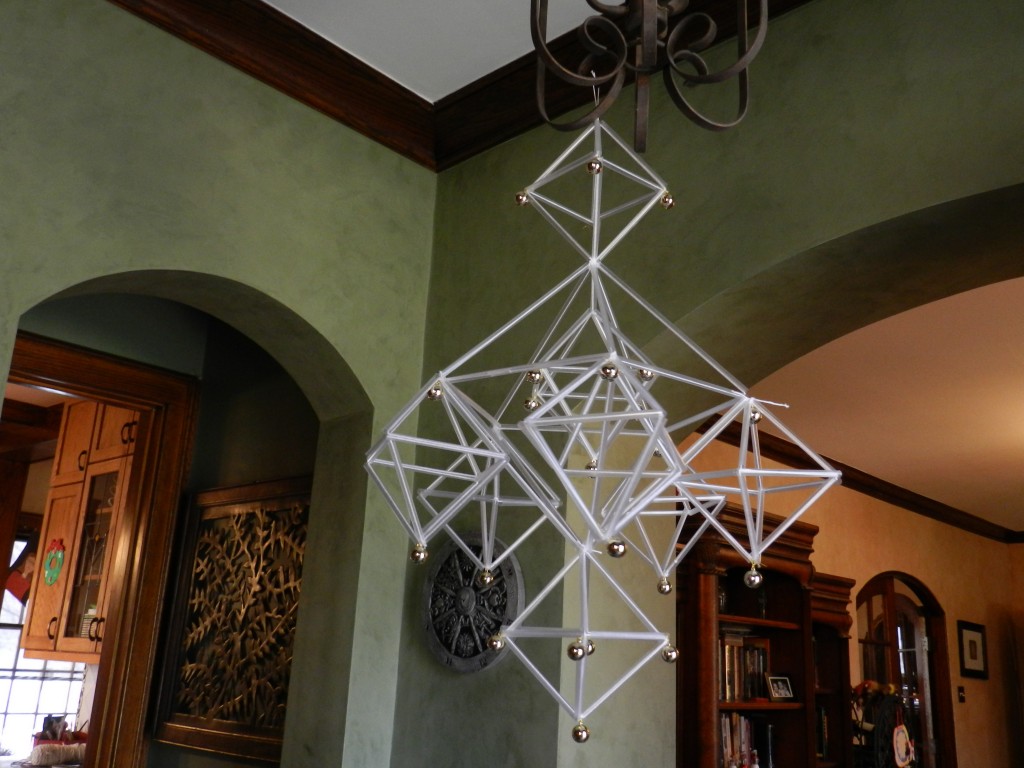
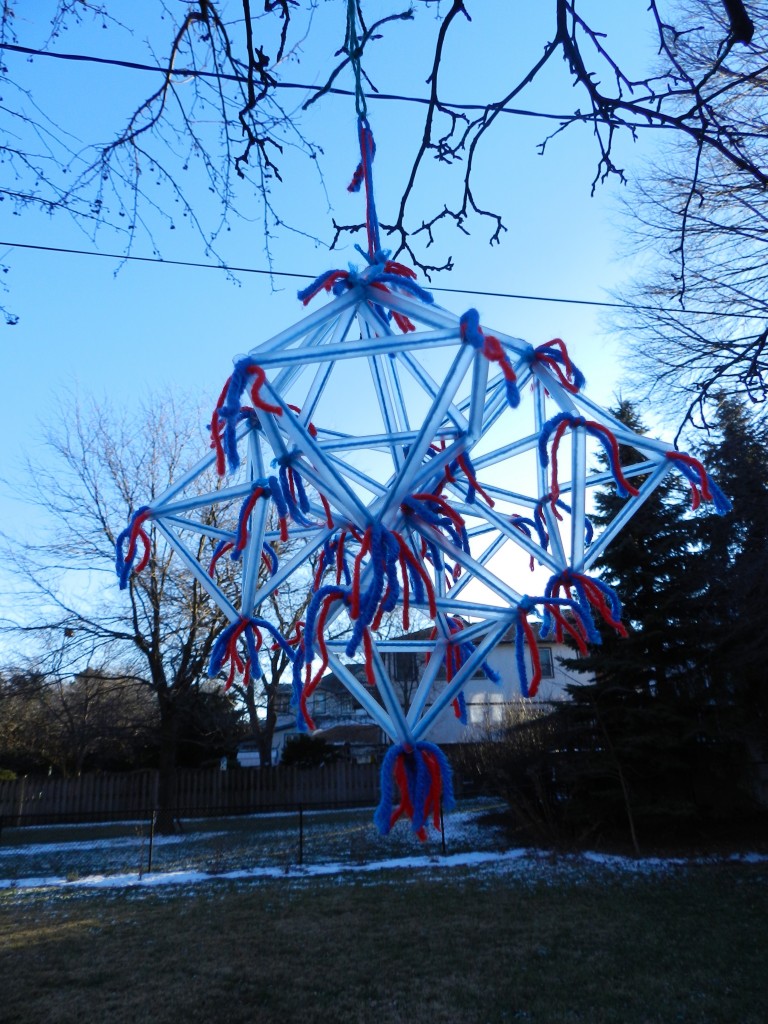
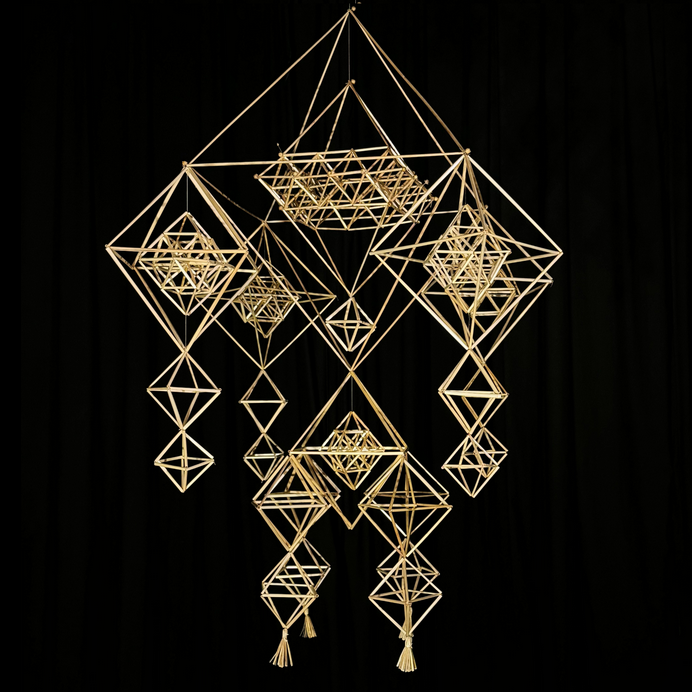
“The Pavuk (“spider”) is a mobile that would also be crafted from straw. It would be hung in the home for the winter season. Out of the chaos of these random pieces of straw , they would cut and craft diamond shapes strung together to make a delicate hanging mobile. Some say the name comes from patterns like a spiderweb, others saw that the hanging mobiles themselves are like giant spiders. Either way, it’s a wonderful name and tradition, since spiders are cherished in Ukrainian culture as messengers, harbingers of good fortune. The pavuk would absorb the negative energies and then get burned on the Feast of the Epiphany. Some believed that they should be left hanging in the home to attract good luck for the family. Some moved it to the barn to bring fortune and health for the animals. Either way, the pavuk reminded the family of the bounty of the harvest through the cold winter days.” – Valya Dudycz Lupescu from her blog post “Spiders and Straw” (Left and middle images above from this website. Right image from St. Volodymyr Institute “Pavuky for 1000 Days exhibit”)
This Youtube video features a two hour workshop offered by the St. Vladimir Institute in Toronto “Design your Pavuk – Straw Spider Mobile Workshop” with Božena Hrycyna: https://www.youtube.com/watch?v=14XUDXuNGW4
The Ukrainian National Museum in Chicago has offered workshops on this tradition in the past: https://ukrainiannationalmuseum.org/traditional-ukrainian-pavuk-by-anna-chychula/
An acquaintance, Rita, provided a link to this wonderful blog post on this tradition in Poland and other Eastern European countries: https://lamusdworski.wordpress.com/2016/10/23/pajaki/
Websites shared with me include the following:
Other Materials
While researching this post I came across two editions of the Ukrainian Weekly that were chock full of articles about Ukrainian Christmas happenings. I include the PDFs here for your information
Ukrainian Weekly Sunday November 3. 1996 (Includes article on authors of the Golden Spider and Silver Threads)
Ukrainian Weekly Sunday January 9, 2011 (Includes mention of Shepko family puppet show, Carpathian Christmas traditions, Christmas straw ornament workshop)
Websites shared with me include the following:
https://kraftmstr.com/christmas/books/spider.html
https://grannysu.blogspot.com/2007/12/christmas-story-christmas-spider.html
 Cider With Maria