Back at the Broome

I have returned to Broome Farm for a visit about six months after my departure, and it’s almost like I never left.  So lovely to slip right back into drinking some amazing cider outside the cellar with the regulars at the end of the workday.  Folks report that, though the apple crop is not a bumper one as media reports have suggested, it is better than last year, and it is nice to see many of the apple and pear trees laden with fruit.

me in front of the Holmer Perry Tree at Broome Farm

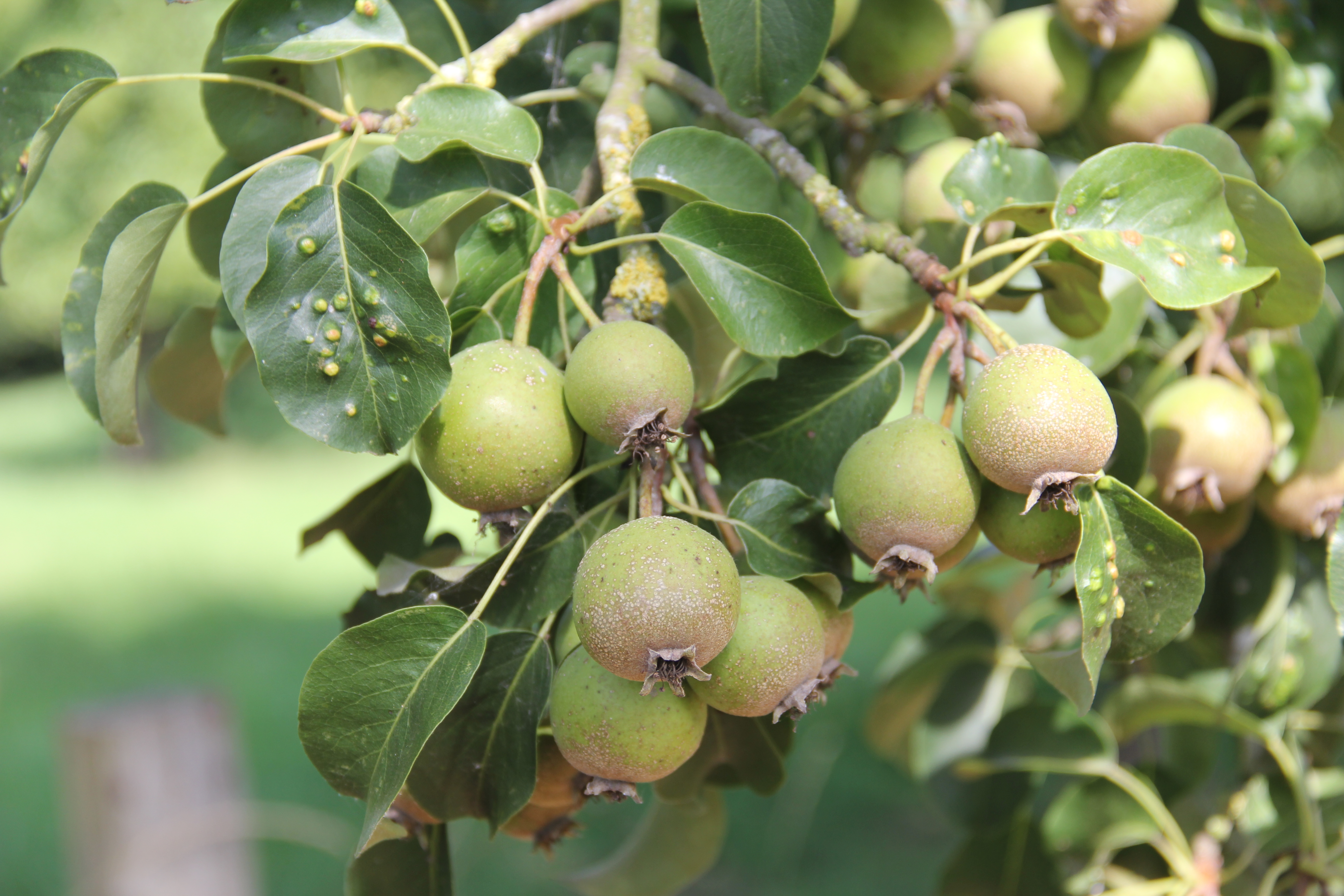
One tree in particular, the old Holmer, is looking particularly laden with its tiny fruits.  Standing under it the other day, I asked how old it was, as it is the oldest and largest fruit tree on the farm.  Our friend John Teiser, cider maker (Springherne Cider), tree enthusiast, and orchard researcher, said it would probably date to about 1828.  I was taken aback by such accuracy of date, and John explained that it was in the decade between 1820 and 1830 that Thomas Andrew Knight, a local Herefordshire gentleman farmer who pioneered fruit breeding in the 19th century, popularized the variety of perry pear he had discovered in the vicinity of the village of Holmer, north of the city of Hereford.  According to John, many large old Holmers date back to this decade, as Knight convinced many people all over the county to plant them during that time.  Mike said he remembers several other large specimens of perry pears standing nearby when he was a boy, but they have died out long ago.  As we were admiring the majestic and craggy old tree, which has skeletal dead branches interspersed with the green boughs full of fruit, my friend Liz grimaced slightly and said it was the worst pear to pick up of all the pears in the orchard, due to its tiny size.  But one can’t help but respect such an old tree.

holmer pear
holmer pear

Meanwhile, I spent the afternoon over at Much Marcle at Westons Cider.  Somehow I had managed never to take their facility tour when I was here previously, so I decided now was the time.  The tour guide was very lovely, and she took us all round the busy facility, stopping frequently to let the Westons lorries pass by.  By far the most interesting part of the tour was the Vat room, where over 90 oak vats of huge proportions, some over 200 years old, stand holding vast quantities of cider during its aging process after fermentation.  Each of them have names, a tradition started by the founder of the company.  The vat room inspires feelings of awe and wonder, even more so than the equally massive holding tanks that loom outside over the distant Malvern Hills.

Oak Vats at Westons
Oak Vats at Westons

No, the vat room is dark, dank, and full of mysteriously huge and ancient vessels whose girth and age, not to mention their very names, seem to bestow upon them a sense of mythical and yet earthy personality.  Titans of cider – the kind of creatures that preceded gods.  You feel you have entered a temple inhabited by mischievious and montrous beings through which billions of litres of cider have flowed.

Well, after that, I needed a bit of a stroll, you know, to relax the mind.  So I drove down the lane to the Helens to visit the avenue of perry pears, trees even more ancient and craggy than the Holmer at Broome.  The avenue was planted to commemorate the coronation of Queen Anne in 1702, and some of the trees still hang on to life.  I’ve admired these trees in the past, and last fall at the Big Apple festival, which is held on the grounds of Hellens Manor, I got to taste the perry made from these pears, the Hellens Early and the Hellens Green, and it was lovely.  Somewhat sweet, with a honeysuckle nectar quality as I recall.  One vintage had a hint of woodiness as well.

More to come on further adventures in perry, cider, Broome Farm this trip.

Avenue of Perry trees at the Hellens, Much Marcle

Preamble, With Feeling

I was encountering some writer’s block as I’ve been trying to work my way into writing, and today a conversation with a colleague unlocked some words for me.  Here’s the result.

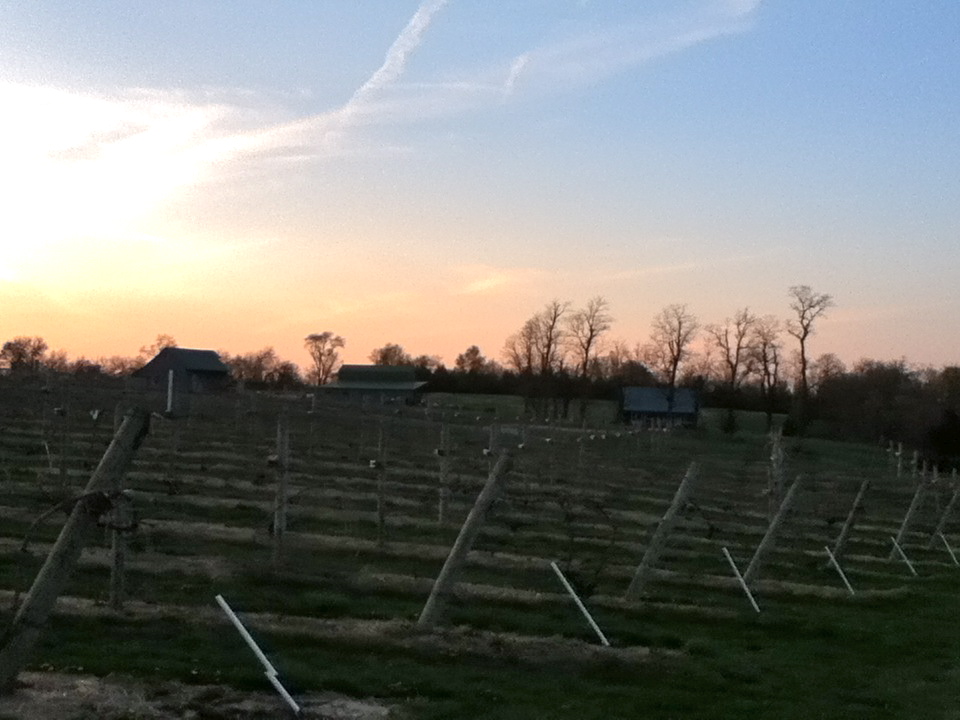
ImageOne summer afternoon in July, 2013, I was sitting on the front porch of a 19th century farmhouse in southern Indiana, watching a terrific thunderstorm roll in from the northwest.  The slate blue clouds billowed across the sky, heavy with rain, as a preamble of cool wind swooped down through the heavy hot humid air in ferocious drifts, lifting the tendrils of the grape vines that lay in orderly rows across the rolling, hilly farmland.  I had been working all morning in the vineyard, but we were dismissed after lunch as the threat of the storm wiped out any possibility of continuing outdoors through the afternoon.  So I decided to watch the storm roll in on the farmhouse porch, set myself up with some books, and determined to accomplish some academic reading in a solitude away from the internet and other distraction, cut off from the rest of the world by a sheet of rain.  It was on this porch that I found myself entering into another rich landscape through the page – a landscape I had inhabited in England, living in the deep countryside of Herefordshire, where my habitat was an orchard instead of a vineyard, and the summer was cool and rainy instead of the heat-charged and electric climate of Midwestern thunderstorm.  To be in two places at once with such intensity was jarring.  Surrounded by the vineyard which I had grown to love through sweat drenched and exhausting work among the vines, accompanied by the camaraderie of the other vineyard workers, I attempted to burrow back into my memories of the English countryside through a dense academic rendering of theoretical conceptions of the rural.  But the Indiana vineyard had a physical hold on me in the present, even as I tried to rethink and replay the Herefordshire orchard I had loved so recently.  As so many ethnographers before have done, I felt deeply torn, emotionally and intellectually, between two places: trying to think and feel one place while thinking and feeling another place.  Perhaps some are better equipped for such multi-tasking, but for me, it was difficult – I felt a subterranean friction jarring the singular unity each place held in my emotional imagination.  One intense emotional place-memory recalled in the midst of another place, composed also of senses and feelings.  How can these compositions of experience coexist, one rupturing the wholeness of the other, simultaneously heightening the intensity of both, and then their loss.  Of such feelings is nostalgia born, but this is more than just nostalgia.  It is an attempt to hold two experiences intact, but their collision creates an excess of each, a calling forth of references and relations, so that one memory cascades from another.  In the midst of a Midwestern thunderstorm, I remember the floods on the River Wye, and all my days walking next to it, and all the farms and people on its banks.

It is feeling to which I turn in this preamble because feeling will play out in the remaining parts of this work frequently, and it is this deeply-felt connection to a unity of people and place which characterized both my fieldwork experience and my own evolving sense of the ways I uniquely and personally experience my world.  The reflexive turn in ethnography has allowed us to re-examine the personal lenses and biases which colour our own attempts to construct objective scientific study, and further has also allowed us to imagine and engage in critically emergent study – research in which we come to recognize our biases and the interesting questions they present in the course of our work.  Such research rejects the simple objective positivism of deductive reasoning, where a hypothesis is generated and then tested through a pre-conceived and vetted methodology.  Positivism has its uses and its place, but emergent and reflexive research suggests a series of discoveries about the types of questions we have asked, as well as the data generated by them.  This preamble of feeling then, is a first discovery, that my reactions to places are rooted essentially in deeply emotional connections to people in their places, connections that are experienced in a present-time rich and dense in the sensual perceptions which give texture to the social relationships enacted in the landscape.

Though these are my own personal tendencies, they are also windows into particular kinds of questions about social and cultural landscapes, perhaps questions which my proclivities can give particular insight into.  As academics, too often we forget to mention not only how our personal histories, biases, and experiences influence our research, but also our personal talents. It is as if our scholarly talents are a given, separate from our personal lives, a set of intellectual exercises refined by our scholarly disciplines.  Reflexive scholarship could increase its potential to enrich academic life by helping to inform students and professors alike not only of their intellectual, cultural, and political biases, but also how their personalities and talents contribute unique approaches to the questions we consider.  This would seem self-evident, and yet methodology does not usually require us to ask how we approach and process our experiences in highly personal ways dependent not only on unique social and cultural experiences, but on temperament, talent, and character.

Image

So what is the quality of feeling and affect on our experience of places and landscapes?  The following chapters will attempt to tease out a few strands of thought relating to the causes and consequences of feelings related to the landscape.  Feeling, emotion, and affect continue to be difficult subjects to attend to in scholarly study.  David Matless, in his essay “Doing the English Village, 1945-1990: An Essay on Imaginative Geography” organizes his argument around the importance of attending to beliefs, myths, feelings, and impressions related to place:

This essay, by contrast, critically embraces the many imagined realities of the English village – its sentiments, its fantasies, its dreams, even its sugar-sweet pond ducks – as things real, powerful, political and moral; things serious and of importance in the culture of the country.  Its purpose in doing so is in part to establish a complexity in the discourse of the rural. (Matless 1994, 8-9)

Writing against what he calls the “rhetoric of reality”, Matless foregrounds the imaginary construction of the landscape, including the affective and emotional aspects of the imagination, as real entities, no less important or powerful than the realities of poverty or isolation with which some sociological studies (useful and important in their own right) have dried to debunk the myth of the rural idyll.

So I walk through the vineyard, tying up vines, pruning, shaping the growth of the place, feeling the sun, the heat, the electric thunder and the enjoying the chatter that we toss to each other across the vines like so many clusters of grapes. And loving this place, I try to conjur up an orchard in England, in the valley of the Wye, and I try to unlock the feeling, the imagination of a place where the orchard pressed out cider and laughter too, where the river floods, and a glass is never empty for long.

From Cider to Wine

IMG_0084As some of you may know, I’ve recently taken on a new job at a local winery in Indiana – Oliver Winery.  Why wine and not cider?  Well, Oliver does happen to make some ciders, and as the oldest and largest winery in the state of Indiana, right down the road from where I currently live and am attending grad school, it seemed like the best choice and a really good opportunity to get more insight into the wine and cider business here in the United States.  Plus, they were hiring right when I needed to find a job.  So this blog may begin to take on the world of wine as well as cider.

I was hired to work in the tasting room, and I have been happy also to find my way into some work in the vineyard as well.  Let me just say, that up until now, I have enjoyed wine, but have known very little about it.  My introductory training at Oliver has opened up a whole new world of the grape!  Southern Indiana, it turns out, has some great advantages as a wine growing area.  Our upland landscape has some ideal topogaphy for drainage, and we get enough sun and heat in the summer to support some good growing conditions.  Oliver makes over 40 different wines, some from grapes imported from other growing regions in the US, and some from its own Creekbend Vineyard, where I am also now working.  Some of my favorites at the moment are the Chambourcin, Zinfandel, Cabernet Sauvignon, Chardonnay, and Traminette, and Vignoles.  Let me just say that our training was wonderful, thorough, and very fun (but very responsible!).  In the tasting room, we have to be able to describe and discuss all of these wines for customers, so we really do have to know how they taste, and how they are made.  And customers are many!  On a weekend, there are usually at least five people behind the tasting bar at all times, not to mention many other staff on the floor, at the registers, and behind the scenes.  Thus far, I am really impressed with Oliver as a company – they seem really dedicated to treating customers and staff really well.

My time out in the vineyard has just started, but I am so glad to be able to spend time working in an agricultural setting – this is one of the things I love about cider and wine – the connection these drinks have to their agricultural source.  Working out in the landscape is so rewarding.  On my first day, I spent all day pruning and tying vines.  And today, I spent most of the day digging holes and planting replacement vines with some wonderfully friendly and fun co-workers.  We’ve had very cool wet weather interspersed with some tantalizing warm sunny days.  Many of the vines are breaking bud, and it it quite exciting to think that they will soon begin to leaf out.  I’m learning little tidbits about wine grape cultivation along the way, and I hope to keep learning more.  As much as I miss the orchards in Herefordshire, I am really happy to have found my way back out in the fields here in Indiana, contributing to the alchemy of fruit growing and fermentation.

Meanwhile, my dissertation has been on the backburner – moving back to the States, getting this new job, training, and starting in both capacities at the tasting room and the vineyard have taken up a lot of my time for the past two months. (As well as some academic tasks like attending some conferences, writing reviews for journals, and submitting paper proposals for more conferences).  In addition, I’ll be teaching a summer course at the University during May and June, which has diverted time and energy into preparation for that task.  However, I have been reading and picking up new books on the dissertation subject.  Some interesting readings on Cider and the English Landscape are on my desk, and I hope to share some thoughts on these as I work through them.  Stay tuned!

Final Cider Con Catch-Up

Apologies for my week-late final post on Cider Con – I was laid low with a cold and moving into a new house, so I neglected my follow-up.

However, here is another summary / partial-transcript depicting Friday morning’s panel of Cider Makers.  Again, not an exact transcript, but my best attempt

Cider Market Review 2012-2013 Outlook – A Panel Hosted by Ben Watson

  • Tilted Shed Cider: California-based company, We started 2010.  We fell into cider because we loved to grow our own food, grow our own drink.  Scott is a fermentation mad scientist, and if he can make alcohol with something he will.  We had been doing some market farming at that time and something about cider captured us.  We couldn’t believe it could be good.  Took Peter Mitchell’s courses, read the cider books.  Moved to California.
  • Tieton Cider Works.  Washington. Started in 2009.  30,000cases this year, distributing to 7 states.  &th generation orchardists,  Wine background.  In 2008, Campbells decided to start propagating 40 varieties of trees to see how they would do.  Seattle or Portland area, not uncommon to see 4 taps out of 12 of cider.  A really good region.  Nation’s first cider bar in Portland.  We’ve been developing a brand that people enjoy, producing high end drinkable ciders that go well with the market trends that are pushing it.
  • Bantam Cider, Boston.  Very new cider company – two women.  Started a few years ago, launched product last January.  Family background in winemaking for one of us.  Being in Massachustettes, apples are really part of the culture.  There was awareness of cider, but in the past couple of years, cider has become more known.  We started making a little as a hobby, and it has evolved.  Mass is a pretty fantastic market – an interest in local, artisanal products, an entrepreneurial spirit. A thriving community focused on innovation, which has allowed us a great opportunity for collaborations with other local producers, as well as a thriving craft beer market.
  • Virtue Cider, Chicago.  First cider on the market in Chicago last April.  Started Goose Island many years ago in Chicago – long experience in the craft beer business.  I see a lot of similarities.  We chose to do our cider in Michigan, as it has a great history of apples.  Lot of great cider makers and craft beer scene there.  We look at craft cider very similar to the way the craft beer scene has grown.  I think this whole craft beer thing has gone so local, and I think the same thing will happen with cider.  There will always be room for the big national brands.  Beer guys and wholesalers and retailers are really excited about cider, because they see that is where the growth is.  In Chicago, we don’t have producers in the city, though there are outside and in the suburbs, but we think there is room.  We had Woodchuck on tap at Goose Island in the early years, because that was all we could get. I learned more about beer talking to other brewers, rather than at the institute.  I learned lot more about cider talking to other cider makers, rather than taking the Peter Mitchell class.

Ben Watson: What are the demographics of Cider?  Who are your customers?  At the Cider Salon, the crowd that waits in a long line outside of the church community center is getting younger and hipper every year.  What do you see?  Who are the new cider drinkers?

  • Virtue Cider: in the cateogry or 24-27 year olds, drink preference for cider has skyrocketed.  In Chicago, the bars who order our cider every week – At Hopleaf, we are always in the top 3 of the drinks they sell.  Going young and very very crafty with beer drinkers is where we will continue to go

Ben: Cider has always been the red-headed stepchild of beer or wine, and it is a fools errand to compare it to beer or wine.  What is everyone else’s perception

  • Bantam Cider: Our top selling accounts are the craft beer package stores and craft beer bars.  Not excluding wine drinkers, and we see all the time that the younger people are open to it.  The older side of the demographic is more cautious.
  • Tilted Shed: We make cider in wine country, so the culture there is heavily steeped in wine.  Our primary market is the Bay area.  I find there isn’t such a huge age split.  We get equal interest from the beer geeks as the the wine appreciators.  We are getting dedicated cider drinkers from both beer and wine drinkers, from both young and older drinkers, from people who are really into exploring.  We do get recognition of the food friendliness of our cider.  Alice Waters is our patron said of food and wine.  We have real appreciation for the localization of products.  People want to know the story of food.  It’s less about category and more about the connection to the land.  Our market is a bit younger – the majority of craft ciders in our market are in 750 mls – a lot of our drinkers are coming from the wine market.  For us, the wine drinkers are more apt to pick it up, which could be from the bottle format. We’ve decided to put it on tap to get hold of the craft beer drinkers.  I think as the bottle format changes, younger drinkers will come on.  The older crowd doesn’t know about it, whereas the younger crowd does have a preconceived notion of it.

What preconceived notions do people come to your cider with?

  • Tieton: people think of a fresh pressed cloudy juice, who think hard cider is going to be the same.  And when they taste dry cider, it is difficult.  It was a matter of getting people to understand that ciders aren’t alcho-pops, or Mike’s Hard Lemonade .
  • Tilted Shed: To help people understand that we are not a sweet fizzy pop – though there is a room for every style – we don’t do that.  Because we are in a wine region, and we are geeks about the cider apples, we compare to the way grape varietals make good wines.  By geeking out about it, people start thinking about it the way they do about craft beer or wine.

Audience Question: Are there solid numbers to tell our bankers where the cider market is going?

  • Virtue: I think that is something we can look forward to asking the conference and the association in the future.  Cider has grown 20% in a year according to someone in the craft brewing industry.  The preference data is even more exciting, because that is where it is going.  Supermarket and scan data from big chains doesn’t quite capture the on-premise numbers – it lags behind.

Audience Question: Where do you see the consolidation of the market and how does it compare to the craft brewing industry?

  • Virtue – With brewers, the vast majority don’t know where their product comes from.  I think part of the story of cider is that 40% are growing their own fruit and most know where their apples are coming from and are local.  I think that is really cool, and that makes us different and unique.  I like to call wine, “cider made from grapes.” But I think that is where the staying power of cider is going to be.  There is always room for the big guys, who can’t use local fruit, because they need to keep their supply chains.  And I think everyone in this room needs to respect that.  They’ve been at it much longer than any of us, with a few exceptions.  The big guys are the ones with the money who can help us get the legislative stuff going.  I saw this in craft beer, where the little guys thought the big guys were bad.  I think we all want to be successful.  We’ve got to act like a family.  We can have our disagreements in this room, but when we leave we need to say all cider is good.  I think all cider is good, and I’m really proud of being part of this new cider association.

___________

Apple Market Panel, with Greg Peck – Virginia Tech; Panel: David Watkins – Fruitsmart, Steve Wood – Farnum Hill Cider, Kevin Zielinsky –
E.Z. Orchards, Mike Beck – Uncle John’s

This spirited panel brought together professional commercial orchardists who are also cider makers to discuss the pressing issues of apple supply for the growing cider market.  With an overview of last year’s weather and apple crop, these folks launched into the uncharted territory concerning the development of an orcharding industry catering to the cider market’s desire for cider varieties.  The core issues remain ones of risk – who is going to take on the risk of trialing apple varieties in different US regions?  Who is going to take the risk of financing the propagation and planting of cider varieties as commercial ventures?  While all of these orchardists have taken on growing cider varieties in a small way through their own interest, they largely insist that the cider makers will need to take the step of ensuring a market for cider apples if growers are going to commit to the large investments necessary for planting and maintaining orchards over long periods of time.  Long term contracts seem to the buzz word on orchardists’ lips, though they also recognize that cider could be an alluring new market with far more dependability than the current pack-apple market.  Here’s some highlight points of discussion:

  • EZ Orchards, Oregon – Not a large producers of apples, more pears.  Those that are are Fresh.  Small acreages of cider varieties and older varieties such as Newton Pippin which are being used for cider
  • Uncle John’s Cider, Michigan – 2012 was tough.  US Apple data is different than MI apple data.  We estimate a 90% crop loss.  We bring 12 varieties to the market: Winesap, Northern Spies, Jonathan, Reds, Yellows, Galas, Breaburn, Fuji.  We are a processing state: 65% of total crop.  Lots of Manufacturing: Gerber, Sarah Lee, etc…  For a cider maker you aren’t going to find more varieties anywhere else.  2013 is looking great.  Processors have very low inventories.  As a grower, we are looking forward to good prices.
  • Steve Wood, Farnum Hill Cider,  New Hampshire –  2012 horrific early spring.  A lot of the cider fruit we grow is fairly late budding, so frost damage can be less for those.  Good Cider crop, despite erratic apple crop.  Market was as strange for processing fruit as for everything else, due to low availability.  We sold cider crop for 50 cents a pound.  Rest of the crop at 15-18 cents a pound. We could have sold much more for cider than we did sell.  Next year, hoping for a huge crop nation wide of cider fruit, so I can find out how much of the enthusiastic market that existed last year will be as interested this year.  What is encouraging to me, is that the cider fruit market had been calling me before the crop shortage – I am encouraged to think that the value of proper cider apples is high and supportable.  We may cut back on our high end specialty market for heirloom apples.  But I don’t think we would have been able to charge more for our premium apples the cider makers are interested in if they had been organic.

Questions

On investing in varietal specific production for the cider market

  • One of our big decisions is the long-term 20-year investment in the orchard.  We are looking at where cider will peak?  We want to do a long term contract.  I don’t want to speculate on putting in cider apples if there won’t be demand in a few years.  We are doing 1200 trees per acre.  It takes a lot of commitment for someone to grow them.  If you want commercial guys to grow you a lot of cider apples, I think you are looking at a contract.  It is a specialty type of growing.
  • There are a lot of question marks about these varieties as well.  We need a lot of investment from the universities as well, or a contract.
  • There are more commercial growers budding more bittersweets than ever.  But cider makers have to pay the growers.  For my money as a grower, I see this as a stable investment, because I see it going up for long time, compared to a pack apple.
  • The universities are not spending any money on cider or organics research.  They are sponsored by the Ag companies for high-end apples.
  • Fruit used for cider apples does not have a second use in the fresh market, so there is no other market stream for them, making it is a real risk for the grower
  • Growing cider apples is also still not very well understood and best practices not online for orchardists, especially the English and French varieties
  • Mass market ciders are not using bittersweet, because it isn’t available
  • How far along does the cider industry need to be before you will sign on to a 20 year contract?  Looking ahead?
  • A lot of the English cider varieties don’t do well in our area (Oregon).  We are looking at what will grow well and what we will use, but not to the extent that we will gamble on planting 500 acres.
  • To find what we could grow in New Hampshire, we trialed a few hundred varieties, and ended up with a handful.  This was private research.

On being a maker or a grower – pros and cons of growing your own apples, contracting, and sharing innovation risk

  • If you are a cider maker thinking of buying an orchard, think twice, because growing apples is a demanding business.  The growing of fruit to that standard will demand you be a good accomplished  grower who knows their soil and their climate.
  • (Audience member response) I know I will never be a commercial grower, but I want to plant an orchard to be a database for the growers in my area.  There is risk out there that people will need to take to put these trees in the ground.
  • The need for investment in targeted research in quality cider-apple growing
    • Do higher quality apples make higher quality cider?  One of the most important parts of fruit production is the level of production you can expect year to year.  Since Long Ashton, there hasn’t been any research about how micro-managment of growing can affect the qualities of apples.
    • If you are out-sourcing apples, you need to know about the situation of those apples – as a grower of our own apples, we watch all of those levels – sugar, nitrogen, ex – and we treat cider apple trees differently than we treat the fresh market apples to get optimum sugar in those apples for fermentation.

Cider Con Day 2 – Beer Market or Wine Market?

Day two of Cider Con has been perhaps even more energetic than day one, with general positive enthusiasm leading into some intense discussion of issues, problem solving, and networking.  One of the major themes I’ve encountered today has been the Beer vrs Wine issue.  While in the UK, cider has a culturally recognized place as a distinctive and individual drink (relatively speaking here – I know the same issues do still apply), here in America, people are dealing the issue that hard cider is essentially a non-entity, and many discussions today have revolved around how to fit your product into the appropriate beer and wine markets, how to communicate with distributors in those markets, and how to speak to them in a language they understand while educating them about the character of the drink you want to create.  Britons, you’ve probably dealt with all this too, but the thing that I can’t help but notice here is that AMERICANS LOVE TO SELL STUFF.  That’s right, I’ve come back home to the land of the aggressive, enthusiastic, and self-assured entrepreneur.  Americans love to sell stuff, and they know how to do it well.  The challenge I see people tackling here is not just developing product identity and creating markets to fit – which I am sure will happen in the long term – but rather harnessing the strengths of the wine and beer markets that already exist and channeling cider through those markets in the ways most beneficial to individual businesses and their products.  The strength of the distinction between the wine and beer markets, and the approaches to these markets in the United States was very striking, perhaps the more so because of the muscular approach these American cider makers have towards using and manipulating the markets to their best advantage, something I had not experienced in England.  This is possibly attributable to both the difference in cider culture itself between the countries, but also to the cultural differences in the approach to business practice and marketing.

Below, I include a rough transcript following an exchange during one of the workshops led by representatives from Virtue Cider, based in Chicago and run by folks with a successful history in the craft beer industry, and Farnum Hill Cider of New Hampshire, with a background in orcharding and a more wine market approach.  This is not an exact transcript – but an approximation of some interesting exchanges on these topics, with me typing as fast as possible while listening and trying to get as much of the words and the gist of it as possible:

What to say when you don’t know how to sell cider?

  • Farnum Hill Ciders: We are more wine-like in our behavior than beer like – we don’t want a sales associate to think if we run out of something that there will be more soon.  We want to create the sense that scarcity is good.  Beer reps find this difficult to understand
  • Virtue Ciders: We looked at cider within the craft beer market of Chicago.  We were able to use the momentum of craft beer here and in other regions, also with the craft beer expertise of me and Greg from Goose Island. We needed to educate our audience when we started with craft beer.  How to do this with cider?  With Virtue, we use a lot of beer yeasts and barrel age our ciders in wine, raw oak, and bourbon barrels.  For me, with the products that we have, we have been able to penetrate the craft beer business with cider.  I’m still learning the production side, so that we can put it out in the market. I have to let accounts know what is coming up next in production, and explain it to the consumers.  I do tastings in Chicago, not just as a rep for Virtue Cider, but to educate the public in general about styles of cider. 

Audience Question: What are the styles of cider?  Dick Dunn has created styles for use in the Great Lakes competition. 

  • Farnum Hill Ciders: I think that is a pile of horsefeathers, as there aren’t any defined styles now.  I don’t think we want to predefine styles by region too early – it took a long time to do in Europe, and it will take a long time to do here.  Same with single variety cider.  I think what is happening now happened in the American Wine market in the 50s 60s an 70s.
  • Audience Question: Dick Dunn is trying to satisfy the beer geek crowd –
  • Farnum: But you shouldn’t have to do that to satisfy people who don’t know anything about your product
  • Audience comment: let the consumers choose – tell them what is in the product and let them decide what they want out of it.
  • Virtue: If we are educating people about the variety of ciders in general, than we should have things to satisfy different parts of the market.
  • Farnum Hill: You have to get rid of the preconceptions the consumers might have about cider before they get the product in their mouths
  • Farnum Hill: The challenge of dealing with the beer market – they always expect something new ie Christmas beer etc?  And we don’t do that.  We make the same thing every year.  Like wine, our strength is terroir.
  • Virtue: with my experience in beer, we still have the flagship products, like the Redstreak.  Also we have accounts who are more interested in local than in new.  We are relaunching, in a sense, the 2012 harvest of the Redstreak to get a bit of hype about this year’s product.
  • Farnum: Wine people aren’t about what is new, but what is continuous. The culture of the beer world is hard on cider makers, and you have to decide what you want to take from the beer world and what you want to stamp out of your representatives. 
  • Farnum: As to styles: I’m against regional styles that tie styles to cultures that no longer exist and need to regenerate (idea of a New England style based on historical cider making to which there is little continuity).  As we become better cider makers, and establish orcharding traditions for cider, these styles will emerge.  In the meantime let’s talk about sensory style, so that people know what kind of taste experience we are going to take them through.

Stay tuned – I’ll post some more on other issues from today later on.

Summary of Day One Cider Con 2013

WHOA!  Cider friends!  It is the end of the first day of Cider Con 2013 in Chicago, and my mind is positively spinning.  Having just come back from England, the opportunity to contrast and compare the English and American cider worlds is particularly fresh.  The conference is buzzing with excitement and activity – with between 200 and 300 participants from all around North America, including one from Mexico City, and representatives from NACM over from England.

One of my first impressions from the day is that cider makers here are really excited and interested in the chemistry of fermentation.  There were a lot of technical terms being thrown around that were frankly beyond my knowledge and left me out of my depth.  This seems to stem in part from the fact the many cider folks are crossing over from the beer or wine industries and are bringing that brewing and fermenting expertise with them.  One of the big events of the day was a sensory analysis session, where we were presented with a series of ciders which had been doctored with chemical additives to simulate what kinds of faults or variations could happen with fermentation processes, including detailed chemical diagrams and names which I barely recognized, followed by adjectives that were far more familiar to my tasting experience: farmyard, buttery, grassy, etc…..  But the level of detail was far beyond anything I had previously experienced.  The name of Peter Mitchell loomed large everywhere, and seems to definitely be the authoritative expert to whom most in the industry are turning for information.  Indeed, his partnerships with the academic research institutions detailed below seem to be very key to the information network.

There is a lively little group of academic researchers who are keen to work with the emerging cider industry to find best practices for orchard production and fermentation.  They helped kick off the conference this morning with a live survey of all the participating cider businesses, asking questions about their business profiles, expectations, and research needs for the emerging industry.  They hope this information will prove useful not only to the newly formed American Cider Association, but also as primary data for developing research proposals and funding applications to conduct substantive research. These people included:

Olga Padilla-Zakour from Cornell University Department of Food Science, who is a specialist in fermentations, presented on “Developing Educational Programs for Hard Cider Producers.”  Cornell has a history of research in wine fermentation due to the nearby finger lakes wine region, and they are excited about the resurgence of interest in apple juice fermentation.

Greg Peck from Virginia Tech Department of Horticulture presented about research into the economics of setting up a cider orchard, taking a survey of the cider industry in Virginia, here. He notes interest amongst commercial growers in converting to cider fruit but lack of knowledge about appropriate varieties for climate and soil conditions, in addition to the needs of the cider makers, currently precludes substantive investment. Cider makers will need to convince fruit producers that there is a market.

Carol Miles from Washington State University Department of Horticulture (see extension website on cider fruit here), in association with David Bauermeister of the Northwest Agricultural Business Center and Northwest Cider Association, have been looking at a host of agricultural and horticultural issues of fruit production and are keen to start trials of cider varieties in North America to assess the quality and commercial viability of cider varieties, which are currently almost non-existent in North America on a commercial scale. In addition, they have also looked into re-purposing blueberry and raspberry harvesters, which currently lay dormant during the apple harvest season, for use as mechanical harvesters for high density trellis system cider fruit harvesting.  Most apple harvesting for the cider industry currently occurs through hand-picking, due to the fact the most orchard systems in use are high density dessert fruit plantations.  Trials for repurposing soft fruit mechanical harvesters to apples are ongoing.

Nikki Rothwell from the Northwest Michigan Horticultural Research Station.  She presented on Cider Varieties suitable for northern climates, based on trials of a few specimens of cider fruit existing in the research station’s collection.  Her report can be found on the Station’s website here. Under the title “Hard Cider Varieties 2012”

Aside from the fermentation chemistry and the horticultural research, I also had a really fascinating conversation with a woman who works as a sales rep for a Washington based cider company, who had also lived and worked in England for several years.  I asked her what she thought the emerging American cider culture was?  What was cider ABOUT in America, as compared to England.  She seemed to think that it was still really in flux, with a lot of enthusiasm from converts from the wine and beer industries, a healthy interest in fermentation, and distinctly different from the very locally-oriented traditions of farmhouse cider we are used to England.  She saw the market as very much a 30-something urban educated consumer.  One of my own thoughts had to do with the relationship of the orchards and landscape to the cider industry.  While England has come to expect regional differences in craft cider due to traditional local varieties, soil types, and economic histories (desert fruit in East Anglia for example), these distinctions have yet to emerge as known entities in America – at least that I am yet aware of.  The relationship of craft cider to its fruit remains one of the components of cider culture in America to be further developed, both in terms of agricultural social and economic systems and in terms of cider styles and tastes.

While chatting with the NACM folks from England, I also made the acquaintance of representatives from Gilder Gagnon Howe and Co., an investment firm from New York who have decided to invest in the emerging cider market.  They knew little about cider but had identified it as a growing market and were keen to learn more about the industry.  Many other vendors at the conference, including bottle and container vendors, equipment producers, etc, expressed a keen interest to learn about the cider industry and its commercial needs.  So it seems the learning curve is high for a lot of people, but the business world is ready to take it on.

All in all, I found this experience very different and very surprising, compared to my sojourn in the small-scale craft cider world of the UK.  This is definitely a new and different cider world. Stay tuned for more updates and revisions of information!  Let me know if you have any questions .  This summary represents who and what I saw at the conference, there was of course a lot more going on.  Look for the schedule of events here.

And Broome Farm Folks, Canadian Kate says a big Hello!!!