It’s that time of year, where I respond to media and friend requests for information on Christmas customs.
Query:
Would it be possible to provide even a few lines of commentary on these mushrooms, specifically (separately from anything Santa-related)? As in, how/why did decorating for Christmas with these red and white mushrooms become a tradition in the U.S.?
Answer:
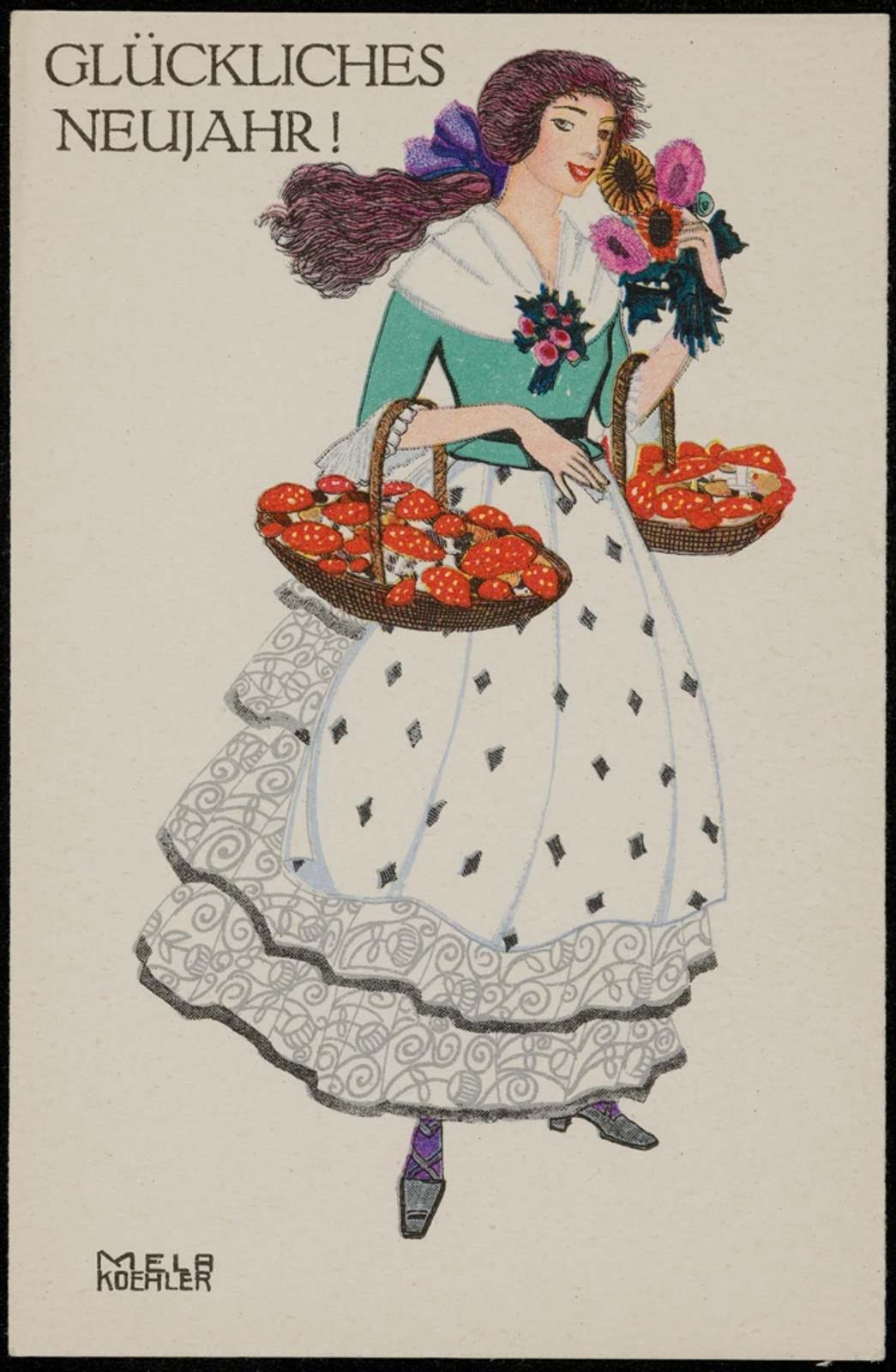
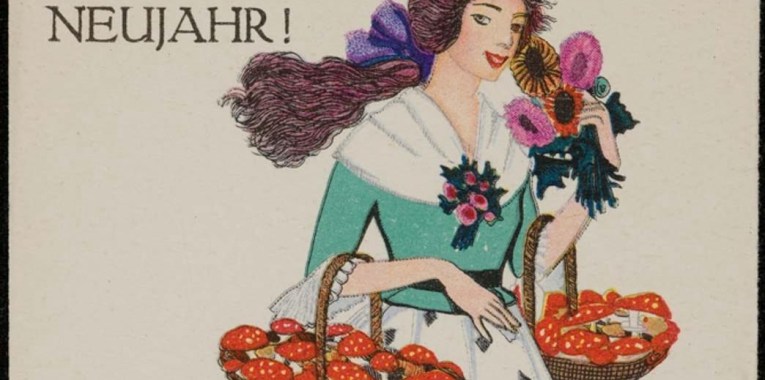
With just an evening to devote to this query, I decided to do some quick and dirty research and a little bit of theorizing. In short, I think it would be an interesting question to look into the history of design and illustration to find when and where mushrooms become part of the visual lexicon of Christmas in America. If anyone out there has further thoughts or sources, please send. Below are are three threads of thought on Mushrooms and Christmas I wanted to mention. The image above left is “Happy New Year” postcard from the Boston Museum of Fine Art Leonard A. Lauder Postcard Archive—Gift of Leonard A. Lauder. It is by Mela Koehler, Vienna, Austria, about 1910. See below for the German mushroom good luck custom!(https://collections.mfa.org/download/555796;jsessionid=1CDA61E3A483B2C6D9A8462A6D7CD46C)
1) The Psychedelic Mushroom Santa Story. These days, if one googles “Christmas Mushrooms” one is likely to get a raft of media articles about fly agric, shamans, Sami, and Santa. While fanciful and sometimes intriguing, these associations are are more speculative than strictly historical. One of these articles inspired my blog post on the history of Santa last year. A fantastic response to the psychedelic mushroom Santa story is available in an article in National Geographic that interviewed my folklorist colleague Tim Frandy on this topic. He addresses the potential use of the mushroom amanita mascara, also known as fly agric, by Sámi shamans, and whether this played a role in shaping the myth of Santa. Frandy says:
“While it’s possible, even likely, that Sámi people formerly used amanita, it’s unlikely that this had any meaningful impact on Christmas lore in Europe,” says Frandy. The only time Frandy has seen Sámi shaman in particular connected to amanita was when a Finnish ethnographer claimed in the 1940s that Inari Sámi noaiddit used to consume amanita with seven spots. “Growing up Finnish, Swedish, and Sámi, I’ve never heard of any mushroom associations with Christmas … until Ikea started selling mushroom decorations for Christmas trees,” Frandy muses. “In Sápmi, those mushrooms emerge in September, and by December are long gone under snow.” (https://www.nationalgeographic.com/environment/article/santa-claus-magic-mushroom-legend)
2. Fairy Tales and Mushrooms. A better approach to understanding Christmas mushrooms might lie in looking at the ongoing relationship of fairies and elves to mushrooms in lore, literature, and illustration. We see mentions of toadstools, Puck, and fairies all the way back in Shakespeare’s A Midsummer Night’s Dream. Fairy Tales in the 19th century were often illustrated with mushrooms, toadstools, and whimsical but detailed botanical drawings. It would be a worthwhile venture to investigate the depiction of mushrooms in art and illustration during this period, and draw links between the general approach to illustrating fairy tales and the specific application of that style to the magical interpretations of Christmas as a genre of fairy stories. The article below has a very interesting take on this relationship, drawing a connection to the development of scientific and fantastical imagery in illustration:
Yet, like the microscope, the fairy offered Victorians a means of imaginatively reconceptualizing the natural world as a place of minute wonders; the microscope revealed real, living particles in the crevices of nature, while fairy texts imagined mushrooms and flower buds populated with miniature fairies. (Forsberg, Laura. “Nature’s Invisibilia: The Victorian Microscope and the Miniature Fairy.” Victorian Studies 57, no. 4 (2015): 638–66. https://doi.org/10.2979/victorianstudies.57.4.03.)
3) German and Austrian Good Luck Charms, Sylvester / New Years, and Chimney Sweeps. Several internet posts I found referenced the fact that the mushroom is a symbol of good luck in German speaking cultures of Central Europe. Several noted a particular relationship between the depiction of Fly Agric and chimney sweeps on cards traded during the New Year, also celebrated as Sylvester. The quotations below note this historical development of a mushrooms as a good luck custom and their subsequent incorporation into a visual motif on holiday cards in Germany. The transition of this folk belief of mushrooms as good luck into a custom of depicting mushrooms on holiday cards would be a fascinating topic to explore further. As Christmas / New Years cards grew in popularity, became commercialized, and crossed cultural boundaries, did this good luck mushroom imagery migrate from Germany and come into use in America? And did it become part of a growing design motif integrated into contemporary Christmas images? I’d love to know more! Two of the quotes below are from websites which give no scholarly or historical attribution, and I have not had time to follow up on scholarly sources for this custom, but I think it is an interesting direction to follow up with more research. Does anyone out there have good historical sources to share on this topic?
“Whatever the case may be, the stunning and seductive be Amanita muscaria has inspired various people in different ways. It is a favorite among illustrators, and its image is repeatedly found in fairy-
tale books as an archetype for all mushrooms. In Germany and Austria it came to be considered a good luck omen and from there was adopted as the mascot of chimneysweeps throughout Europe.” (Whelan, Christal. “‘Amanita Muscaria’: The Gorgeous Mushroom.” Asian Folklore Studies 53, no. 1 (1994): 163–67. https://doi.org/10.2307/1178564.)
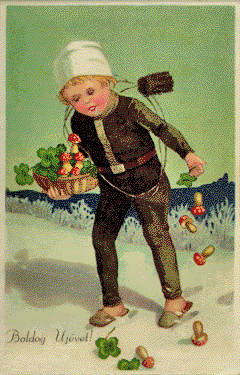
“The appearance of the Chimney Sweep (in German, Schornsteinfeger) on the New Year is thought bring good fortune, and this ordinarily lowly figure is met with reverence and good cheer. Folk images of the Chimney Sweep often depict him spilling forth woth tokens of good luck, including the familiar four-leafed clover and the more regional “red fly” mushroom. The Chimney Sweep bearing gifts begs comparison to another seasonal fireplace visitor, Santa Claus (from the Dutch Sinterklaas, or “Klaus of the cinders”), thought by some mythologists to be in part derived from the Norse God Thor, whose traditional altar is the home hearth. The distinctive red-and-white coloring of the “red fly” mushroom (amanita muscaria) carried by the Chimney Sweep, seems to further reinforce these connections.” (https://www.superiorconcept.org/Firstnight/germany.htm)
“The imagery on this card is unusual to American eyes because the slipshod young chimney sweep is not only sprinkling the ground with four-leaf clovers, he is equally generous in his distribution of toxic red and white Amanita muscaria mushrooms. This is not as strange as it seems, however, for while the four-leaf clover is considered lucky throughout Europe and North America, the Amanita muscaria or “gluckpilz” (“lucky mushroom” in German) is deemed fortuitous in Central and Eastern Europe, where there are remnants of respect for its ancient use as a shamanic hallucinogen.” (https://www.luckymojo.com/chimneysweep.html)
 Cider With Maria